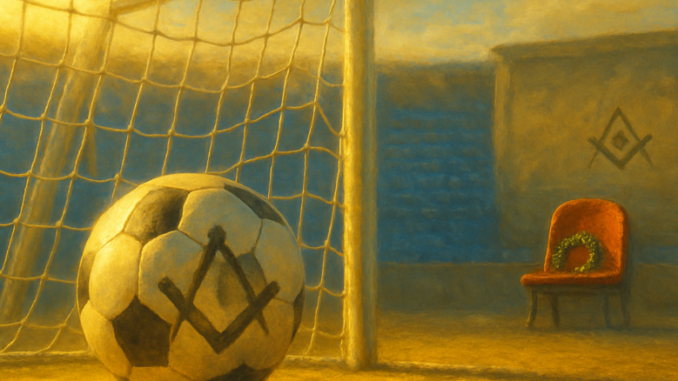
A ball rolls into the net. A stadium erupts. A name is etched into club history. Then, years later, that same name surfaces again — this time surrounded by silence. The story of a young footballer who scored a decisive goal against a powerhouse and then passed away at the age of twenty-eight raises questions that reach far beyond sport. What remains of a person after they are gone? What is the true value of that single, seemingly fleeting moment when everything comes together? Freemasonry, with its centuries-old contemplation of mortality and meaning, offers a surprisingly illuminating perspective on these questions.
The Ball as a Symbol of Fate
On the surface, a football is nothing more than an object of leather and air. Yet it carries within it the potential for triumph and defeat, for heroes and forgotten names. In Freemasonry, we are familiar with the concept of working tools that transcend their material form. The gavel, the compasses, the square — they represent inner qualities and life lessons. In much the same way, the ball can be seen as a symbol of fate itself: round, without beginning or end, unpredictable in its movements, yet ultimately subject to the laws of cause and effect.
When a player strikes that ball at exactly the right moment, a convergence of preparation, talent, and chance occurs. The ancient master builders would have recognized this principle. They understood that a cathedral does not rise through the effort of a single stonemason but through the coming together of countless skills, labors, and moments of decision. Every goal, however small it may seem in the grand sweep of things, is a stone in the wall of a human life.
Impermanence in the Lodge and on the Pitch
Freemasonry invites its members to regularly pause and reflect on the finite nature of existence. This is not a morbid fascination — it is an invitation to awareness. In Masonic rituals, the brother is reminded through symbols such as the skull and the hourglass, which whisper: your time is limited, use it wisely. A football match, with its measured ninety minutes, mirrors this truth in a surprisingly direct way. There is a beginning, a middle, and an end. What you do within that span defines your contribution.
It is not the length of life but its depth that determines its value.
A young man who dies at twenty-eight has, by objective measure, lived few years. But who would dare claim that a life without decisive moments — without that one instant of complete surrender to a purpose — would be richer? The Freemason learns that quality trumps quantity, that it is not about how many stones you lay but how carefully you place each one.
Historical Echoes of Forgotten Heroes
The history of Freemasonry is steeped in names that once rang out like bells but are now mere whispers in dusty archives. Grand Masters, philanthropists, thinkers — those who founded lodges in times of persecution, those who built bridges between hostile peoples. How many of them do we still know by name? And yet their work still stands. The traditions they established, the rituals they refined, the values they passed on — these live on in every new brother who is initiated.
The same is true of a footballer whose name may eventually fade from collective memory. The goal lives on in the statistics, in the stories of supporters who were there, in the small spark of inspiration it may have ignited in a child watching from the stands. Freemasonry teaches us that we are links in a greater chain. Our individual links may seem small, but without them the entire structure falls apart.
The Net as a Gateway to Meaning
There is something profound about the moment a ball crosses the goal line. It is a transition, a threshold experience. In the symbolic language of Freemasonry, the threshold is a sacred place — the boundary between the profane and the sacred, between ignorance and insight, between the old self and the new. When that ball hits the back of the net, a transformation occurs. The player is no longer merely a participant; he becomes the author of a moment larger than himself.
Consider these symbolic layers: the ball symbolizes potential and unpredictability; the goal represents the gateway to meaning; the player embodies the place where preparation meets opportunity; and the crowd forms the community that bears witness.
This last element is crucial. Without witnesses, an act is merely a ripple that fades away. The Freemason never works alone. He is surrounded by brothers who observe his growth, forgive his mistakes, and celebrate his triumphs. The stadium, with its thousands of eyes, fulfills the same function. It transforms a personal achievement into a shared experience, a collective memory.
What We Leave Behind
Freemasonry often speaks of building an inner temple — a spiritual structure not made with hands. But it also acknowledges that we leave traces in the outer world. Every act of kindness, every moment of courage, every time we remained true to our principles under pressure — these are the stones we lay for those who come after us. A winning goal against a seemingly invincible opponent is, in this sense, an act of faith. Faith in one’s own ability, in the possibility of the improbable, in the value of trying despite the odds.
When we hear of the passing of someone who experienced such a moment, we are invited to reflect — not only on their life but on our own. What goals have we scored? What decisive moments have we seized or let slip? Freemasonry does not offer ready-made answers, but it asks the questions that matter. And perhaps that is its greatest gift: the invitation to live consciously, knowing that any moment could be the decisive one.
A young life, a historic goal, a farewell that came too soon. In the symbolic language of Freemasonry, none of these things are wasted. Every moment of genuine commitment, every act of courage on whatever field we find ourselves, contributes to a structure that outlasts us. The winning goal is not just a sporting achievement — it is a reminder that meaning is not measured in years but in the depth and intention with which we live each fleeting moment we are given.
Copyright text & image: devrijmetselaar.nl
Texts are based on the ideas and content of the author of devrijmetselaar.nl, reviewed, corrected, and supplemented with the assistance of OpenAI. Images are created based on the ideas of the author of devrijmetselaar.nl using OpenAI/DALL-E.
Frequently Asked Questions
What is the connection between Freemasonry and the symbolism of a football match?
The article uses a football match as a metaphor for Masonic principles, where the ball represents fate and the ninety-minute game mirrors life's finite nature. Just as Freemasons use working tools like the gavel and compass to represent inner qualities, the football symbolizes how preparation, talent, and decisive moments converge to create meaning. Both teach us that quality of action matters more than quantity of time.
How does Freemasonry view mortality and the meaning of life?
Freemasonry encourages members to reflect on the finite nature of existence through symbols like the skull and hourglass, not out of morbidity but as an invitation to live with greater awareness and purpose. The Masonic teaching emphasizes that the depth and quality of a life matters far more than its length, and that a single moment of complete dedication to purpose can define an entire existence. This perspective helps Freemasons find meaning in their actions and contributions, no matter how small they may seem.
What do Masonic working tools teach us about everyday moments?
In Freemasonry, tools like the gavel, compasses, and square transcend their material form to represent inner qualities and life lessons that guide personal development. Similarly, the article illustrates how ordinary moments—like scoring a goal—can carry profound significance when they represent the convergence of preparation, skill, and dedication. This teaches us that even seemingly fleeting moments deserve our full attention and careful execution, as they become the stones that build the walls of our lives.
Does Freemasonry believe that forgotten or unknown contributions have value?
Yes, Freemasonry deeply values contributions regardless of whether they are remembered or celebrated by history. The article notes that Masonic history is filled with names of Grand Masters, philanthropists, and lodge founders who are now barely remembered, yet their work created lasting impact. Freemasonry teaches that the true value of our actions lies not in fame or recognition, but in the careful, intentional way we place each stone in the collective building of civilization and human progress.

Be the first to comment