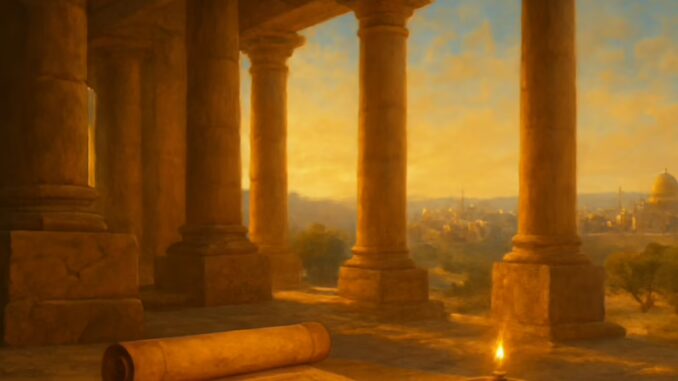
You probably know the feeling. You work hard toward a goal, finally reach it, and then find yourself wondering: was that really it? That quiet doubt, that subtle emptiness after an achievement — it has been described for thousands of years. The Book of Ecclesiastes confronts you with exactly this experience. And surprisingly, this ancient wisdom text touches on something that has occupied Freemasons for centuries: the question of what truly matters in a life defined by impermanence.
An Ancient Voice That Still Resonates
Ecclesiastes stands apart within the Old Testament. Where other books offer direction and certainty, Ecclesiastes asks questions. The author, who presents himself as a wise teacher, examines what life really means. He tries everything — wealth, pleasure, labor, knowledge. And each time, he arrives at the same conclusion: all is vanity, or as the Hebrew puts it, hevel. The word literally means vapor, breath — something that vanishes the moment you try to grasp it.
Consider how radical that message was in an era when success and prosperity were seen as signs of divine favor. The Preacher dares to say aloud that the wise man dies just like the fool. That your efforts may disappear without leaving a trace. It sounds bleak at first, but read more carefully and you discover something else entirely. It is precisely by acknowledging impermanence that space opens for a different way of living.
The Symbolism of Building and Breaking Down
For Freemasons, the symbol of the builder is central. You work on the rough stone — on yourself — striving to become a better person. But what are you really building if everything is transient? Ecclesiastes seems to present a paradox here, yet on closer inspection, his vision aligns seamlessly with Masonic thought. The point is not the finished product — it is the process itself.
There is a time to build and a time to tear down.
This well-known verse from Ecclesiastes speaks to the cyclical nature of existence. In Freemasonry, you encounter this in the understanding that growth is not linear. Sometimes you must dismantle what you previously built. Let go of convictions, change habits, start over. The hammer and chisel are tools of transformation — they shape, but they also remove what no longer fits. Ecclesiastes reminds you that this is not failure; it is the natural rhythm of life.
Wisdom as Light in the Darkness
Although Ecclesiastes acknowledges the limits of knowledge, he does not reject wisdom. On the contrary, he calls wisdom better than folly, just as light is better than darkness. This imagery of light versus darkness is a core theme in Freemasonry. The search for light symbolizes the pursuit of insight, truth, and moral clarity.
What Ecclesiastes teaches is that wisdom does not protect you from the inevitability of the end. But that does not make wisdom worthless. It simply changes what wisdom means to you. It is not about accumulating knowledge as a shield against uncertainty. It is about the quality of your attention, the depth of your understanding, the way you engage with what you cannot change.
The Inner Journey and Embracing Mystery
Freemasonry invites its members on an inner journey. You examine not only the external world but, above all, yourself. Ecclesiastes does something remarkably similar. The author meditates, observes, withdraws to reflect. He attempts to understand the world but keeps arriving at a mystery greater than himself.
The sun rises and the sun sets, and hurries back to where it rises. All streams flow into the sea, yet the sea is never full. What has been will be again; what has been done will be done again.
These images speak of endless cycles, of a universe far greater than human plans. In the lodge, you learn to stand humbly before that which you cannot fully comprehend — not as defeat, but as liberation. You do not need to understand everything in order to live a meaningful life.
Brotherhood in the Face of Finitude
One of the most beautiful passages in Ecclesiastes speaks to human connection. Two are better than one, he writes, for if either of them falls, the other can help them up. This is brotherhood in its purest form — not based on eternal promises, but on the recognition that we stand stronger together in an uncertain world.
The Masonic brotherhood offers precisely this: a circle of individuals who support one another on the journey. Not because they have found the same answers, but because they dare to ask the same questions. Ecclesiastes would feel at home in such company — someone who does not look away from the shadow side of existence but looks through it toward what truly matters.
The Gift of the Present Moment
Ultimately, Ecclesiastes arrives at a surprisingly positive conclusion. Enjoy your food and drink, your work, the people around you. This is not shallow hedonism — it is profound wisdom. If everything is impermanent, then every moment becomes precious. The meal you share, the conversation you have, the silence in which you reflect — they gain their value precisely because they pass.
In Freemasonry, this awareness is ritually celebrated. The lodge as sacred space, the symbols as reminders of what lies beyond the everyday — not to escape impermanence, but to be consciously present within it. Ecclesiastes and Freemasonry meet in this insight: life does not have meaning despite its finitude, but because of it.
Ecclesiastes invites you to pause — both literally and figuratively. To ask yourself what you are building and why. Freemasonry offers a space where such questions are welcome, where you search for light alongside others, knowing that complete clarity may never come. And perhaps that is enough. Perhaps the search itself is the answer.
Copyright text & image: devrijmetselaar.nl
Texts are based on the ideas and content of the author of devrijmetselaar.nl, reviewed, corrected, and supplemented with the assistance of OpenAI. Images are created based on the ideas of the author of devrijmetselaar.nl using OpenAI/DALL-E.
Frequently Asked Questions
What does Ecclesiastes teach Freemasons about the purpose of self-improvement?
Ecclesiastes teaches that the value of self-improvement lies not in achieving a perfect final state, but in the transformative process itself. In Freemasonry, this aligns with the understanding that working on the rough stone of yourself is a continuous journey of growth, where the tools of refinement—like the hammer and chisel—shape your character through the very act of building and rebuilding.
How does Freemasonry respond to the idea that everything is temporary and meaningless?
Rather than seeing impermanence as meaningless, Freemasonry embraces it as part of life's natural rhythm. By acknowledging that all things are transient, Freemasons find freedom to focus on what truly matters: the quality of their character, their relationships, and their pursuit of wisdom and truth, which create lasting value despite life's temporary nature.
Why is the symbol of light so important in Freemasonry, according to this article?
Light represents the pursuit of insight, truth, and moral clarity—the essence of Masonic wisdom. Ecclesiastes teaches that while wisdom cannot shield us from life's uncertainties, it remains infinitely more valuable than ignorance, just as light is superior to darkness, making the search for enlightenment a cornerstone of Masonic practice.
Does Freemasonry believe that effort and hard work are worthwhile if everything eventually fades?
Yes, Freemasonry teaches that effort and work remain deeply worthwhile because their true value lies in the personal transformation and growth they produce. Like Ecclesiastes, Freemasonry recognizes that while physical achievements may be temporary, the character development, wisdom gained, and connections forged through sincere effort create meaning that transcends impermanence.

Be the first to comment