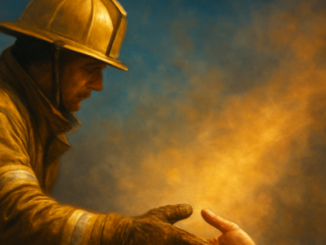
Firefighters working together during Greek wildfires symbolizing brotherhood
Personal Development & Leadership

Greek Wildfires: What Fire Teaches Us About Brotherhood

Seventy wildfires are currently raging across Greece. Residents in suburbs around Athens are being evacuated. The flames consume everything in their path — without regard for property or status. And yet, amid the destruction, something remarkable emerges: strangers reach out to one another. Firefighters from across Europe rush to help. Neighbors open their doors to people they’ve never met. Isn’t this precisely what Freemasonry speaks of when it invokes brotherhood — not as an abstract ideal, but as a lived reality that only becomes visible when everything goes up in flames? The Paradox of Destruction and Connection There is an unsettling truth in the way disasters bring people together. The Greek philosopher Heraclitus, who saw fire as the primordial element from which all things arise and to which all things return, would perhaps not be surprised. Fire destroys — but in its destruction, it also reveals what truly endures. Possessions burn in minutes. But the impulse to help a stranger, to risk your own safety for another — that impulse proves fireproof. This is not a romanticization of suffering. The images from Greece are heartbreaking. Families are losing everything. Landscapes that served as home for generations are scorched black. But […]
A rough ashlar stone illuminated by a single spark of light in a Masonic lodge
Philosophy & Ethics

The Question as Starting Point: What If Everything Began Today?

Imagine the world was created today. Imagine that all our memories, our history books, our fossil records and ancient manuscripts are nothing more than illusions — conjured into existence in this single moment of creation. It’s a thought that pulls the ground from beneath your feet, a question that destabilizes everything you think you know. And yet, this very disruptive question is one of the most powerful tools available to a thinking person. The Question Mark as a Tool In everyday life, we use question marks casually. We ask for directions, the time, the weather forecast. But there is another kind of question — one that doesn’t seek information but transformation. The philosopher René Descartes once subjected everything he believed to systematic doubt, until he arrived at his famous conclusion: “I think, therefore I am.” He wondered whether an evil demon might be deceiving him entirely about the nature of reality. It is no coincidence that precisely these kinds of radical questions laid the foundations of modern philosophy. In Freemasonry, the question plays a distinctive and central role. The seeker who knocks at the door of the lodge arrives not with answers but with a question in the heart. The […]

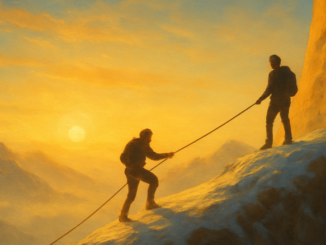
Mountain climbers roped together ascending a snowy peak at dawn
Freemasonry & Society

The Mountain as Mirror: Climbing Tragedy and Brotherhood

Somewhere high in the Karakoram, bodies lie beneath the snow. A renowned climber is missing, and the world waits in uncertainty. The mountain refuses to reveal who it has taken. In the tension between hope and grief, between knowing and not knowing, there lies a deeper lesson about what connects us as human beings — a lesson that reaches far beyond any summit, straight into the heart of every community built on trust. The Rope That Binds Mountaineers know a simple truth: you are only as strong as the weakest link on your rope. The line that connects climbers is more than a safety device. It is a promise — a promise not to let go when the abyss beckons, when the storm rises, when strength begins to fail. In that promise, Freemasons recognize something deeply familiar. We too are bound by an invisible cord, woven from ritual, trust, and mutual devotion. The tragedy in Pakistan confronts us with the fragility of that bond. When one link in the rope falls, the entire group feels the shock. The bodies in the snow are not merely individuals — they are links in a chain of relationships: families, friends, climbing partners who […]

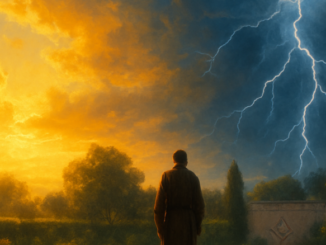
Dramatic sky with lightning and sunlight symbolizing Masonic inner balance
Spiritual Traditions

Heat and Storms: What Weather Extremes Teach About Balance

Scorching daytime heat, violent thunderstorms, and nights that finally bring relief — it’s a weather pattern most of us simply endure. We crank up the air conditioning, flee from the first rumble of thunder, and breathe a sigh of relief when the cool air arrives. But what if we looked at this cycle not merely as a meteorological event, but as a mirror for our inner lives? In Freemasonry, nature has served as a teacher for centuries, and extreme weather offers a perfect opportunity to put that ancient wisdom into practice. Heat as a Test of Patience We all know the feeling: once temperatures climb past ninety degrees, we become irritable, our patience thins, and minor annoyances suddenly feel monumental. Extreme heat has a way of testing character like few other things can. In Freemasonry, we speak of working the rough ashlar — the slow, deliberate process of smoothing away our sharp edges. Intense heat acts as a kind of trial by fire, exposing exactly those unfinished corners we’d rather not see. Next time the temperature soars, pay conscious attention to how you respond. Do you snap at your partner? Lose your composure in the checkout line? These moments aren’t […]

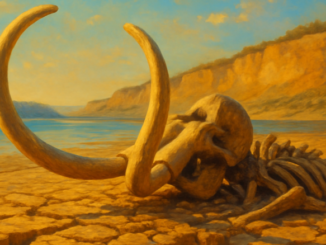
Mammoth bones exposed along the Danube River banks during low water levels
Freemasonry & Society

Mammoth Bones in the Danube: What the Depths Reveal About Us

Imagine walking along the banks of the Danube River in Bulgaria and spotting something protruding from the mud — something that last saw the light of day tens of thousands of years ago. Mammoth bones, exposed by historically low water levels this summer. It’s the kind of discovery that stops you in your tracks and makes you wonder: what lies hidden beneath the surface of our world, our society, and ourselves? And what happens when those hidden layers are unexpectedly revealed? When the River Reveals Its Secrets The Danube has flowed through the heart of Europe for millennia, carrying far more than water. It carries history, culture, and apparently the remains of creatures that roamed these plains long before the first human ever set foot on its banks. This summer’s extreme drought dropped water levels so dramatically that these ancient relics became visible once more. It’s a striking image: what normally stays hidden beneath the current of daily life suddenly surfaces when conditions change. You may recognise this feeling from your own experience. There are moments in life when something forces you to look deeper than you’re accustomed to — a crisis, a loss, an unexpected event. Suddenly you see […]

Rough ashlar stone on stable ground symbolizing Masonic self-improvement
Personal Development & Leadership

Tremors and Character: What Earthquakes Teach About Inner Strength

On July 27, 2026, seismologists recorded a minor earthquake — just 1.6 on the Richter scale — beneath the village of Sappemeer in the northern Netherlands. Most residents barely felt it. Yet the event raised a question that resonates far beyond geology: how solid is the ground we stand on? Not just the physical earth beneath our feet, but the inner foundation we’ve built for ourselves. In Freemasonry, this question sits at the very heart of the Craft. How do you build a character that can withstand the inevitable tremors of life? The Ground Beneath Your Feet Picture this: you’re sitting at the kitchen table on an ordinary morning, coffee in hand, when the floor trembles. Just for a second. You might blame a passing truck, but then you check the news and discover the earth itself shifted beneath you. For many people living in earthquake-prone regions, this isn’t an abstract concept — it’s the reality of life on unstable ground. But this isn’t really about geology. It’s about what that experience reveals about us. The ground we walk on feels permanent and reliable — and so does our sense of self. We assume we know who we are, what […]

Vrijmetselarij - Wat is vrijmetselarij?
Freemasonry & Society

What is Freemasonry?

Freemasonry is one of the world’s oldest and most widely recognized fraternal organizations, uniting men across cultures, borders, and generations through a shared commitment to moral development, philosophical inquiry, and brotherly fellowship. Founded on the symbolic tools of the stonemason’s craft, Freemasonry uses allegory and ritual to encourage its members — known as Masons or Freemasons — to become better versions of themselves. With millions of members worldwide and lodges active on every inhabited continent, understanding what Freemasonry is means exploring a tradition that has quietly shaped much of Western civilization for centuries. Historical Background: The Origins of Freemasonry The history of Freemasonry is a rich tapestry woven from medieval craft guilds, Renaissance philosophy, and Enlightenment idealism. While the precise origins remain a subject of scholarly discussion, most historians trace the formal establishment of speculative Freemasonry to the founding of the Premier Grand Lodge of England in London on June 24, 1717 — the feast day of St. John the Baptist. Four London lodges came together at the Goose and Gridiron Alehouse in St. Paul’s Churchyard to form this central governing body, marking the beginning of organized, modern Freemasonry as we know it. However, the roots of the fraternity stretch […]

Masonic rough ashlar and perfect cube symbolizing personal growth amid division
Personal Development & Leadership

Division and Character: Masonic Lessons for Divisive Times

You know the moment. A family dinner, a meeting at work, a conversation with friends. Someone brings up a loaded topic, and suddenly the tension is palpable. How do you respond? Do you get swept up in the emotion, withdraw entirely, or look for a third way? The deep divisions currently visible in political movements around the world show just how sharply disagreements can cut. But it’s precisely in moments like these that we have the opportunity to reveal our true character. Freemasonry offers concrete, practical tools for staying grounded when division swirls around you. When Convictions Collide Picture this: you’re sitting with a group of people you respect. Maybe colleagues, maybe brethren in your lodge, maybe old friends. A discussion erupts over a sensitive subject. You notice your heart rate climbing. You feel the urge to raise your voice — or to say nothing at all. This is the moment when your personality is truly tested. It’s not your opinion that defines who you are, but how you express it and how you treat those who see things differently. Current tensions within political movements worldwide illustrate just how difficult this is. People who worked side by side for years […]

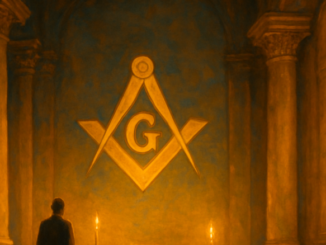
Masonic square and compasses symbol representing the fraternity of Freemasonry
Freemasonry & Society

What Is Freemasonry? Origins, Values, and Philosophy

Freemasonry is one of the oldest and most influential fraternal organizations in the world, with roots stretching back to the early eighteenth century. It’s a question many people ask — what is Freemasonry, really? — and the answer is far richer and more nuanced than most expect. Freemasonry is not a religion, not a political movement, and not a secret society in the sensationalized way popular culture might suggest. It is an ethical and philosophical brotherhood that brings men — and in some lodges, women — together around shared values such as fraternity, truth, charity, and moral self-improvement. Through symbolism, ritual, and philosophical reflection, Freemasonry invites its members on a lifelong journey of personal growth and service to society. The Historical Background of Freemasonry From Stonemasons to Philosophers: The Medieval Guilds The history of Freemasonry begins with the medieval craft guilds of masons and stonemasons. During the Middle Ages, the skilled craftsmen who built Europe’s great cathedrals, churches, and castles were organized into guilds that carefully guarded their trade knowledge, techniques, and tools. These guilds had their own rules, initiation ceremonies, and signs of recognition that allowed members to identify one another and distinguish themselves from outsiders. The so-called “operative […]

Vrijmetselarij - Wat is vrijmetselarij?
General

What is Freemasonry?

Freemasonry is one of the world’s oldest and most widely recognized fraternal organizations, uniting men across cultures, borders, and centuries through shared values, symbolic ritual, and a commitment to personal and moral development. To ask what is Freemasonry is to open a door to a fascinating tradition that has shaped philosophers, statesmen, architects, and artists — and continues to offer meaning and brotherhood to hundreds of thousands of members worldwide today. Far from the shadowy caricature sometimes painted in popular culture, Freemasonry is a transparent, structured, and deeply thoughtful institution rooted in timeless human ideals. Historical Background: The Origins of Freemasonry Understanding what Freemasonry is requires looking back at its origins, which are both historical and, in part, deliberately symbolic. The organization traces its operative roots to the medieval stonemason guilds of Europe — skilled craftsmen who built the great cathedrals, castles, and civic buildings of the Middle Ages. These guilds developed systems of recognition, mutual aid, and graduated knowledge to protect their craft and regulate entry into the profession. The tools they used — the square, the compass, the level, and the plumb line — became the symbolic vocabulary of the fraternity that would eventually evolve from their ranks. […]

Vrijmetselarij - Wat is vrijmetselarij?
General

What is Freemasonry?

What Is Freemasonry? A Comprehensive Guide to the World’s Most Enduring Fraternity Few organizations in human history have inspired as much curiosity, admiration, and mythology as Freemasonry. From the grand lodge halls of London and Paris to modest meeting rooms in small towns across the globe, Freemasons have gathered for centuries to pursue personal development, practice ancient rituals, and build bonds of brotherhood. But what is Freemasonry, exactly? Is it a religion, a secret society, a philosophical school, or simply a club for like-minded men? The answer, as with most things worth understanding, is both simpler and more profound than popular imagination tends to suggest. This page offers a thorough, honest, and respectful overview of Freemasonry — what it is, where it comes from, what its members believe and practice, and why it continues to attract thoughtful people in the twenty-first century. Whether you are considering membership, conducting research, or simply curious, you will find everything you need to know here. Definition: What Is Freemasonry? Freemasonry is a fraternal organization built around a system of moral philosophy, symbolism, and ritual. It brings together men from diverse backgrounds — different professions, religions, and nationalities — under a shared commitment to self-improvement, […]

Vrijmetselarij - Wat is vrijmetselarij?
General

What is Freemasonry?

“`json { “meta_desc”: “What is Freemasonry? Discover its history, values, symbols, and rituals in this comprehensive guide. Learn what Freemasons believe and do.”, “content”: “ What Is Freemasonry? A Comprehensive Guide n What is Freemasonry? It is one of the oldest and most widely recognised fraternal organisations in the world — a brotherhood dedicated to moral development, mutual support, and charitable service. Freemasonry brings together men of good character from every background, profession, and belief system under a shared commitment to self-improvement and the betterment of society. With lodges in virtually every country on earth and a history stretching back several centuries, it remains one of the most enduring institutions of civil society. n Yet despite its long presence in public life, Freemasonry is also one of the most frequently misunderstood organisations. Popular culture often portrays it as secretive or conspiratorial, but the reality is far more straightforward. Freemasonry is, at its heart, a system of moral philosophy taught through allegory and symbolism — using the tools of the medieval stonemason as metaphors for building a virtuous life. This pillar page aims to provide a thorough, factual, and accessible answer to the question “what is Freemasonry?” — covering its origins, […]

A steaming cup of coffee on a kitchen table at dawn symbolizing Masonic calm
Personal Development & Leadership

Black Saturday and the Cup of Coffee: Rest as Character Building

The alarm goes off at four in the morning. A father loads the last suitcases into the car while the children doze on the back seat. The highway beckons, the destination calls — but somewhere in the kitchen, a cup of coffee sits steaming on the counter. “Have a quiet cup of coffee first,” someone had said. It’s Black Saturday, the busiest travel day of the year, and right now that advice sounds like a small act of rebellion against the collective rush. The Paradox of Slowing Down to Move Forward There is something striking about the suggestion to sit still on the most hectic day of the year. It seems illogical, perhaps even counterproductive. Yet this simple gesture touches on a deeper insight that Freemasons have cherished for centuries: real progress begins with inner stillness. In Freemasonry, we speak of subduing the rough ashlar — refining one’s own character before attempting to build anything in the outer world. That cup of coffee is, in a sense, a modern version of that ancient ritual. When thousands of travelers flood onto the highway at the same time, all driven by the same impulse to leave first, they create the very traffic […]

Candle burning in darkness symbolizing Masonic inner light and character
Personal Development & Leadership

Power Outage in Georgia: What Darkness Reveals About Character

Somewhere in a small town in Georgia, a man stands at his window. The streetlights have gone dark, the refrigerator has fallen silent, and even the distant hum of the highway has ceased. In the sudden stillness, he hears his own breathing, his own thoughts. The entire country is plunged into darkness by a massive power outage. And in that darkness, a question arises — one far older than electricity itself: who am I, really, when no one is watching? The Mask Falls in the Dark When the lights go out, masks fall with them. In everyday life, we constantly present curated versions of ourselves. We are the friendly colleague, the patient parent, the competent professional. But what happens when those spotlights are extinguished? The recent nationwide power outage in Georgia offers an unexpected laboratory for a question that Freemasons have explored for centuries: what lies at the core of our character? In Freemasonry, we speak of working the rough ashlar into a perfect cube. This is not a decorative metaphor — it is a lifelong assignment. The question it poses is not who we appear to be in the company of others, but who we truly are when we […]

Crested mangabey symbolizing the Masonic journey of departure and return
Personal Development & Leadership

What an Escaped Monkey Teaches Us About Personal Growth

For a full month, a crested mangabey roamed the Dutch countryside, far from his familiar enclosure at the Beekse Bergen safari park. Eventually, he was captured and returned to his group. This small news item from July 2026 raises a timeless question that lies at the very heart of Freemasonry: what happens to our personality when we break free from the familiar — and what changes when we return? The Primal Urge to Escape In the eighteenth century, when modern Freemasonry was establishing its first lodges, the understanding of human nature was deeply intertwined with ideas about freedom and constraint. Philosophers of that era wrestled with a fundamental question: is man by nature a social creature, or does he possess a deep-rooted longing to escape every structure that binds him? The English thinkers who laid the foundations of the lodge were well acquainted with their contemporaries’ writings on the social contract. They understood that brotherhood can only exist when individuals voluntarily choose to be part of something greater than themselves. The crested mangabey who spent a month wandering through the Brabant countryside acted on an impulse we all recognize. There is something in every living being that wants to cross […]

Rough ashlar stone on a builder's workbench symbolizing Masonic self-knowledge
Personal Development & Leadership

Departure as Self-Knowledge: What Breaking a Contract Reveals

In the seventeenth century, breaking an oath was considered one of the gravest transgressions a person could commit. Guild brothers swore loyalty to their craft, knights to their lord, and apprentices to their master. Today, we read about a footballer having his contract terminated and departing with immediate effect. Reactions range from understanding to outrage. But those who look deeper will recognize an ancient question lurking beneath the surface: what does a rupture reveal about the character of the one who breaks away? The Historical Weight of the Broken Word In the medieval guilds, a contract was far more than a business arrangement. It was a sacred promise, sealed through a ritual in which the apprentice placed his hand upon the tools of his trade or a holy object. Historians of the craft guilds describe how a departing member didn’t just lose his profession — he lost his name and reputation. The collective had invested in his formation, and a premature departure was seen as theft of that shared capital. Yet even those strict times recognized exceptions. When a journeyman discovered that his calling lay elsewhere, when a master proved unjust, or when circumstances changed fundamentally, there existed rituals of […]

Rough ashlar stone symbolizing personal growth in Freemasonry
Personal Development & Leadership

Bologna and the Wounded Soul: On Rage and Personality

When dozens of officers are injured during protests, when streets burn with collective outrage, an uncomfortable question arises: what happens to the human personality when a sense of justice tips over into destruction? The events in Bologna following a fatal arrest compel us not only to reflect on social tensions, but also on the fragile architecture of our own character. The Paradox of Righteous Anger Here lies a paradox that has fascinated philosophers throughout the ages: the person who rises up for justice can, in that very pursuit, become unjust. Those who protest against violence can themselves become violent. Those who cry out for humanity can lose their own humanity in the heat of the moment. This is not a judgment on protesters or authorities — it is an observation about the human condition itself. The ancient Greeks had a concept called thumos, roughly translated as “spiritedness” or “wrath.” Plato placed this element of the soul between reason and appetite — a force that could be both constructive and destructive. Thumos could drive someone to courageous deeds, but also to blind fury. The question was never whether this force existed, but how it could be mastered. Personality as Architecture In […]

A single candle flame glowing in darkness symbolizing Masonic inner light
Spiritual Traditions

Violence Against Journalists: Keeping Light in Dark Times

The brutal murder of a local sports journalist in Italy strikes a deep chord. Here was someone who told stories about sport and community — silenced by unimaginable violence. News like this raises questions that go far beyond the headline: how do we preserve our inner light when the world reveals its darkest side? This article offers practical guidance from a spiritual perspective rooted in Masonic tradition. When the Incomprehensible Crosses Your Path You read the news, scroll past it, but something lingers. An uneasy feeling in your stomach. A question you don’t ask aloud: what am I supposed to do with this? It’s a familiar moment for anyone who tries to live consciously. Senseless violence confronts us with the limits of our understanding and our power. In Freemasonry, this moment is never avoided. It sits at the very heart of the Craft: how do you relate to darkness while striving toward light? The tradition teaches that spiritual growth doesn’t happen in spite of life’s dark aspects — it happens through our conscious engagement with them. This is not abstract theory. It is a daily practice. The First Response: Acknowledgment Without Judgment What do you actually do when such news […]

Medieval blacksmith forging iron symbolizing Masonic character building
Personal Development & Leadership

Working in the Heat: What Ancient Crafts Teach About Character

The summer of 2026 is shattering temperature records, yet something remarkable is happening on the work floor: heat waves are barely causing worker absenteeism. Where does this resilience come from? The answer reaches far beyond modern air conditioning — it stretches back to an ancient tradition of laboring under extreme conditions. The cathedral builders, the blacksmiths at their glowing forges, and the stonemasons under the scorching sun understood something we seem to have forgotten. Their secret was hidden in the deliberate formation of character. The Blacksmith and His Inner Fire In the Middle Ages, the smithy was one of the most brutally hot workplaces anyone could enter. Temperatures soared to unbearable heights while the craftsman spent hours forcing iron into shape. Yet blacksmiths rarely abandoned their duties. The reason was not merely physical toughness — it was something far deeper: the cultivation of an inner disposition that could withstand external hardship. The smith learned not only to master metal, but above all, to master himself. This tradition of inner formation found its way into the lodges of operative masons. Before an apprentice was allowed to begin complex stonecutting techniques, he first had to prove he could persevere. It was not […]

Racing cars on a circuit symbolizing Masonic brotherhood through adversity
Personal Development & Leadership

Falling and Rising: What Racing Teaches About True Brotherhood

Picture two drivers on the same circuit, facing the same conditions, carrying the same ambitions. One pulls a flawless line through the corners of the Ardennes; the other ends up in the barriers. It’s an image you might recognize from your own life — moments where you perform brilliantly while someone beside you stumbles, or the other way around. What do you do then? How do you handle that inequality of fortune? And what does your response reveal about the nature of true connection? The Circuit as a Mirror of Life A racetrack is more than asphalt and curves. It’s a concentrated version of existence itself — risk, choices, timing, and the eternal dance between control and surrender. During a training session in the Belgian Ardennes this week, two experienced drivers had entirely different experiences. One drove smoothly and with composure; the other lost grip and crashed. Neither could have predicted the outcome beforehand. You probably know that feeling. You’re in the same meeting as a colleague, following the same training, facing the same challenge. Yet things go differently for you than for the person beside you. Sometimes you’re the one who falls. Sometimes you’re the one who keeps going. […]