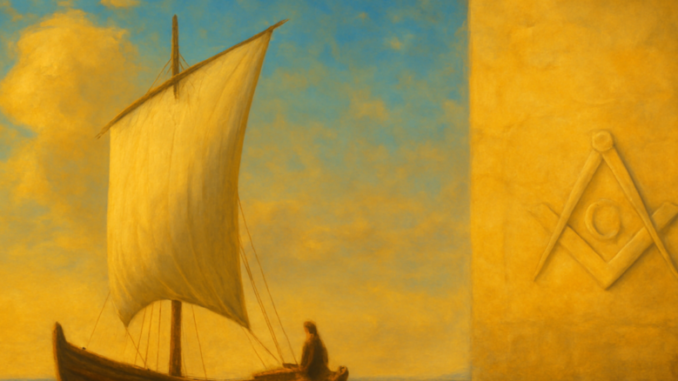
Picture this: you’re sitting around a table with friends after a long working week. The conversation doesn’t drift toward salaries or possessions — instead, it lingers on what truly makes you happy. Someone says, “I have enough as long as I know I can count on you.” In that single sentence lies a truth that Lucius Annaeus Seneca described nearly two thousand years ago in his letter to Lucilius on true wealth. It’s also a truth that echoes through every Masonic lodge when brothers work together on their inner growth.
What Seneca Means by Wealth That Cannot Be Stolen
In Letter XCVIII, Seneca writes to his student Lucilius that most people seek wealth in exactly the wrong place. They accumulate possessions and then live in constant fear of losing them. Seneca turns this on its head: true wealth lies in the ability to be happy without those possessions. Not because poverty is virtuous in itself, but because inner strength makes you independent of whatever fortune might take away.
This is not some abstract philosophical idea. Think of a moment when you lost something you held dear — a job, a relationship, a certain status. What remained? The people who stood beside you. The skills you had cultivated within yourself. The calm you felt because you knew who you were, even without that external layer. That is precisely what Seneca describes: wealth anchored within you, and therefore independent of circumstance.
Brotherhood as Living Proof of Seneca’s Insight
Freemasonry has no admission requirement based on income or social standing. In the lodge, people meet as equals, regardless of what they possess outside its walls. This equality is not merely a rule of etiquette. It is a daily exercise in what Seneca advocates: the recognition that your worth is not determined by what you own, but by your character and your willingness to contribute to the well-being of others.
In practice, this means that a brother who is financially successful and a brother of more modest means stand side by side, participating in the same rituals. They share the same search for truth and light. That shared pursuit creates a form of connection Seneca would recognize as one of the highest forms of wealth: the ability to be genuinely and unconditionally connected to another human being.
True wealth does not come from possessing more, but from being more deeply connected — to yourself and to the people around you.
Three Practical Lessons You Can Apply Today
Seneca’s letter is not a museum piece. Its power lies in its practical applicability. Here are three ways to weave his insights and Masonic values into your life starting today.
1. Practice Daily Self-Reflection
Seneca ended every day with an honest conversation with himself. What did I do well? Where did I fall short? This habit is also a core element of Freemasonry, where self-reflection is seen as the first step toward inner growth. Start small: take five minutes each evening to evaluate three moments of your day. Not to judge yourself, but to know yourself better. After a few weeks, you’ll notice that you make more conscious choices and react less on impulse.
2. Invest in Connection, Not Impression
Seneca warns that we often spend energy trying to impress people we barely know, while neglecting those closest to us. This week, consciously choose one conversation that doesn’t need to lead anywhere — except to genuine connection. Call a friend not to ask a favor, but to ask how they’re truly doing. In Freemasonry, we call this brotherly care: the willingness to be present without an agenda. It is one of the simplest and yet most powerful things you can do.
3. Practice Letting Go of What You Cannot Control
Seneca’s Stoic philosophy converges with Masonic ethics on one crucial point: direct your energy toward what lies within your sphere of influence. You cannot steer the economy, prevent a pandemic, or dictate the behavior of others. What you can do is work on your own response, your own virtue, your own contribution. Choose one situation today where you would normally become frustrated by something beyond your control, and consciously redirect that energy toward something you can improve. Perhaps it’s your patience with a colleague. Perhaps it’s finishing a task you’ve been putting off.
The Lodge as a Training Ground for the Good Life
What makes Freemasonry unique in this context is that it doesn’t merely offer a philosophy — it provides a place where that philosophy is practiced. The lodge functions as a space where brothers put the principles of virtue, brotherhood, and moral growth into action together. As Michel de Montaigne, whose essays on human shortcomings and the value of connection are explored elsewhere on this site, once observed: wisdom is worthless if it is not lived. Seneca would have wholeheartedly agreed.
The Stoic tradition of Seneca, the humanistic legacy of thinkers like Marcus Aurelius and Epictetus, and the ethical quest of Freemasonry share a fundamental conviction: that human beings are capable of improving themselves, not by accumulating more, but by digging deeper. This conviction is not a luxury reserved for philosophers. It is an invitation to anyone willing to look honestly at themselves and act from that place of awareness.
Why This Matters Now
We live in an age where wealth is primarily measured in numbers — followers, account balances, square footage. Seneca’s letter reminds us that these metrics are finite. A bank balance can evaporate. Followers can vanish. But the inner strength you build through self-reflection, the bonds you forge through genuine brotherhood, and the peace of mind that comes from knowing your worth is not tied to external validation — these are forms of wealth that no market crash can diminish and no algorithm can erase.
Freemasonry offers a living framework for cultivating this kind of wealth. Every lodge meeting, every ritual, every quiet conversation between brothers is an opportunity to practice what Seneca preached. Not perfection, but progress. Not accumulation, but depth. In a world obsessed with more, perhaps the most radical act is to discover that you already have enough — and to build from there.
Seneca’s ancient wisdom and the timeless values of Freemasonry converge on a single, transformative idea: true wealth is not found in what you possess, but in who you become and the quality of the connections you nurture. Whether you are a Freemason or simply someone searching for a more meaningful life, the invitation is the same. Look inward. Reach outward. And measure your richness not by what fills your hands, but by what fills your heart.
Copyright text & image: devrijmetselaar.nl
Texts are based on the ideas and content of the author of devrijmetselaar.nl, reviewed, corrected, and supplemented with the assistance of OpenAI. Images are created based on the ideas of the author of devrijmetselaar.nl using OpenAI/DALL-E.


Be the first to comment