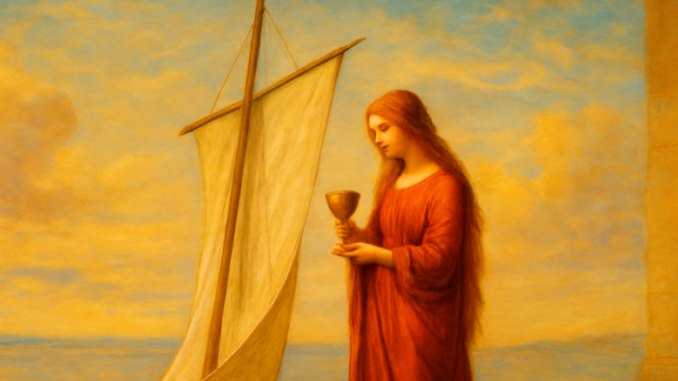
Ever since Dan Brown’s The Da Vinci Code captivated millions of readers, people have wondered whether Mary Magdalene truly represents the Holy Grail — and whether secret societies have been guarding this knowledge for centuries. The novel implies that Freemasons and related organizations are involved in concealing an explosive secret about the bloodline of Jesus. But what does Freemasonry actually teach? And how can modern seekers separate fascinating fiction from genuine, usable wisdom?
The Theory from the Novel: A Brief Overview
In The Da Vinci Code, Dan Brown presents the idea that the Holy Grail is not a chalice but a person: Mary Magdalene. According to this theory, she was the wife of Jesus and the mother of his children. The book suggests that secret societies — including the Priory of Sion — protected this knowledge through the ages. Freemasonry is mentioned in the same breath as a possible guardian of hidden truths.
It is a compelling narrative that speaks to our deep human hunger for hidden knowledge and deeper meaning. But if you genuinely want to understand what Freemasonry is about, it is essential to separate fiction from reality. Not to strip away the magic, but to find something you can actually apply in your own life.
What Freemasonry Actually Teaches
Freemasonry is not a secret society guarding hidden bloodlines or religious secrets. It is a fraternity devoted to personal development, ethical conduct, and brotherly connection. Its rituals and symbols do not refer to specific religious doctrines about Jesus, Mary Magdalene, or the Grail. Instead, they offer a universal framework for self-reflection.
Freemasonry does not guard religious secrets — it provides tools for inner transformation that every seeker must wield for themselves.
The symbols Freemasons use — the compasses, the square, and the rough ashlar — are instruments for moral self-development. They invite questions such as: How can I become a better person? How do I serve my community? These are practical questions you can ask and begin answering today.
Where the Confusion Comes From
The confusion between Freemasonry and Grail secrets has deep historical roots. During the eighteenth and nineteenth centuries, countless pseudo-historical theories about secret societies emerged. Writers linked the Knights Templar, Rosicrucians, and Freemasons to all manner of mysteries. Dan Brown drew heavily from these traditions when crafting The Da Vinci Code.
The Priory of Sion, which plays a central role in the novel, turned out to be a twentieth-century fabrication. Historical research has demonstrated that the documents on which the claims were based were manufactured in the 1960s. Yet the story continues to resonate, because it taps into our longing for hidden truths.
Practical Lessons: What Can You Do with This?
The real question is not whether Mary Magdalene was the Grail, but what you are actually searching for when you reach for stories like these. Freemasonry offers a concrete answer: stop looking for external secrets and start pursuing inner growth. Here are three practical steps you can take today:
1. Examine your own motivations. Why does mystery attract you? What do you hope to find? This kind of self-reflection is the beginning of every genuine quest.
2. Study primary sources. Read about the actual history of Freemasonry through reputable historians. Anderson’s Constitutions of 1723 provide a clear picture of the Craft’s original values and aims.
3. Apply symbolism to your daily life. Choose one symbol — such as the rough ashlar — and ask yourself each week: which rough edge of my character can I smooth this week?
Acknowledging the Power of Stories
None of this means that The Da Vinci Code is without value. Quite the opposite. Dan Brown’s novel inspired millions of people to think more deeply about history, religion, and secret societies. It opened doors to questions that might never have been asked otherwise. The key is to treat that curiosity as a starting point, not a destination.
Goethe, himself a Freemason, understood the power of symbols and stories. He knew that myths and rituals do not need to be literally true in order to be transformative. What matters is the inner movement they set in motion. When you read about Mary Magdalene and the Grail, ask yourself: what quest does this awaken in me?
From Fiction to Action
Freemasonry does not invite passive belief in secrets — it calls for active work on yourself. Where Grail romanticism can seduce you into endlessly hunting for hidden documents, the Masonic tradition points toward the only place where real transformation happens: within you. The Grail you seek is not a chalice or a bloodline, but the capacity to live with integrity and wisdom.
This is not abstract philosophy — it is a daily practice. Every morning you can ask yourself: will I act as a good person today? Every evening you can reflect: where did I fall short, and how will I do better tomorrow? These are the true rituals of personal growth.
Dan Brown’s The Da Vinci Code captured the imagination of a generation with its story of Mary Magdalene and the Holy Grail. But Freemasonry does not guard bloodlines or religious conspiracies. It offers something far more valuable: a method for developing yourself, day by day, stone by stone. The real quest does not begin in ancient manuscripts or secret archives — it begins in the mirror. That is where you will find the only mystery truly worth unraveling.
Copyright text & image: devrijmetselaar.nl
Texts are based on the ideas and content of the author of devrijmetselaar.nl, reviewed, corrected, and supplemented with the assistance of OpenAI. Images are created based on the ideas of the author of devrijmetselaar.nl using OpenAI/DALL-E.


Be the first to comment