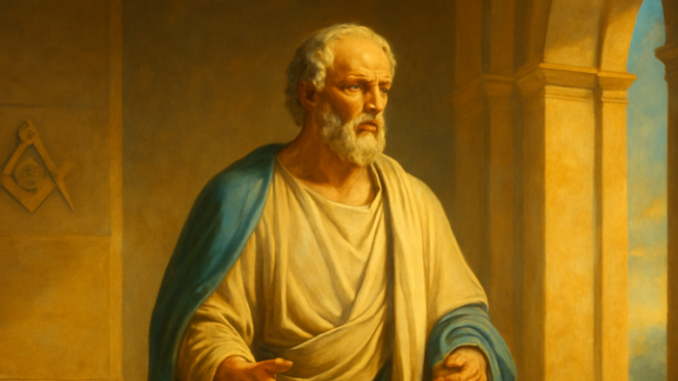
What truly makes a life happy? The question sounds thoroughly modern, yet Lucius Annaeus Seneca posed it nearly two thousand years ago with a sharpness that remains uncomfortably relevant. In his essay De Vita Beata — On the Happy Life — he dissects the confusion between pleasure and happiness, between what the crowd chases and what actually fulfills the wise person. It is a text that not only distills the essence of Stoic philosophy but also stands remarkably close to the ethical quest that Freemasonry sets before its members. Two worlds, two eras, but the same fundamental question.
The Heart of the Essay: Happiness as a Virtuous Life
Seneca wrote On the Happy Life as an extended argument addressed to his brother Gallio. The central thesis is clear: genuine happiness does not consist in the pursuit of pleasure, wealth, or fame, but in a life aligned with reason and virtue. Seneca draws a sharp distinction between pleasure — which is fleeting and often deceptive — and the enduring happiness that springs from inner harmony. The happy person, he argues, is not the one who possesses the most, but the one who needs the least in order to be content.
The essay opens with a striking observation: most people blindly follow the path that others have laid out for them. They allow themselves to be guided by habit, by the opinions of the crowd, by whatever happens to be conventional. Seneca compares this to a herd that does not walk toward what is good, but merely follows wherever the animal ahead happened to wander. A truly happy life, he writes, only begins when a person stops following the masses and finds the courage to think independently about what is good and valuable.
Two Views of Happiness: The Crowd and the Philosopher
One of the most powerful elements of this essay is the way Seneca places two attitudes toward life side by side. On one hand, there is the perspective of the crowd: happiness is measured by possessions, status, and sensory pleasure. The more you have, the more you are seen, the more you indulge — the happier you must be. It is a worldview that is instantly recognizable in our own time, where success is so often judged by external markers.
Against this stands the perspective of the Stoic philosopher. For Seneca, happiness is an inner state that does not depend on circumstances. The wise person can be happy in poverty, in exile, even in physical suffering, because their happiness is rooted in character and in their relationship with reason. Pleasure is not inherently wrong, but it becomes dangerous the moment it becomes the standard by which life is measured. Seneca writes that pleasure is a poor guide: it lures us off the path and makes us slaves to our desires.
True happiness, according to Seneca, is not a state of pleasure but one of inner freedom. The person who knows themselves and follows virtue needs no permission from the outside world to be happy.
The Problem of Wealth: Seneca’s Personal Paradox
A fascinating section of the essay is Seneca’s defense against the charge that he himself was an extraordinarily wealthy man. How can someone who lives in luxury preach about simplicity and virtue? Seneca acknowledges this tension openly. He argues that wealth in itself is not reprehensible, as long as its owner is not controlled by it. The wise person can possess wealth without being attached to it. They use it, but are not defined by it. Should fortune vanish, the wise person remains just as happy, because their happiness was never anchored in material possessions.
This argument is remarkably nuanced. Seneca does not condemn the rich person, but the person who makes an idol of their riches. He does not condemn pleasure, but the person who places their entire life in service of pleasure. It is a subtle but important distinction — one that finds a clear echo in the teachings of Freemasonry.
The Stoic Vision and Freemasonry: Where Both Worlds Meet
When we place Seneca’s philosophy alongside the ethical practice of Freemasonry, the parallels are striking. The Freemason is invited to work on himself continually — not primarily to achieve outward success, but to grow inwardly. The rough ashlar that must be shaped into a perfect cube is not a story about material gain; it is about the formation of character. Just as Seneca teaches, Freemasonry holds that the good life is not determined by what you have, but by who you are and how you act.
At the same time, there are differences in approach. Seneca speaks as an individual philosopher who personally guides his student. Freemasonry, by contrast, is a brotherhood that embeds the individual path within a community. Where Seneca emphasizes personal autonomy and rational self-discipline, the lodge adds a dimension of mutual support and shared ritual experience. Both roads lead toward the same destination: a life lived from inner conviction rather than external pressure.
The Masonic principle of meeting on the level reinforces Seneca’s message powerfully. In the lodge, worldly distinctions of wealth and status are set aside. What matters is the quality of a man’s character and his commitment to self-improvement — precisely the standard that Seneca champions throughout his essay.
Key Themes and Images from the Essay
Throughout On the Happy Life, Seneca employs a series of vivid images and examples that give his argument memorable force. The most important themes include:
The herd as metaphor: The person who follows the crowd without exercising independent judgment will never find true happiness. This resonates deeply with the Masonic emphasis on seeking light — truth arrived at through personal reflection rather than passive conformity.
Pleasure as a poor master: Enjoyment is acceptable as a byproduct of a well-lived life, but catastrophic as a life goal. In Masonic terms, the candidate is taught to govern his passions, not to be governed by them.
Nature as a guide: Happiness means living according to human nature — that is, according to reason and virtue. The Masonic tradition similarly invokes natural law and the use of reason as foundational principles.
Inner freedom: The truly free person is not the one who wears no chains, but the one who refuses to be chained by desire. This principle lies at the heart of every degree in Freemasonry, where the candidate progresses from darkness to light, from bondage to self-mastery.
Honest self-criticism: Seneca’s candid acknowledgment of his own shortcomings gives the essay a personal, vulnerable tone that makes it deeply accessible. Freemasonry, too, asks its members to confront their own imperfections honestly — the rough ashlar is, after all, each Brother’s own starting point.
What This Ancient Essay Still Teaches Us
The enduring power of On the Happy Life lies in its refusal to offer easy answers. Seneca does not promise a formula for happiness. Instead, he challenges his reader to abandon comfortable illusions and to confront the difficult truth that happiness is not something that happens to us — it is something we build through deliberate choices, through self-knowledge, and through the steady cultivation of virtue.
For Freemasons, this message carries particular weight. The Craft does not promise its members happiness as a reward. It offers them tools — symbolized by the working tools of each degree — and a framework within which to do the demanding interior work that genuine fulfillment requires. Seneca would have recognized this approach immediately. The philosopher and the Freemason share a conviction that the examined life, the life of conscious ethical effort, is the only life truly worth living.
In an age saturated with messages about instant gratification and external validation, Seneca’s ancient challenge remains as urgent as ever. Stop following the herd. Think for yourself about what is good. Pursue virtue, not pleasure. And remember that everything the world can give you can also be taken away — except the quality of your own character.
Seneca’s On the Happy Life is far more than a historical curiosity. It is a living document that speaks directly to anyone engaged in the Masonic pursuit of self-improvement and moral growth. The rough ashlar and the Stoic’s undisciplined soul are, in the end, the same starting point. Both demand the same honest labor, the same willingness to chip away at what is false in order to reveal what is true. Nearly two millennia after Seneca set down his words, the question he posed has lost none of its edge: not what makes you comfortable, but what makes you worthy of happiness?
Copyright text & image: devrijmetselaar.nl
Texts are based on the ideas and content of the author of devrijmetselaar.nl, reviewed, corrected, and supplemented with the assistance of OpenAI. Images are created based on the ideas of the author of devrijmetselaar.nl using OpenAI/DALL-E.


Be the first to comment