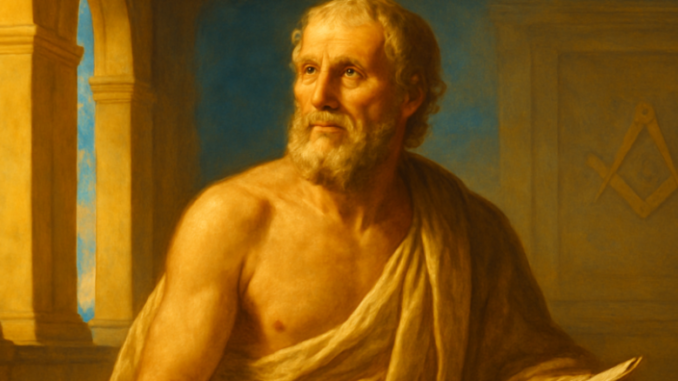
Have you ever felt a flush rise to your cheeks even though no one was watching? That inner warmth that surfaces when you do something at odds with who you aspire to be? Nearly two thousand years ago, Lucius Annaeus Seneca wrote about this very experience in a letter to his friend Lucilius — and his words still resonate. Letter XI of the Moral Letters to Lucilius explores shame and moral nobility through a rich philosophical tradition that runs far deeper than Stoicism alone. In this article, we trace the intellectual sources that inspired Seneca and discover why his insights remain so relevant for anyone committed to self-improvement and the pursuit of virtue.
The Stoic Understanding of Shame
When Seneca writes about shame, he draws on a tradition stretching back to the early Stoa in third-century Athens. Zeno of Citium, the founder of Stoicism, made a crucial distinction between emotions born from faulty judgments and those that arise naturally. Shame occupies a special category: it can be both a useful signal and an obstacle to growth.
The Stoics viewed the soul as a unified whole with reason at its center. When you act against your rational nature, an inner conflict arises that can manifest as shame. Chrysippus, the great systematizer of Stoic philosophy, developed the idea that emotions are essentially judgments. In this view, shame is the judgment that you have done — or are about to do — something wrong. Seneca builds on this foundation by arguing that true shame is not about the opinions of others but about your own inner standard of conduct.
This is a vital distinction for anyone walking the path of moral development. External shame — the fear of being caught or criticized — is fleeting and unreliable. Internal shame, however, acts as a moral compass, guiding you back toward alignment with your highest principles.
Socrates as the Moral Compass
An indispensable influence on Seneca’s thinking about moral nobility is Socrates. Although Socrates left no writings of his own, we know his ideas through Plato and Xenophon. Seneca refers to Socrates regularly as the exemplar of someone who lived according to inner principles, regardless of the opinions of the crowd. The Socratic paradox — that no one does wrong willingly — forms a cornerstone of Seneca’s approach to shame.
For Socrates, self-knowledge was the key to a good life. The famous injunction “know thyself” from the Oracle at Delphi permeates his entire philosophy. Seneca translates this into daily practice: shame can be a teacher, pointing out the gap between who you are and who you could become. This is not condemnation but an invitation to growth.
As Seneca’s reflections suggest: shame is not the enemy of moral nobility, but its guardian. It keeps us honest with ourselves when no one else is watching. For those who engage in regular self-examination — whether through evening reflection, journaling, or the kind of introspection practiced within a Masonic lodge — this Socratic principle offers a powerful anchor.
The Influence of Cynicism
Stoicism did not emerge in a vacuum. The Cynics, with Diogenes of Sinope as their most famous representative, exerted a profound influence on the early Stoics. The Cynic tradition embraced a radical rejection of social conventions and any shame attached to outward appearances. Diogenes lived in a barrel and openly criticized the hypocrisy of his contemporaries.
Seneca, however, takes a more nuanced position. Where Diogenes dismissed shame entirely as a social construct, Seneca acknowledges that a natural form of shame exists and has genuine value. The difference lies in the source: shame rooted in fear of others is weakness, but shame arising from respect for your own principles is strength. This nuance makes Seneca’s approach remarkably practical and accessible — especially for those who strive to live by a moral code within a fraternal community.
Freemasonry, like Stoic philosophy, asks its members to look beyond social appearances and measure themselves against an inner standard. The Cynic rejection of all convention goes too far; the Stoic refinement — embracing constructive shame while discarding vanity — strikes a more workable balance.
Aristotle and the Golden Mean
Although Seneca was a committed Stoic, his treatment of shame bears striking parallels with Aristotle. In the Nicomachean Ethics, Aristotle describes shame not as a virtue in the strict sense but as a valuable quality for young people on the path to maturity. The truly virtuous adult, Aristotle argued, would have no need for shame because he simply would not commit disgraceful acts.
Seneca appears to refine this view. He acknowledges that even the wise person may still blush — not out of weakness, but from a refined sensitivity to the good. The physical response of blushing is not entirely under the control of the will, and that is no deficiency. It shows that body and soul are deeply intertwined with moral values. For Seneca, this involuntary response is evidence that virtue has taken root not just in the mind but in the whole person.
This resonates with the Masonic understanding that moral development is not merely an intellectual exercise. It involves the whole being — heart, mind, and action working in concert.
The Roman Context of Moral Nobility
Seneca wrote during a period when the Roman aristocracy struggled with the tension between traditional values and the corrupt political climate under emperors like Nero. The Latin concept of pudor encompasses more than our English word “shame”: it contains elements of modesty, proper restraint, and respect for moral boundaries.
The Roman tradition carried a strong sense of virtus — a masculine ideal of courage, integrity, and service to the community. Seneca weaves this heritage together with Greek philosophical thought. For him, moral nobility is not a distant ideal but a practical attitude that can be cultivated daily. Every choice, however small, contributes to the shaping of your character.
This is deeply familiar territory for Freemasons, who understand that character is built not in grand gestures but in the quiet, consistent practice of virtue — in the small decisions made when no one is looking. The Roman emphasis on duty, integrity, and communal responsibility mirrors the obligations a Mason undertakes when he joins the Craft.
Relevance for Personal Development and the Masonic Path
The philosophical background of Letter XI reveals a confluence of traditions that all point toward the same central insight: true moral nobility comes from within. It is not about avoiding criticism or pleasing others but about remaining faithful to your own higher nature. Seneca offers no easy answers — only an invitation to ongoing self-reflection.
For those working on self-improvement within a brotherhood of like-minded individuals, these insights offer a valuable framework. The shame you feel when you fall short is not your enemy but your ally. It reminds you that you are striving for something higher. And the moral nobility Seneca writes about is not a final destination but a path you walk anew each day, in the company of others making the same journey.
Within Freemasonry, this idea finds expression in the concept of the rough ashlar — the unfinished stone that every Brother works to shape and refine throughout his life. Seneca’s Letter XI, standing on the shoulders of a rich philosophical tradition from the early Stoics to Socrates, from the Cynics to Aristotle, reminds us that the tools for this work have been available for millennia. The only question is whether we have the courage to pick them up and use them honestly.
Seneca’s Letter XI is far more than a meditation on blushing. It is a gateway into a profound philosophical conversation about what it means to live with integrity. Drawing on Stoic, Socratic, Cynic, and Aristotelian traditions, Seneca shows us that constructive shame — the kind born from an honest inner standard — is one of the most powerful forces for moral growth. For Freemasons and all seekers of self-improvement, his message is timeless: true virtue is not performed for an audience but cultivated in the quiet chambers of the heart, tested daily in the choices we make, and refined in the fellowship of those who share the journey.
Copyright text & image: devrijmetselaar.nl
Texts are based on the ideas and content of the author of devrijmetselaar.nl, reviewed, corrected, and supplemented with the assistance of OpenAI. Images are created based on the ideas of the author of devrijmetselaar.nl using OpenAI/DALL-E.
Frequently Asked Questions
What is the main difference between external and internal shame according to Seneca?
External shame is the fear of being caught or criticized by others and is fleeting and unreliable. Internal shame, however, acts as a moral compass that guides you back toward alignment with your highest principles and inner standards of conduct. Seneca emphasizes that true shame is not about others' opinions but about your own inner standard of behavior.
How did the Stoics, particularly Chrysippus, view shame and emotions?
The Stoics viewed shame as a judgment rather than merely an emotional reaction. Chrysippus, the great systematizer of Stoic philosophy, developed the idea that emotions are essentially judgments. In this framework, shame is the judgment that you have done or are about to do something wrong. The Stoics saw shame as occupying a special category—it can be both a useful signal and an obstacle to growth.
Why is Socrates important to understanding Seneca's approach to moral nobility?
Seneca regularly refers to Socrates as the exemplar of someone who lived according to inner principles regardless of public opinion. The Socratic paradox that no one does wrong willingly forms a cornerstone of Seneca's approach to shame. Additionally, Socrates' emphasis on self-knowledge—the injunction to 'know thyself'—is translated by Seneca into daily practice as a key to moral development and a good life.


Be the first to comment