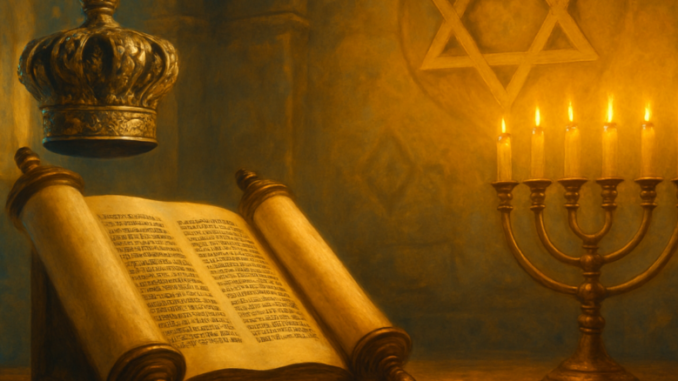
Imagine standing at the edge of a new beginning. Behind you lie years of growth, hard-won lessons, and sometimes painful detours. Ahead stretches unknown terrain. This is the moment when you must distill everything you have learned — not only for yourself, but for those who will follow. That profoundly human moment lies at the heart of Devarim, the fifth and final book of the Torah. In this concluding article of our series on the Torah, we explore how ancient words and the modern search for meaning continue to speak to one another.
Words at the Threshold
Devarim means literally “words,” and the book opens with Moses addressing his people at the border of the Promised Land. It is a book of looking back and looking forward at the same time. Moses knows he will not cross over. Yet instead of bitterness, he chooses to teach. He restates the law — not as a dry set of rules, but as living guidance for a people who must learn to stand on their own.
Perhaps you recognise this feeling. There come moments in life when you realise that certain knowledge must not die with you. Whether you are an elder passing something on to a younger generation, or someone beginning a new chapter and reflecting on what came before, Devarim speaks to that universal desire to transmit meaning across time.
The Power of Repetition and Deeper Understanding
In Jewish tradition, Devarim is also known as Mishneh Torah — the “repetition of the law.” But this is no mere copy. Moses adds context, reveals connections, and adapts his message for a new generation. It is like reading a book for the second time and suddenly discovering layers you had missed before.
The medieval Jewish scholar Maimonides saw in Devarim a blueprint for ethical leadership — leading not through power, but through wisdom and the ability to make complex truths accessible. The philosopher Spinoza, himself deeply influenced by the Jewish textual tradition, would later write about the importance of understanding laws from their inner logic rather than their outward form alone.
For anyone walking a path of personal development, this insight is transformative. True understanding does not come from memorising rules but from internalising their spirit. Every repetition is an opportunity for deeper comprehension.
Words as Building Stones
For Freemasons, the image of building stands at the centre of their philosophy — not merely the construction of physical structures, but the building of oneself and of community. In Devarim we find a kindred idea: words are tools with which we build. The Hebrew term davar means both “word” and “thing” or “matter.” Words are not idle sounds; they carry the power to shape reality.
Words are the building stones of character. What you speak aloud shapes not only the world around you, but also the temple of your own soul.
This resonates closely with the Masonic principle that each person must work upon themselves as upon a rough stone. The lessons you receive, the rituals you undergo, the conversations you hold — all are forms of “words” that determine your inner architecture. Devarim reminds us that the transmission of wisdom is a sacred task, one that every Mason undertakes when sharing light with a fellow Brother.
The Responsibility That Comes with Knowledge
A striking theme in Devarim is its emphasis on individual responsibility. The book contains the well-known declaration: “See, I set before you today the blessing and the curse.” The choice rests with each person. This is not a deterministic worldview where everything is fixed, but an invitation to moral freedom.
Freemasonry carries the same principle. You are never forced toward virtue — you are invited. The tools are placed in your hands, but you must take them up yourself. The compasses and the square are symbols of this choice: they help you work within proper bounds, but you alone determine the direction.
Consider the implications: knowledge obliges us to act; wisdom asks to be shared; freedom walks hand in hand with responsibility; and the choice for what is good is not a single grand gesture but a daily practice. These are not abstract ideals. They are lived commitments that both the Torah and the Craft ask of us.
Farewell as a New Beginning
The closing passages of Devarim describe the death of Moses. He sees the Promised Land from the summit of Mount Nebo, but he will not enter it. This might seem tragic, yet Jewish tradition reads it differently. Moses’ task was never to arrive — it was to lead. His words, not his physical presence, would carry the people forward.
In Freemasonry, we know a similar awareness. Our personal journey is finite, but the chain of brotherhood endures. The rituals we pass on, the values we embody, the conversations we hold — these are our true legacy. Like Moses, we stand at the threshold and hand on what we have received, trusting that others will carry the work further.
The Enduring Message of Devarim
Devarim invites you to pause and consider a question: what words do you pass on? Not only in the literal sense, but in the way you live, work, and engage with others. The book reminds us that tradition is not a dead weight but a living stream, reinterpreted afresh by every generation.
The great thinker Philo of Alexandria, who sought to bridge Jewish thought and Greek philosophy, saw an inner meaning behind the literal text of the Torah. That allegorical reading is also characteristic of the way Freemasons engage with symbols and texts. It is never about the letter alone — it is about the spirit that lies behind it.
With Devarim, we conclude our journey through the five books of the Torah. From the creation story in Bereshit to the farewell words of Devarim, a single thread runs through it all: the human being as a creature perpetually in the process of becoming. Like the Mason who continually works upon the self, the reader of these ancient texts is invited not to receive passively, but to search actively for wisdom.
The words have been given. Now it is up to you to bring them to life — in your lodge, in your community, and in the temple of your own soul. The rough stone awaits the chisel, and the journey, as Devarim teaches us, never truly ends. It only transforms into a new beginning.
Copyright text & image: devrijmetselaar.nl
Texts are based on the ideas and content of the author of devrijmetselaar.nl, reviewed, corrected, and supplemented with the assistance of OpenAI. Images are created based on the ideas of the author of devrijmetselaar.nl using OpenAI/DALL-E.
Frequently Asked Questions
What is the significance of Devarim for Freemasons?
For Freemasons, Devarim holds deep symbolic meaning through its focus on building—both the construction of physical structures and the building of oneself and community. The book's emphasis on transmitting knowledge and wisdom across generations aligns with Masonic principles of personal development and the transmission of meaning through initiation and mentorship.
Why is Devarim called the 'Repetition of the Law' and what makes it significant?
Devarim is known in Jewish tradition as Mishneh Torah, the 'Repetition of the Law.' However, it is not a mere copy of previous laws. Instead, Moses adds context, reveals connections, and adapts his message for a new generation. This demonstrates that true understanding comes from internalizing the spirit of wisdom rather than simply memorizing rules—a principle central to Masonic teaching.
How does Devarim address the theme of personal transformation and knowledge transmission?
Devarim speaks to the universal human desire to transmit meaning across time, whether as an elder passing knowledge to younger generations or as someone reflecting on lessons before a new chapter begins. Moses demonstrates ethical leadership by teaching not through power, but through wisdom and making complex truths accessible—principles that resonate deeply with the Masonic path of personal development and community building.


Be the first to comment