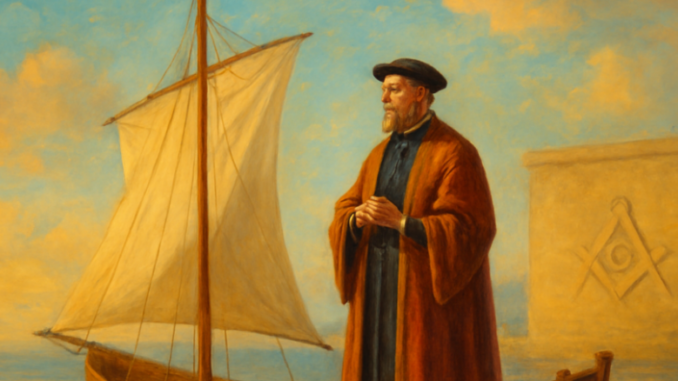
What if a sixteenth-century philosopher, secluded in his tower study, was asking the very same questions that Freemasons have woven into their rituals for centuries? Michel de Montaigne’s essay “On Practice” confronts our own mortality, champions self-knowledge, and calls for the courage to look honestly at ourselves. These themes resonate in every lodge around the world. So where do these two traditions intersect — and what can they learn from each other?
Why Did Montaigne Write About Confronting Death?
Montaigne opens his essay with a deeply personal experience: a fall from his horse that left him unconscious and, for the first time, forced him to contemplate what it truly means to die. But the essay isn’t really about death itself. It’s about practice — the willingness to prepare yourself for moments when you lose all control. Montaigne argues that we only learn to live authentically when we dare to feel the finitude of existence, not as an abstract concept, but as a physical reality.
That unflinching honesty toward yourself, that raw confrontation with your own vulnerability, lies at the very heart of Freemasonry. From the moment a candidate enters the lodge, he is invited to face uncomfortable truths about himself. Montaigne’s essay and Masonic ritual share this essential conviction: avoiding the reality of death diminishes the richness of life.
What Does Self-Reflection Have to Do With the Work in the Lodge?
This may be the most obvious question — and the most profound one. In Freemasonry, the seeker is invited to turn inward from the very first moment. The Chamber of Reflection, the silence before initiation, the probing questions about one’s own motivations: these are all forms of practiced self-knowledge. Montaigne would have recognized them immediately. He wrote that the hardest thing in the world is to know yourself — an idea that stretches back to the ancient Greek philosopher Socrates and the famous inscription “Know Thyself” at the Temple of Delphi.
Where Montaigne used the pen as his tool for self-reflection, the Freemason uses ritual. Both methods demand repetition, patience, and the willingness to begin again, over and over. The word “practice” in the essay’s title is no accident. It doesn’t refer to a one-time effort but to a lifelong discipline. Just as the rough ashlar in Freemasonry is not shaped with a single blow, but through constant and patient labor.
Does Montaigne Speak of Brotherhood and Connection?
At first glance, “On Practice” seems like a deeply individual essay. Montaigne describes his own fall, his own body, his own thoughts. But a careful reader notices something remarkable: Montaigne tells us how the members of his household cared for him after his accident, how they brought him back to life. He describes the warmth of their presence, the comfort of human contact at a moment of complete vulnerability.
Here, Montaigne touches on what Freemasons call brotherhood — the knowledge that you don’t stand alone, that others will carry you when you can no longer stand on your own. In Freemasonry, the Chain of Union is formed when every Brother in the lodge takes the hand of the person beside him. That chain is more than a gesture. It is a promise of solidarity, mutual support, and shared vulnerability. Montaigne may never have known this practice as a ritual, but the underlying value — the understanding that human connection makes us stronger — permeates his work.
The true practice of a Freemason is not the perfection of rituals, but the continuous refinement of one’s inner self — precisely as Montaigne used writing to come to know himself.
How Does the Search for Truth Relate to Montaigne’s Doubt?
Montaigne is renowned for his skepticism. His famous motto, “Que sais-je?” — What do I know? — speaks volumes. But this is not cynical skepticism. It is an invitation to intellectual humility, to acknowledging that absolute certainty is rarely within our grasp. In Freemasonry, we find a kindred principle: the search for truth is never presented as a destination, but as a perpetual journey. The light that the Mason seeks is not a definitive answer, but an ever-deepening awareness.
This is where the Masonic approach differs fundamentally from dogmatic systems. No single truth is imposed. Instead, the Brother is asked to seek, to question, to grow. Montaigne fits seamlessly into this tradition. His essays are not textbooks with conclusions but open conversations with himself and his reader. It is no coincidence that later thinkers profoundly influenced by Montaigne — Voltaire and Jean-Jacques Rousseau among them — were also closely connected to the Enlightenment ideals that helped shape modern Freemasonry.
What Can We Still Learn From This Connection Today?
In an age dominated by quick answers and unyielding opinions, both Montaigne and Freemasonry offer a counter-voice. Both advocate for slowing down, for reflection, for the courage to tolerate uncertainty. The “practice” that Montaigne writes about is ultimately nothing more than the willingness to begin anew each day with the work on yourself. In Masonic terms: the labor on the rough ashlar has no endpoint.
The power of this connection lies not in superficial similarities but in a shared philosophy of life. Both Montaigne and Freemasonry invite us to stop avoiding discomfort, to stop rationalizing death away and instead use it as a compass for a meaningful life. They ask us to meet one another in brotherhood and with compassion, precisely because we know that every one of us is vulnerable.
Consider these shared principles as guideposts for daily life: self-reflection as a daily practice rather than a one-time exercise; brotherhood as a safety net in moments of vulnerability; the search for truth as an open journey without a fixed destination; and intellectual humility as a source of strength, not weakness.
Montaigne and Freemasonry, separated by centuries and by form, are united by something deeper: a commitment to honest self-examination, a reverence for human connection, and the understanding that wisdom is not a prize to be claimed but a path to be walked. The essay “On Practice” reminds us that this path requires patience, repetition, and above all, the courage to begin again. In the lodge and in life, that is the work that never ends — and the work that makes us most fully human.
Copyright text & image: devrijmetselaar.nl
Texts are based on the ideas and content of the author of devrijmetselaar.nl, reviewed, corrected, and supplemented with the assistance of OpenAI. Images are created based on the ideas of the author of devrijmetselaar.nl using OpenAI/DALL-E.
Frequently Asked Questions
What is the connection between Montaigne's essay 'On Practice' and Freemasonry?
Montaigne's essay and Freemasonry share fundamental themes about confronting mortality, practicing self-knowledge, and developing authentic living through honest self-reflection. Both traditions invite individuals to face uncomfortable truths about themselves and their vulnerability, recognizing that this unflinching honesty is essential to living a meaningful life.
How do Montaigne and Freemasonry approach self-reflection differently?
While Montaigne used the pen as his tool for self-reflection through essay writing, Freemasons use ritual as their method. Both approaches, however, demand repetition, patience, and willingness to continually begin again. This lifelong discipline is reflected in Montaigne's emphasis on 'practice' as an ongoing process, similar to how the rough ashlar in Freemasonry is shaped through constant and patient labor rather than a single effort.
Why does Montaigne believe confronting death is important for living authentically?
Montaigne argues that we only learn to live authentically when we dare to feel the finitude of existence as a physical reality, not merely as an abstract concept. His near-death experience from a horse fall taught him that avoiding the reality of death diminishes the richness of life, a conviction that lies at the heart of Masonic ritual and practice.

Be the first to comment