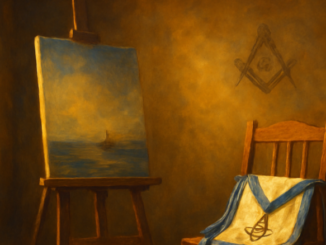
Candlelit Masonic lodge with artistic tools and creative works by brethren
Culture & Media

The Eighth Child as Philosopher and Brother: Art in the Lodge

Candlelight flickers softly as a young man sets down his brush and stares at the canvas. As the eighth child in a large family, he learned early to observe, to listen, and above all, to wait his turn to be heard. Now, years later, he stands in a Masonic lodge where brethren have gathered around the art he has created. The story of the eighth child who becomes both philosopher and brother is a story about creativity born from necessity, wisdom cultivated in the shadows, and the art that emerges when a searching spirit finally finds a home. The Philosopher Who Grew Up as the Eighth Child Throughout the history of philosophy and the arts, we find a remarkable number of thinkers and artists who grew up among the youngest children in large families. The eighth child — whether literally or figuratively the youngest — learns early that the world does not revolve around him. This position creates a unique perspective on reality: observing, reflecting, and often developing a deep need to find meaning beyond the well-trodden path. Jean-Jacques Rousseau, the eighteenth-century philosopher whose ideas helped shape the Enlightenment, knew this experience of being an outsider. His philosophy about the […]

Open book with garden imagery symbolizing Voltaire's Candide and Freemasonry
Symbolism & Rituals

Voltaire’s Candide and Freemasonry: Finding Connection in Chaos

You probably know the feeling. Someone tells you that everything happens for a reason, that life has meaning, that we live in the best of all possible worlds. And something doesn’t sit right. Because you’ve also seen the suffering, the randomness, the misfortune that strikes people without cause. This exact tension lies at the heart of Voltaire’s masterpiece Candide. And hidden within that tension is a surprising connection to the values of Freemasonry. The Illusion of the Best Possible World Voltaire wrote Candide in 1759 as a satirical attack on the philosophical optimism of Gottfried Wilhelm Leibniz. The story’s hero, Candide, grows up under the tutelage of Professor Pangloss, who insists that we live in the best of all possible worlds. Every misfortune, every disaster serves a purpose. Everything is ultimately good. But Voltaire then drags Candide through an unrelenting chain of catastrophes — earthquakes, war, slavery, betrayal. The naïve hero gradually loses faith in Pangloss’s doctrine. Not through philosophical arguments, but through raw, concrete experience. By witnessing what human beings are capable of doing to one another. What Seekers of Truth Can Learn from Candide The first lesson from Candide is confrontingly simple: do not blindly trust systems. This […]

Open Bible at 2 Thessalonians with Masonic square and compasses in soft light
Christianity

2 Thessalonians and the Masonic Light of Perseverance

What does it mean to stand firm when everything around you seems to shift and tremble? The Second Epistle to the Thessalonians — a brief but powerful text from the New Testament — poses this question with striking urgency. Written to a young Christian community grappling with confusion and doubt, the letter offers a timeless meditation on perseverance, labor, and the strength found in brotherly bonds. For the Freemason, accustomed to symbolic language and moral reflection, this ancient text opens surprisingly resonant perspectives. A Letter Born from Uncertainty The paradox at the heart of 2 Thessalonians lies in its origin: a community so fervently convinced of imminent salvation that it was in danger of neglecting the present. Some had abandoned their work, certain that the end of days was upon them. Others had been thrown into confusion by false messages and counterfeit letters. The epistle, traditionally attributed to the Apostle Paul, calls for reflection — not by denying the vision of hope, but by reminding its readers of their duty to the here and now. This tension between future expectation and daily responsibility touches on a universal human theme. How often do we lose ourselves in dreams of what is […]

Open Bible at Colossians with Masonic square and compasses symbolizing wisdom
Christianity

Colossians and Freemasonry: Practical Wisdom for Every Day

You probably know the feeling: you’re facing a difficult choice, a conflict at work or at home, and you wonder how best to act. Where do you find your moral compass in such moments? The Epistle to the Colossians — a short but powerful text from the New Testament — offers surprisingly concrete guidance for anyone seeking moral direction. For Freemasons, this text resonates with particular force, because it centers on the same pursuit of inner refinement and brotherly conduct that lies at the heart of the Craft. Two Perspectives on the Same Text The traditional Christian reads Colossians as a pastoral letter from the Apostle Paul to a young community of believers in Asia Minor. The text warns against false teachings and calls for steadfastness in faith. The Freemason reads the same words through a different lens: he sees a blueprint for moral architecture, a manual for building character in everyday life. Both readings are worthy and valuable. They do not exclude each other — they enrich each other. The Hidden Treasure: Wisdom and Knowledge In the second chapter of Colossians, there is a remarkable passage about the hidden treasures of wisdom and knowledge. For the Freemason, this strikes […]

Father and children symbolizing brotherhood and Masonic family values
Personal Development & Leadership

Fatherhood and Brotherhood: Lessons from an Eighth Child

A well-known celebrity recently announced the arrival of his eighth child, declaring himself ‘on cloud nine.’ The news slips past in the endless stream of celebrity updates and family announcements. But pause for a moment. Eight children. Eight unique souls bound together by blood. Doesn’t that raise a deeper question — what does it truly mean to be a brother or sister, and to build a community that extends beyond yourself? What Turns a Family Into a Brotherhood? Let’s start with a deceptively simple question: is a family automatically a brotherhood? On the surface, the answer seems obvious. Siblings share parents, a home, a last name. But if we’re honest with ourselves, we all know that blood ties alone don’t guarantee genuine connection. How many families do we know where members barely speak to one another, where old wounds have never healed? True brotherhood, as Freemasonry teaches us, is not born from the accident of birth. It is built — stone by stone, conversation by conversation, gesture by gesture. A father raising eight children faces the task of not merely educating individuals but forging a community. In a very real sense, he becomes the architect of a small Lodge within […]

Symbolic staircase representing the 33 degrees of Freemasonry and brotherhood
Personal Development & Leadership

The 33rd Degree: Where Brotherhood Becomes a Paradox

The 33rd degree fascinates and confounds in equal measure. How can a brotherhood that preaches equality simultaneously maintain a system of thirty-three ascending steps? It’s a question that occupies outsiders and initiates alike — and perhaps that is exactly the point. Because within this tension between hierarchy and equality lies a deeper insight into what human connection truly means. The Paradox of the 33rd Degree Explained Let’s begin with a provocative proposition: the highest degrees of Freemasonry exist not to elevate people, but to make them smaller. Not in the sense of humiliation, but in the original meaning of the word humilitas — derived from humus, the earth. The higher one climbs on the symbolic ladder, the sharper the awareness of one’s own limitations becomes. The thirty-third step is not a throne but a vantage point from which the horizon remains infinite. This may sound like a contradiction. We live in an age in which hierarchy has become suspect, in which every form of rank is automatically associated with power and oppression. Yet the structure of degrees within Masonic traditions operates in a fundamentally different way. It is not a ladder upward, but a spiral inward. Each degree reveals not […]

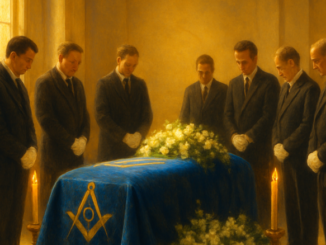
Masonic lodge in solemn remembrance during a ceremony honoring a departed Brother
Philosophy & Ethics

Grieving a Colleague: What Loss Teaches Us About Ethics

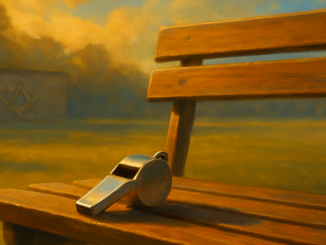
The phone goes silent after the message. A referee stares at an empty field where yesterday a familiar face still stood. The news of a valued colleague’s sudden death hits like a hammer blow. In that moment of loss, a question emerges that reaches far beyond personal grief: what does our mourning reveal about who we truly are — and how we treat one another? The Silence After Loss When a colleague dies unexpectedly, a hole opens up in the world. Not just in the workplace, but in the fabric of everyday connections. The world of refereeing, like any tight-knit community, knows this feeling of collective grief. These are moments when achievements and results suddenly seem meaningless. What remains is the memory of a person — shared experiences, the way someone carried themselves through life. In Freemasonry, we know these moments of stillness as well. When a Brother enters the Eternal East, as passing is described in Masonic terms, the lodge gathers in reflection. Not to judge what someone accomplished, but to remember who someone was. This tradition reminds us that ethics is not only about action — it is also about remembrance and honor. Ethics in the Face of […]

Vrijmetselarij - Freemasonry and Ethics – Building Your Best Self
Philosophy & Ethics

Freemasonry and Ethics – Building Your Best Self

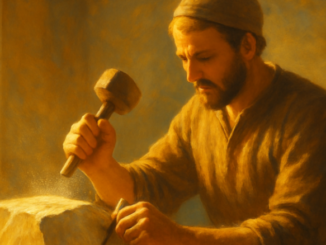
In a world increasingly driven by superficiality and snap judgments, many of us long for something deeper. For integrity. For authenticity. For a way to grow — not just in knowledge, but in character. This is where Freemasonry enters the picture: an ancient system that doesn’t just offer philosophical insights, but actively invites you to put them into practice. And nowhere is that invitation more powerful than in the realm of ethics. What Does Ethics Mean in Freemasonry? Ethics in Freemasonry is not a rigid set of rules or dogmas. It functions as a living compass — an inner guide that is continually sharpened through self-reflection, ritual, and fraternal interaction. You don’t learn a standard answer to what is “good.” Instead, you learn to ask yourself the right questions: What are my true intentions? What is my responsibility? How can I contribute to the greater good — in my community, my work, my relationships? Freemasonry invites you to see ethics not as abstract theory, but as something you experience, apply, and develop in your daily life. Ethics Begins with Yourself Freemasons work with a powerful symbol: the rough ashlar. This unworked stone represents your unrefined self — full of potential, […]