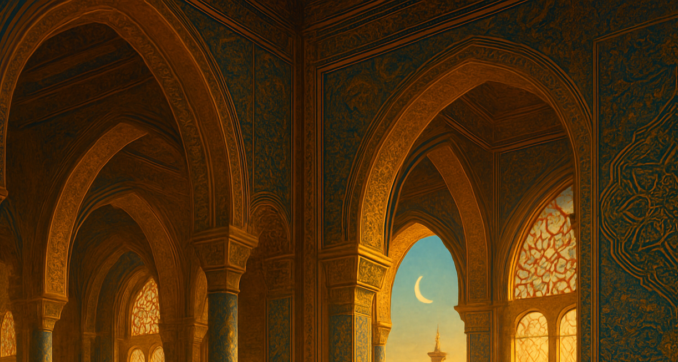
There is an act so commonplace that we barely notice it, yet it carries within it one of the deepest spiritual truths known to humanity: the moment when people come together to consult with one another. In the forty-second surah of the Quran, known as Ash-Shura — The Consultation — this seemingly simple practice is elevated to the status of a divine principle. For those willing to look, an extraordinary vision of human interconnectedness unfolds here, one that reveals striking parallels with the spiritual traditions of Freemasonry.
The Round Table as Sacred Space
Imagine a round table. Not an ordinary piece of furniture, but a place where voices converge, where the ego yields to collective listening. The forty-second surah describes how believers conduct their affairs through mutual consultation. This Arabic concept of deliberation — shura — not only gives the surah its name but forms its beating heart. It is not the table itself that matters, but what emerges there: a space where individual wisdom blends into something greater than any single mind could produce.
In Freemasonry, we recognize this principle in the lodge, where brethren gather not to debate or persuade, but to build. The gavel wielded by the Worshipful Master brings not judgment but order. Every member may speak; every insight counts. Aristotle wrote that man is a social being, destined to flourish in community. The surah affirms this in spiritual terms: whoever truly consults with others acknowledges that no one person possesses the full truth alone.
Revelation Through Dialogue
The forty-second surah speaks of revelation as a process that reaches humanity through multiple channels — sometimes directly, sometimes from behind a veil, sometimes through a messenger. This multifaceted character of divine communication sheds light on the nature of consultation itself: human wisdom, too, reaches us along many paths. One brother speaks from experience, another from intuition, yet another from scholarly learning. Together, these voices form a chorus that encompasses far more than the sum of its parts.
Plato demonstrated in his dialogues how truth arises in conversation, not in solitary contemplation. The Socratic method of questioning and answering mirrors what the surah teaches: that through open deliberation we draw closer to the light. In Masonic ritual, this principle is practiced continually. The question posed to the candidate, the answer he seeks, the silence in which wisdom ripens — all are forms of consultation between the known and the unknown.
Forgiveness as the Foundation of Consultation
A striking theme in this surah is its emphasis on forgiveness and reconciliation. True consultation requires the willingness to look beyond personal grievances. Those who cling to old resentments cannot listen with sincerity. The text encourages its readers to answer evil with good, allowing enmity to transform into friendship. This is not weakness — it is spiritual strength.
Consultation is not the imposition of one’s own will, but the collective search for a light that no individual can kindle alone.
In Freemasonry, we find this reflected in the ideal of brotherhood. The ritual handshake upon entering the lodge is a promise: here, we leave the profane world behind us. Marcus Aurelius wrote that every day we will encounter people who irritate us, but that we must see them as co-workers in the great work. The surah confirms this insight: consultation without forgiveness is merely debate; consultation with forgiveness is spiritual building.
The Inner Council Chamber
There is, however, a deeper layer still. The consultation described in the surah can also be read as an inner process. Within every person dwells a multitude: desires, fears, reason, intuition, conscience. Spiritual growth means that these internal voices do not fight for dominance but come together in deliberation. The soul becomes the lodge; the conscience becomes the Worshipful Master.
René Descartes sought certainty by doubting everything until he arrived at the thinking self. The Islamic mystic and the Freemason, however, search further: beyond thinking lies listening, and beyond listening lies surrender. The surah teaches that the heavens and the earth belong to God, that all things return to Him. In that light, every act of human consultation becomes an exercise in humility — an acknowledgment that we are builders working with borrowed stones.
Unity in Diversity
The forty-second surah emphasizes that creation is diverse, and that this diversity is not a misfortune but a sign. The differences between people — the variety of talents, perspectives, and insights — form the very richness of consultation. Without difference, there would be nothing to discuss. Johann Wolfgang von Goethe, himself a Freemason, wrote about the unity hidden behind all outward forms. The kaleidoscopic nature of existence is not an obstacle to harmony but its very precondition.
In the lodge, people of different backgrounds, professions, and convictions meet as brothers. The rough ashlar that symbolizes every newcomer is not hewn into a single uniform shape, but into a stone that fits within the larger edifice. In the same way, the surah teaches that diversity need not mean division — provided we are willing to engage in genuine consultation.
The Silence After the Word
After every consultation comes a moment of silence. The words have been spoken, the voices have sounded, and now there remains the space in which what has been said can settle and take root. It is in that silence that the real work happens. Spinoza understood that true knowledge does not reside in words themselves but in the understanding that words make possible. The surah points toward the invisible, the unseen, the hidden light behind all phenomena.
Those who practice the art of consultation ultimately learn something profound about themselves. The ego that wants to win gives way to the soul that wants to grow. The voice that wants to convince becomes the ear that wants to understand. In that transformation lies the spiritual core of what the forty-second surah holds before us.
The practice of consultation — whether around a table, within a lodge, or deep inside the chambers of the heart — is one of humanity’s most ancient and sacred acts. The forty-second surah of the Quran and the traditions of Freemasonry both point to the same timeless truth: that we grow not by insisting on our own vision, but by opening ourselves to the wisdom of others. In the willingness to listen, to forgive, and to build together, we participate in something far greater than ourselves — a work of spiritual architecture that no single hand could ever complete alone.
Copyright text & image: devrijmetselaar.nl
Texts are based on the ideas and content of the author of devrijmetselaar.nl, reviewed, corrected, and supplemented with the assistance of OpenAI. Images are created based on the ideas of the author of devrijmetselaar.nl using OpenAI/DALL-E.

Be the first to comment