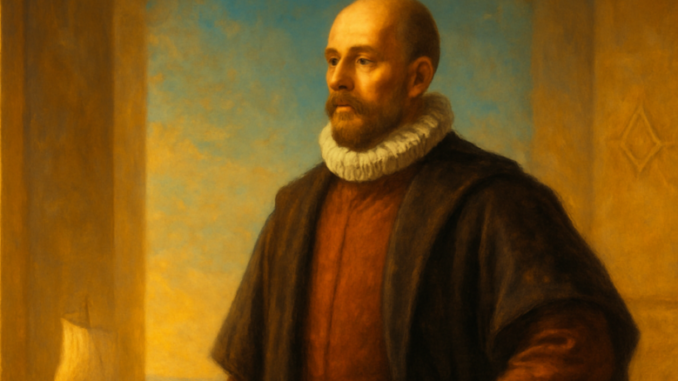
A simple meal on a wooden table. Bread, water, a handful of olives. In the twenty-first century, most people would associate such an image with poverty — or, at best, a deliberate embrace of minimalism. But for Michel de Montaigne, who reflected on the frugality of Roman statesmen in his brief essay ‘On the Parsimony of the Ancients,’ this scene meant something entirely different: it was a sign of inner strength. Behind that seemingly modest observation lies a rich philosophical tradition stretching from the Stoics to Renaissance humanism — one that shares a surprising number of ideals with the moral teachings of Freemasonry.
A Twenty-Line Essay, Centuries of Philosophy
Essay 52 from the first book of the Essais is one of the shortest texts Montaigne ever wrote. In just a few paragraphs, he sketches how Roman consuls and dictators prepared their own meals, governed without personal luxury, and how their sobriety was regarded not as deprivation but as virtue. It would be easy to dismiss this essay as an anecdotal interlude, but anyone who follows the philosophical threads discovers that Montaigne weaves together a network of classical sources into a deeply personal meditation on character and temperance.
Plutarch as a Mirror of the Ancient World
The primary source for this essay is Plutarch, the Greek writer whose Lives of the Noble Greeks and Romans Montaigne regarded as an inexhaustible treasury. Plutarch described how generals such as Manius Curius Dentatus and Gaius Fabricius Luscinus, despite their military triumphs, lived in the utmost simplicity. Montaigne cited Plutarch not merely as a historian but as a moralist — someone who, by portraying great men, invited his readers to examine themselves.
This use of the mirror — coming to know yourself through the example of another — is a method that also stands at the heart of Freemasonry. Just as the Entered Apprentice ritual begins with a symbolic look in the mirror, so Montaigne opens his essay by turning his gaze to the ancestors. The act of reflection, in both senses of the word, becomes a tool for moral growth.
The Stoic Roots of Temperance
Behind Montaigne’s admiration for the sober Romans, one can hear the voice of Stoicism. Seneca, one of the philosophers Montaigne quoted most frequently throughout his entire body of work, wrote extensively about the distinction between genuine needs and artificial desires. In his Letters to Lucilius, Seneca argued that true wealth lies not in possessing much, but in desiring little. This idea saturates Essay 52: the ancestors are not poor because they possess little; they are free because they need little.
Marcus Aurelius, the philosopher-emperor whose Meditations serve as a guide for self-mastery, embodied this same principle. He ate simply, dressed without adornment, and viewed his imperial role as a duty rather than a privilege. The Stoic concept of autarkeia — the capacity to be sufficient unto oneself — forms the backbone of Montaigne’s argument. For the Stoics, temperance was not a sacrifice but an exercise in inner freedom. Whoever is not dependent on external luxury cannot be broken by its loss.
This insight resonates powerfully within the rituals of Freemasonry. The candidate enters the lodge divested of metals and outward signs of status, symbolizing the equality that emerges when the superfluous is stripped away. In both traditions, the message is the same: true strength is revealed not by what you accumulate, but by what you can willingly set aside.
True sobriety is not poverty of possession, but richness of spirit: the ability to own without being owned.
Skepticism and the Distrust of Appearances
Montaigne’s philosophical stance is often characterized as Pyrrhonian skepticism, inspired by Sextus Empiricus and the ancient Greek school that called every certainty into question. In Essay 52, this skepticism manifests not as abstract doubt but as a concrete distrust of outward display. Montaigne implicitly poses the question: if the greatest leaders of antiquity could govern without luxury, what does our modern attachment to wealth say about us?
It is a question that does not judge but unmasks. The skeptic does not seek the definitive answer; the skeptic seeks the honest question. It is precisely this attitude that makes Montaigne a thinker remarkably well-suited to the Masonic tradition, where asking questions is valued more highly than claiming answers. In lodge work, the pursuit of truth is understood as an ongoing journey, not a destination — a perspective Montaigne would have recognized instantly.
Renaissance Humanism: Rediscovering Virtue
Montaigne wrote in an era when Renaissance humanism was bringing the classical world back to life. Thinkers like Desiderius Erasmus and Francesco Petrarch had paved the way by making Greek and Latin texts accessible again and by emphasizing personal virtue over dogmatic obedience. Montaigne stood in this tradition but added something uniquely his own: where Erasmus often approached virtue in theological terms, Montaigne sought it in everyday life. The simple meal of the Roman consul was, for him, not a historical curiosity but a philosophical statement about the relationship between human beings and material things.
This humanist perspective touches the very heart of Freemasonry. The building of the inner temple — a central metaphor in Masonic thought — is ultimately nothing other than the shaping of character through conscious choices. Just as the rough ashlar is worked by the Apprentice into a perfect cube, so Montaigne refined his own thinking by confronting it with the examples of antiquity. The tools differ — hammer and chisel versus pen and paper — but the goal is kindred: to remove the superfluous in order to arrive at the essence.
Three Philosophical Traditions in One Essay
What makes Essay 52 so remarkable, despite its brevity, is the way it braids together three distinct philosophical traditions into a single meditation. First, the Stoicism of Seneca and Marcus Aurelius, which frames temperance as the path to inner freedom. Second, Pyrrhonian skepticism, which cultivates a healthy distrust of appearances and prizes honest questioning above comfortable certainties. Third, the Renaissance humanism of Erasmus and Petrarch, which insists that virtue must be rediscovered and practiced in personal life, not merely admired from a distance.
Each of these traditions speaks directly to the Masonic experience. The Stoic emphasis on self-governance mirrors the Freemason’s commitment to moral self-improvement. The skeptic’s insistence on questioning aligns with the Masonic principle that light is sought through inquiry, not handed down as dogma. And the humanist conviction that character is built through study, reflection, and deliberate practice echoes through every degree of the Craft.
Montaigne’s tiny essay on ancestral frugality may span no more than a page, but its philosophical reach extends across millennia. By holding up the sober lives of Roman statesmen as mirrors for self-examination, Montaigne invites us to ask uncomfortable questions about our own relationship with excess. For Freemasons, this invitation resonates deeply. The work of the Craft has always been about chipping away at the superfluous — in our thinking, in our habits, in our character — to reveal something truer beneath. In this sense, Montaigne’s wooden table, with its bread, water, and handful of olives, is not an image of poverty at all. It is a blueprint for the inner temple.
Copyright text & image: devrijmetselaar.nl
Texts are based on the ideas and content of the author of devrijmetselaar.nl, reviewed, corrected, and supplemented with the assistance of OpenAI. Images are created based on the ideas of the author of devrijmetselaar.nl using OpenAI/DALL-E.
Frequently Asked Questions
What is the main philosophical connection between Montaigne's essay on Roman parsimony and Freemasonry?
Both Montaigne's essay and Freemasonry share the ideal of using reflection and the examination of virtuous examples as tools for moral growth. Just as the Entered Apprentice ritual involves symbolic self-reflection, Montaigne uses Plutarch's accounts of sober Roman leaders as a mirror for readers to examine their own character and practice temperance.
Who was Plutarch and why did Montaigne rely on him for this essay?
Plutarch was a Greek writer whose Lives of the Noble Greeks and Romans served as Montaigne's primary source. Montaigne regarded Plutarch as both a historian and moralist who provided inexhaustible examples of great men living with simplicity, such as generals Manius Curius Dentatus and Gaius Fabricius Luscinus, which invited readers to examine themselves.
What does Montaigne mean by sobriety in the context of ancient Roman leaders?
Montaigne defines sobriety as the virtue of living simply without personal luxury, exemplified by Roman consuls and dictators who prepared their own meals and governed without excess. This sobriety was not viewed as deprivation but as a sign of inner strength and genuine character, reflecting Stoic philosophy's distinction between genuine needs and artificial desires.




Be the first to comment