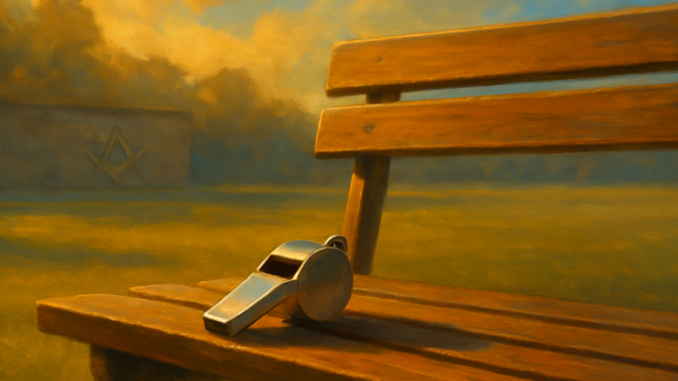
The phone goes silent after the message. A referee stares at an empty field where yesterday a familiar face still stood. The news of a valued colleague’s sudden death hits like a hammer blow. In that moment of loss, a question emerges that reaches far beyond personal grief: what does our mourning reveal about who we truly are — and how we treat one another?
The Silence After Loss
When a colleague dies unexpectedly, a hole opens up in the world. Not just in the workplace, but in the fabric of everyday connections. The world of refereeing, like any tight-knit community, knows this feeling of collective grief. These are moments when achievements and results suddenly seem meaningless. What remains is the memory of a person — shared experiences, the way someone carried themselves through life.
In Freemasonry, we know these moments of stillness as well. When a Brother enters the Eternal East, as passing is described in Masonic terms, the lodge gathers in reflection. Not to judge what someone accomplished, but to remember who someone was. This tradition reminds us that ethics is not only about action — it is also about remembrance and honor.
Ethics in the Face of Mortality
The confrontation with another person’s death holds up a mirror to our own lives. Did we say what needed to be said? Did we act according to our inner convictions? These questions are far from new. As far back as the eighteenth century, philosophers explored the relationship between mortality and moral conduct. The insight was clear: those who are aware of life’s finitude will be more careful with the time that remains.
In Masonic ritual, this awareness plays a central role. The skull and crossbones is no morbid decoration — it is a perpetual call to reflection. It reminds the Freemason that every moment contains a choice, and that these choices together form the architecture of a life. Ethics, then, is not an abstract concept but a daily practice of conscious living.
Brotherhood as an Ethical Foundation
What stands out in reactions to a colleague’s passing is the emphasis on connection. Words like “heartbreaking” reveal not only grief, but the depth of the bond that existed. In a world that often seems competitive and individualistic, mourning reminds us of our fundamental need for community.
We are not merely builders of our own lives — we are bearers of each other’s burdens.
This idea lies at the heart of the Masonic understanding of brotherhood. It is not about superficial friendliness, but about a deeply rooted sense of mutual responsibility. When one Brother suffers, the entire chain feels it. When a colleague dies, the whole community grieves. In this view, ethics is inseparable from empathy and solidarity.
The Referee as a Symbol
There is something remarkable about the profession of referee that touches on core ethical questions. An arbiter stands literally between opposing parties, called to judge fairly and without personal interest. This position requires courage, integrity, and a constant willingness to receive criticism. It is a role that demands inner strength, often without the recognition given to players and coaches.
In Freemasonry, we recognize this striving for justice. The level and the plumb line are symbols that remind the Mason of the necessity of honesty and balance — not only in judging others, but especially in assessing one’s own conduct. The referee on the field and the Freemason in the lodge share this aspiration: to act with integrity, even when no one is watching.
Grief as an Ethical School
Perhaps grief is the most intense ethical education that life has to offer. In sorrow over another, we are confronted with the fragility of existence. That confrontation can be paralyzing, but it can also be liberating. It reminds us that every conversation, every gesture, every choice matters.
Grief teaches us the value of presence. Loss reminds us how fleeting our conflicts truly are. Remembrance is itself a form of ethical action. And shared mourning strengthens the bonds between people in ways that few other experiences can.
In the silence of the lodge, when Brothers gather to remember a departed member, a space opens for these insights. The ritual offers no easy answers, but it poses the right questions. How do we wish to be remembered? What kind of edifice are we leaving behind? These are not somber questions — they are vital ones. They give direction to the life that still lies ahead.
Building Onward After Loss
Life goes on, even after grief. Matches are officiated, lodges convene, the current of life flows forward. But anyone who looks closely will notice that something has changed. The memory of a lost colleague or Brother becomes a quiet companion — a voice that asks about the quality of our actions. In that sense, no one truly dies who lives on in the memory of others.
Freemasonry teaches that we are all builders of the same temple — a temple of humanity that will never be fully completed. Every stone we contribute, every connection we forge, adds to that greater whole. The loss of a fellow worker on this building is painful, but it also reminds us of the necessity to keep building, with care and attention for those who stand beside us.
In the heartbreaking loss of a colleague lies an invitation to deeper ethical awareness. Freemasonry offers no comfort in the form of easy answers, but it does provide a framework for navigating loss with meaning. By remembering, by cherishing our bonds with others, and by choosing justice and humanity anew each day, we honor those who have gone before us. In this way, grief becomes not an ending, but a profound beginning — a call to live more fully, more consciously, and more connected to the people around us.
Copyright text & image: devrijmetselaar.nl
Texts are based on the ideas and content of the author of devrijmetselaar.nl, reviewed, corrected, and supplemented with the assistance of OpenAI. Images are created based on the ideas of the author of devrijmetselaar.nl using OpenAI/DALL-E.
Frequently Asked Questions
What does Freemasonry teach about dealing with the loss of a Brother?
Freemasonry teaches that when a Brother passes into the Eternal East, the lodge gathers in reflection to remember who they were rather than judge their accomplishments. This tradition emphasizes that ethics includes honoring and remembering those we've lost, recognizing that such moments of stillness reveal our true character and values.
How does Freemasonry connect mortality awareness to ethical living?
Masonic ritual uses symbols like the skull and crossbones as reminders that life is finite, and this awareness naturally leads to more conscious and ethical choices. Freemasons understand that recognizing life's finitude helps us make better decisions daily and live with greater integrity and intention.
What does Freemasonry mean by 'brotherhood' as an ethical foundation?
In Freemasonry, brotherhood is not superficial friendliness but a deeply rooted sense of mutual responsibility where members share each other's burdens and griefs. This concept teaches that ethics cannot be separated from empathy and solidarity, and that we are all bearers of one another's experiences.
How does Freemasonry view the relationship between personal reflection and ethical conduct?
Freemasonry teaches that confronting our own mortality through the loss of others prompts genuine self-reflection about whether we've acted according to our convictions. This practice of conscious living transforms ethics from an abstract concept into a daily commitment to integrity and meaningful connection with others.



Be the first to comment