A new law is making headlines: it criminalizes the glorification of terrorism, but only when there is proof of intent. That single word — intent — touches on something profound. What does it truly mean to act consciously? And why does the distinction between deliberate choice and careless behavior matter so deeply, both in a courtroom and in the quiet reckonings of your own conscience?
The Weight of a Single Word
In legal language, intent sounds dry and technical. But behind that term lies an entire view of what it means to be human. The law assumes you are only truly responsible for something when you did it consciously — when you knew what you were doing and chose to continue anyway. That is no minor principle. It says we should not condemn people for unintended consequences. It demands that we distinguish between a misstep and a deliberate choice.
This nuance is not only relevant in courtrooms. It touches on how you see yourself when you look in the mirror. How much of what you do is truly conscious? And how much simply happens — out of habit, conformity, or inattention?
Consciousness as the Art of Living
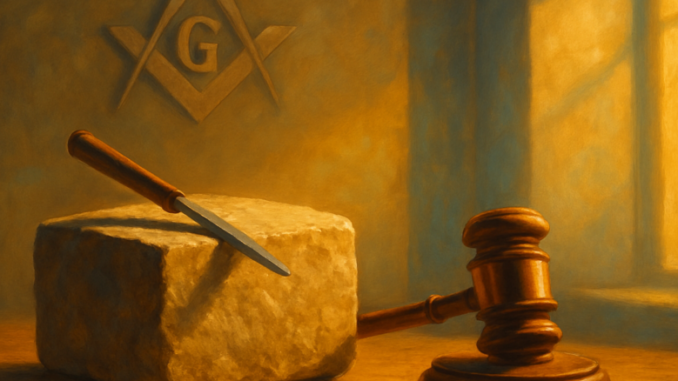
Within Freemasonry, this theme has played a central role for centuries. The entire tradition revolves around the idea that you can shape yourself, refine yourself, and improve yourself. But that is only possible if you first become aware of who you are and what you do. The rough ashlar that Brethren symbolically work on represents the unrefined self. The gavel and chisel used to shape that stone are the tools of self-examination and conscious choice.
Without consciousness, there is no growth. Without intent, there is no real change. That may sound demanding, but it is actually liberating. Because it also means you do not need to condemn yourself for every mistake. What matters is whether you are willing to look honestly, to learn, and to choose differently next time.
The Line Between Word and Deed
The new law specifically targets the glorification of violence. This is noteworthy because glorification is primarily something done with words, images, and gestures. The law acknowledges that words carry power — that they can incite real harm. But at the same time, it says: we will only hold you accountable if you knew what you were doing.
This theme resonates strongly within the Lodge. Great importance is placed on the spoken word. A promise, an oath, an address — none of these are taken lightly. The underlying belief is that words create reality. What you speak aloud takes on weight. That is why Freemasons practice careful speech, attentive listening, and silence when silence is fitting. The recurring question is always: are you speaking consciously, or are you being carried along by the moment?
He who weighs his words also weighs his responsibility.
Justice Begins With Insight
What is beautiful about the legal requirement of intent is that it expresses a certain trust in humanity. It assumes that people are capable of awareness, reflection, and genuine choice. That is not a given. There have been cultures and eras in which people were punished purely on the basis of outcomes, regardless of their intentions. The shift toward requiring intent represents a leap in civilization.
In the Masonic tradition, justice is regarded as one of the cardinal virtues. But justice without insight is blind. Only when you look at the person behind the act — at the intention behind the word — can you truly do justice. That demands patience, nuance, and the willingness to resist hasty judgment.
What This Means for You
You might be thinking: this is about laws and courtrooms — what does it have to do with me? But the question of intent is also a deeply personal one. How often do you operate on autopilot? How often do you say something without truly considering its impact? And what would your life look like if you chose more consciously, more often?
The Lodge does not offer ready-made answers, but it does offer a place to practice. A space where you can reflect on these kinds of questions together with others, without haste and without judgment. Where the point is not to be right, but to grow together in awareness.
Consciousness begins with asking honest questions of yourself. Responsibility requires honesty about your own intentions. Growth does not happen by itself — it happens through deliberate choices.
An Invitation to Self-Examination
The debate surrounding this new law is ultimately an invitation — not only to lawmakers and judges, but to each of us. An invitation to reflect on what it means to be responsible. To examine where you act out of habit and where you act out of genuine choice. To work on the rough ashlar of your own character with care and attention.
That is perhaps the very heart of the Masonic tradition: the belief that every person is capable of awakening, of growth, of taking responsibility for their own life. Not by chasing perfection, but by choosing again and again to be attentive, to be honest, and to act with full awareness.
The law demands intent, and in doing so, it demands something profoundly human. It asks us to acknowledge that we are responsible for what we do consciously — and that this responsibility begins with self-knowledge. Perhaps that is the most meaningful lesson we can draw from this current debate: that consciousness is not merely a legal standard, but a way of life. A practice you can cultivate alone or together with others, in the silence of your own thoughts or in the warmth of a community that asks the very same questions.
Copyright text & image: devrijmetselaar.nl
Texts are based on the ideas and content of the author of devrijmetselaar.nl, reviewed, corrected, and supplemented with the assistance of OpenAI. Images are created based on the ideas of the author of devrijmetselaar.nl using OpenAI/DALL-E.
Frequently Asked Questions
What does Freemasonry teach about personal responsibility?
Freemasonry teaches that true responsibility comes from conscious choice and self-awareness. The tradition emphasizes that you can only grow and improve yourself by becoming aware of your actions and deliberately choosing to change, using self-examination as a tool for personal refinement, much like the rough stone is shaped into a perfect ashlar.
Why do Freemasons place so much emphasis on the spoken word?
Freemasons believe that words carry real power and create reality, which is why oaths, promises, and addresses are treated with great reverence in the Lodge. This teaching encourages Brethren to speak consciously and deliberately, understanding that their words have weight and consequences.
How does the concept of 'intent' relate to Masonic teachings?
Intent is central to Freemasonry because it distinguishes between genuine growth and mere accident. The Craft teaches that without conscious intention and awareness, there can be no real change or self-improvement, which is the ultimate goal of a Freemason's journey.
Does Freemasonry condemn members for making mistakes?
No—Freemasonry teaches that what truly matters is whether you are willing to look honestly at your mistakes, learn from them, and choose to act differently next time. This compassionate approach recognizes that growth comes through conscious reflection rather than condemnation.


Be the first to comment