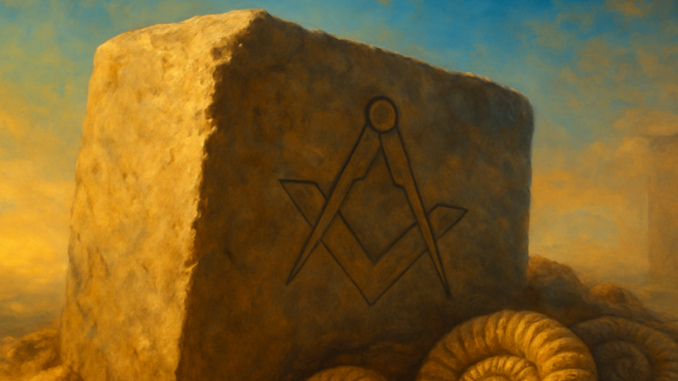
A lodge painter sets down his brush and stares at the canvas. He has just learned that an actor has died — someone who once played a paleontologist surrounded by prehistoric creatures. How strange, he thinks, that certain people remind us of forgotten ages, of what once was and will never return. In the silence of his studio, a question lingers: what remains when the last echo of a voice fades away?
The Echo of Extinct Worlds
There is something deeply fascinating about stories of extinct creatures. When we immerse ourselves in prehistoric times, we realize just how brief our human existence truly is. Millions of years passed before the first humans ever set foot on this earth. And yet, generation after generation, we strive to leave behind something that outlasts us. This longing for a legacy that defies time touches the very heart of what Freemasons have contemplated for centuries.
Freemasonry has always maintained a special relationship with the past. Lodges preserve traditions stretching back to the medieval stonemasons’ guilds — and perhaps even further. Not because the past was better, but because there is wisdom in continuity. Every Freemason who enters a lodge joins a chain of brothers that spans centuries, becoming part of something far greater than any single lifetime.
Cathedral Building as a Masonic Metaphor
Consider the great cathedrals of Europe. The master builders who began work on Notre-Dame knew they would never live to see its completion. Yet they laid the first stones with the same devotion as those who, generations later, placed the final pinnacles. This willingness to labor on something you will never behold in its finished form may be the most profoundly Masonic attitude there is.
We build not for ourselves, but for those who come after us.
This idea is central to the rituals and symbols of Freemasonry. The rough ashlar that must be shaped, the square and compasses that provide direction, the plumb line that reveals the true vertical — all point to a process that transcends the individual. It is not about what you achieve in a single lifetime, but about what you contribute to the whole.
What History Teaches Us About Impermanence
Masonic history is filled with moments when everything seemed lost. In the eighteenth century, lodges in certain countries were banned and persecuted. Under totalitarian regimes of the twentieth century, brethren were imprisoned and killed. Time and again, the chain appeared broken beyond repair. And time and again, there were those who breathed new life into the tradition.
This pattern of decline and renewal mirrors the prehistoric world itself. Species came and went, continents shifted, ice ages gave way to warmer periods. The earth survived not by resisting change, but by embracing it. Perhaps that is the lesson we should draw: true legacy lies not in remaining unchanged, but in the willingness to transform while preserving what is essential.
The Role of Stories in Our Collective Memory
Actors, writers, and artists play a singular role in human existence. They are the storytellers — the ones who create images that lodge themselves in our collective memory. A film about prehistoric creatures is more than entertainment; it is an attempt to connect us with ages we never knew and beings we will never encounter.
Stories bridge the gap between generations. Images endure where bare facts fade. Emotion gives meaning to abstract knowledge.
Freemasonry works with stories and images in much the same way. The legends told within lodge rituals are not literally true in the historical sense, but they carry truth of a different order. They speak to the imagination and touch something within us that pure logic cannot reach. Just as a film about dinosaurs can make us feel how small — and yet how remarkable — human existence truly is, Masonic allegory illuminates truths that reason alone cannot convey.
What Remains When Everything Passes Away
In the end, perhaps it is not about what we build or what we create, but about how we have touched others. The actor who transported us to forgotten worlds, the master builder who laid a stone for a cathedral he would never see, the Freemason who guides a younger brother along his path of development — each passes on something greater than themselves.
Masonic history teaches us that nothing is truly lost. Ideas, values, and insights always find their way to the next generation, even when those who carried them have long been forgotten. That is the comfort hidden within our awareness of impermanence: we are part of a chain that transcends us, a story that began before we arrived and will continue long after we are gone.
The lodge painter picks up his brush once more. Outside, twilight is falling, but inside the light still burns. He thinks of all the artists, builders, and storytellers who came before him, and of all those who will follow. The canvas before him is unfinished, and perhaps it always will be. But that is precisely the point: we do not work toward completion — we work toward continuation. In that infinite chain lies our true legacy.
Copyright text & image: devrijmetselaar.nl
Texts are based on the ideas and content of the author of devrijmetselaar.nl, reviewed, corrected, and supplemented with the assistance of OpenAI. Images are created based on the ideas of the author of devrijmetselaar.nl using OpenAI/DALL-E.
Frequently Asked Questions
What is the connection between Freemasonry and preserving history?
Freemasonry maintains a special relationship with the past by preserving traditions that stretch back to medieval stonemasons' guilds and beyond. Lodges serve as keepers of wisdom and continuity, with each new member joining a chain of brothers spanning centuries. This commitment to preserving essential traditions while adapting to the times ensures that Masonic knowledge and values are passed down to future generations.
Why do Freemasons build things they won't see completed?
This practice reflects the profound Masonic philosophy that we build not for ourselves, but for those who come after us. Just as medieval cathedral builders laid stones knowing they wouldn't witness the finished structure, Freemasons understand that meaningful contribution to society transcends individual lifetimes. This willingness to labor for future generations embodies one of the most noble attitudes in Freemasonry and connects members to a greater purpose.
How has Freemasonry survived challenges throughout history?
Freemasonry has demonstrated remarkable resilience through periods of persecution, bans, and oppression by embracing change while preserving its essential core values. Rather than resisting transformation, the fraternity has adapted to different times and circumstances, allowing the tradition to be renewed and revitalized by each generation. This balance between continuity and evolution has enabled Freemasonry to survive and thrive for centuries.
What do the symbols and rituals of Freemasonry teach us?
Masonic symbols like the rough ashlar, square and compasses, and plumb line all point to a process of personal and collective development that transcends individual achievement. These tools represent how we shape ourselves and contribute to something greater than ourselves, emphasizing that true legacy comes from what we contribute to the whole rather than what we accomplish in a single lifetime. Through ritual and symbolism, Freemasons are reminded of their place in a continuous chain of human progress and spiritual development.

Be the first to comment