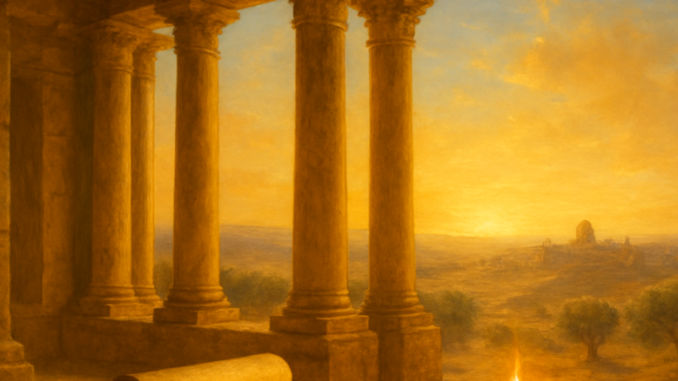
When an ancient prophet raises his fists toward the heavens and demands to know why evil goes unpunished, he touches something deeply universal. The Book of Habakkuk is not a triumphant hymn of praise — it is a struggle, a conversation with the unknown. For the religious reader, a man speaks to his God. For the Freemason, an echo resounds of the eternal quest for light amid darkness. Two perspectives, one fundamental question: how do we live with uncertainty?
The Prophet as Doubter
Habakkuk occupies a unique place among the prophetic books of the Bible. Where most prophets speak on behalf of the divine to the people, Habakkuk reverses the direction entirely. He speaks to the divine on behalf of himself — and in doing so, on behalf of every person who has ever wrestled with injustice. His opening question is raw and unvarnished: why must I witness violence? Why do you make me look upon destruction? This is no rhetorical device. It is genuine anguish.
For the traditional reader of scripture, Habakkuk represents the believer who grows through doubt into deeper trust. The prophet eventually receives a vision — an answer that urges him to wait and to have faith. The celebrated verse “the righteous shall live by his faith” is born out of this very dialogue. It is a message of steadfastness in the midst of chaos, a call to endure when certainty crumbles.
The Seeker as Builder
Viewed from the perspective of Freemasonry, Habakkuk resonates on a different frequency. The lodge is not a place where ready-made answers are handed out. Quite the opposite — Freemasonry invites its members to ask questions, to endure not-knowing, and to build inner understanding stone by stone. Habakkuk’s struggle is immediately recognizable in this context: it is the struggle of anyone who refuses to settle for superficial certainties.
The watchtower upon which Habakkuk takes his position to await an answer becomes a powerful symbol in this reading. It represents the stance of the vigilant seeker — elevated above the daily tumult, gazing toward the horizon where light will eventually break through. Freemasonry is rich with comparable imagery: the rough ashlar that must be shaped, the winding staircase that leads to higher insight, the light that rises in the East.
Two Worlds, One Theme
What these two perspectives share is a profound recognition: wisdom does not begin with certainty, but with the honest acknowledgment of uncertainty. The religious reader finds in Habakkuk a model for prayer during difficult times. The Freemason recognizes a kindred spirit in the search for moral clarity when the world seems impenetrable and confused.
“Though the fig tree does not bud and there are no grapes on the vines, yet I will rejoice in the Lord.”
This verse from the third chapter reveals the transformation Habakkuk undergoes. It is not blind optimism, but a deliberate choice to trust despite circumstances. For the religious tradition, this is faith in divine providence. For the Freemason, it can be read as confidence in the inner strength to keep building — even when the results of one’s labor remain invisible.
The Symbolism of Watching and Waiting
Habakkuk’s watchtower deserves closer attention. In ancient times, the watchman on the tower was the first to see approaching danger or the coming dawn. He stood between night and day, between fear and hope. This liminal position — poised on the boundary between two worlds — is precisely where the deepest insights are born.
Freemasonry contains ritual moments that mirror this experience: transitions from darkness to light, from ignorance to knowledge, from the profane to the sacred. These transitions are never abrupt. They require preparation, patience, and a willingness to dwell in uncertainty. Habakkuk on his tower embodies this very attitude — not passive waiting, but active watching. He is alert, receptive, and open to what the horizon might reveal.
What Habakkuk Can Teach Us
The lessons of Habakkuk transcend religious boundaries. Whether one believes in a personal God, in a cosmic order, or in the transformative power of human brotherhood, the message remains profoundly relevant. Doubt is not weakness — it is a beginning. Asking questions is not a lack of faith — it is a sign of intellectual and spiritual courage.
Consider these enduring principles that emerge from Habakkuk’s story: the courage to ask when answers are not forthcoming; the patience to wait for insight that cannot be forced; the strength to keep building without any guarantee of success; and the trust that the search itself holds value, regardless of the destination.
Both the believer and the Freemason can find a mirror in Habakkuk. One sees a prophet who arrives at deeper faith through trials. The other sees a seeker who grows toward clearer understanding through doubt. Both readings are worthy. Both carry truth. And perhaps that is the greatest lesson of all — that wisdom refuses to be confined within a single perspective.
Habakkuk invites us not to hide our doubts, but to honor them as the beginning of deeper understanding. The prophet who questions and the Freemason who seeks have far more in common than their differences might suggest. Both stand upon their own watchtower, gazing toward the horizon, waiting for the light that is to come. And perhaps the waiting itself — that courageous act of dwelling in the unknown — is already a form of answer.
Copyright text & image: devrijmetselaar.nl
Texts are based on the ideas and content of the author of devrijmetselaar.nl, reviewed, corrected, and supplemented with the assistance of OpenAI. Images are created based on the ideas of the author of devrijmetselaar.nl using OpenAI/DALL-E.
Frequently Asked Questions
What is the connection between the Prophet Habakkuk and Freemasonry?
Both Habakkuk and Freemasonry embrace the journey of seeking truth through doubt and questioning rather than accepting easy answers. The prophet's struggle to understand injustice mirrors the Freemason's quest for light and inner understanding, where members build knowledge stone by stone through genuine inquiry and reflection.
Why do Freemasons find Habakkuk's story meaningful?
Habakkuk's position as a vigilant seeker in his watchtower resonates with Freemasonry's rich symbolism of enlightenment—from the rough ashlar being shaped to perfection, to the winding staircase leading to higher insight, to the light rising in the East. His refusal to settle for superficial certainties embodies the Masonic invitation to ask meaningful questions and endure the process of discovery.
How does Habakkuk's faith develop through his doubts?
Rather than beginning with certainty, Habakkuk honestly acknowledges his uncertainty and wrestles with injustice through dialogue with the divine. His transformation culminates in choosing to trust and rejoice despite difficult circumstances—a deliberate faith that Freemasons recognize as the wisdom born from genuine seeking and the willingness to question.
What does the watchtower symbol represent in Freemasonry?
In Freemasonry, Habakkuk's watchtower represents the stance of the vigilant seeker—elevated above daily confusion and positioned to perceive truth and light on the horizon. It symbolizes the Masonic principle of maintaining moral clarity and spiritual awareness while waiting patiently for deeper understanding to emerge.
Does Freemasonry provide ready-made answers to life's questions?
No, Freemasonry invites members to ask questions and build understanding through personal reflection and experience rather than handing out predetermined answers. Like Habakkuk's journey, the Masonic path honors the seeker's struggle and recognizes that true wisdom emerges from honest inquiry and steadfast commitment to personal growth.

Be the first to comment