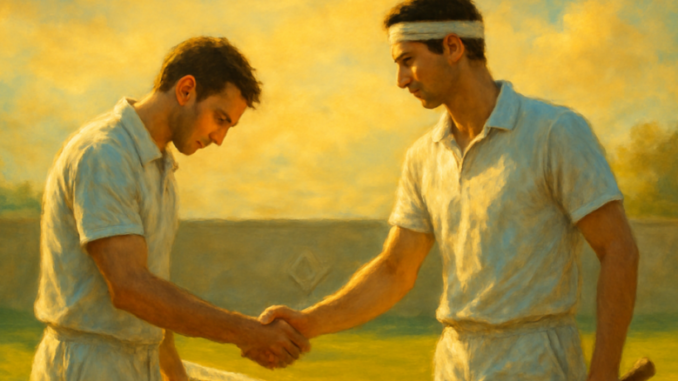
Picture the scene: two men stand facing each other on the sacred grass of one of the world’s most famous tennis tournaments. One celebrates; the other bows his head. But what happens in that quiet moment at the net, when they shake hands? Is it mere formality, or does something deeper reside in that gesture? It’s worth asking what these sporting moments can teach us about a concept Freemasons have cherished for centuries: brotherhood.
Why Does That Moment at the Net Move Us So Deeply?
There is something extraordinary about the instant two opponents look each other in the eye after everything has been said and done. One has won. The other has lost. And yet they reach out and shake hands. Why does this touch so many viewers? Perhaps because we recognise something in it that goes beyond competition. We see two people who, despite their battle, acknowledge each other as equals. That is precisely what brotherhood means: the recognition that you stand before a fellow human being, not merely a rival.
In Freemasonry, we often speak of meeting our Brethren “on the level.” Regardless of rank, background, or achievement, we stand as equals before one another. The tennis court is, in a sense, a similarly levelled space. It doesn’t matter how many titles you’ve won before. In that moment, only the game matters — and afterward, the human connection.
Is Brotherhood Only for Winners?
It’s an understandable question. We live in a world that celebrates success and prefers to forget loss as quickly as possible. But it is precisely in losing that the true nature of brotherhood reveals itself. Who can lose with dignity, and who can win without arrogance? Freemasonry teaches that every Brother is sometimes the apprentice and sometimes the master. Today you stand in the light; tomorrow it may be someone else. This rotation of roles is not a weakness — it is the essence of a living community.
True greatness is not revealed in victory, but in the way you treat the one who has lost.
When a tennis player congratulates the winner after a defeat — without resentment, without bitterness — we witness something rare. We see someone who understands that the game is bigger than any single individual. This is a lesson taught within the Lodge as well: the whole is more important than any one person, and yet every individual is fully respected.
How Do Struggle and Connection Coexist?
This is perhaps the most intriguing question. Can we compete and yet remain connected? In the outside world, competition often seems like the opposite of cooperation. But in reality, the two can go hand in hand. Two tennis players make each other better. Without an opponent, there is no match, no growth, no challenge. The other person is not your enemy — they are your mirror.
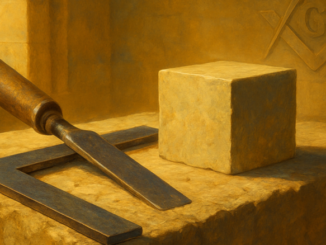
In Masonic circles, we are familiar with the concept of the “rough ashlar” — the unfinished stone that must be shaped and refined. That shaping does not happen in isolation. It happens through contact with others. Sometimes it chafes. Sometimes it hurts. But from that friction emerge form, character, and depth. The opponent across the court is, in this sense, a Brother in disguise: someone who helps you become who you are capable of being.
What Can We Take Away from This Sporting Spectacle?
Let’s be honest: not everyone watching tennis is thinking about philosophical lessons — nor should they be. But for those willing to look, there is much to discover. The tension of the match, the emotion of winning and losing, and then that moment of human connection — these are all mirrors of life itself.
Brotherhood asks us to recognise the other as an equal, even in competition. Losing with dignity is just as important as winning with humility. The opponent is not an enemy but a mirror that helps you grow. And the moment at the net is a ritual of mutual respect.
In Freemasonry, every meeting concludes with a Brotherly chain. We stand in a circle, hand in hand, and realise that together we are more than we could ever be alone. That chain is not so different from the handshake at the net. It is a gesture that says: we have experienced this together, and that binds us.
Is This Too Romantic a View?
Perhaps. The reality of professional sport is harsh, and not every handshake is sincere. There are disappointments, disputes, and bruised egos. But that is precisely why the ideal of brotherhood is so valuable. It is not a description of how the world is — it is a compass for how we might treat one another. An aspiration, not a destination.
Freemasonry does not claim that its members are perfect. On the contrary: we acknowledge our imperfections and work on them together. Every match, every encounter, every setback is an opportunity to practise that brotherly attitude. Not because it is easy, but because it is worth the effort.
As one player celebrates and the other walks off the court, one moment lingers: the handshake, the look, the silent acknowledgment. It is a reminder that behind every competition lies a deeper truth. We are all travellers on the same path — sometimes facing each other, but ultimately walking side by side. That is the essence of brotherhood, on the tennis court and far beyond it.
Copyright text & image: devrijmetselaar.nl
Texts are based on the ideas and content of the author of devrijmetselaar.nl, reviewed, corrected, and supplemented with the assistance of OpenAI. Images are created based on the ideas of the author of devrijmetselaar.nl using OpenAI/DALL-E.
Frequently Asked Questions
What does Freemasonry mean by meeting 'on the level'?
Meeting 'on the level' means that all Masons stand as equals before one another, regardless of rank, background, or achievement in the outside world. This principle reflects the idea that every person has inherent worth and dignity, and that true brotherhood transcends social distinctions. Just as tennis players acknowledge each other as equals after a match, Freemasons recognize the fundamental humanity and equality of every Brother.
Does Freemasonry only value winners and success?
No, Freemasonry teaches that true greatness is revealed not in victory alone, but in how one conducts oneself during both triumph and defeat. The fraternity recognizes that every member takes on different roles—sometimes as apprentice, sometimes as master—and that dignity in loss is just as important as humility in victory. This philosophy helps create a community where all members support one another through both successes and challenges.
How can competition and brotherhood exist together in Freemasonry?
In Freemasonry, friendly competition and mutual support work hand in hand rather than against each other. Just as tennis opponents make each other better through their match, Masons understand that engaging with one another—even in disagreement—helps refine and strengthen the entire community. The concept of the 'rough ashlar' teaches that personal growth happens through contact and interaction with others, making connection essential to development.
What can the handshake at the tennis net teach us about Masonic values?
The handshake between opponents represents the recognition of shared humanity and mutual respect that transcends competition, which is at the heart of Masonic brotherhood. That gesture embodies the principle that despite conflict or difference, there is a deeper connection that unites all people. Freemasonry celebrates such moments because they demonstrate that true brotherhood means acknowledging your fellow human being as an equal, regardless of circumstance.

Be the first to comment