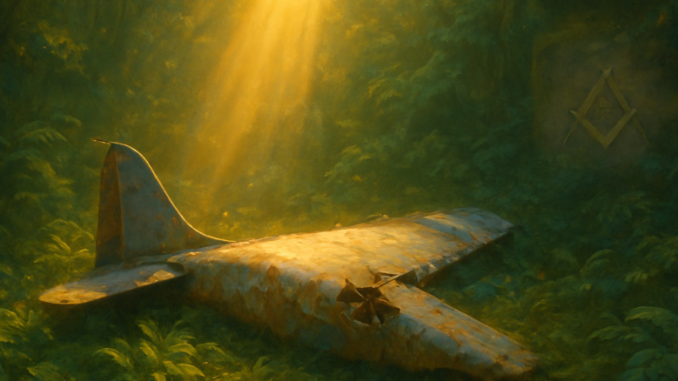
A plane crashes in the jungle. A life ends far from home. A message echoes across borders — designed to shock, to warn, to force the world to listen. When violence becomes a means of communication, society faces a fundamental question: how do we respond to messages written in blood? This is not a question reserved for diplomats and strategists. It strikes at the very heart of what it means to be human in a world of broken connections.
The Airplane as a Symbol of Connection
An airplane is more than a mode of transport. Symbolically, it represents the deeply human urge to bridge distances, to connect what has been separated. The pilot at the controls embodies the role of a connector between worlds that might otherwise never touch. When such a plane is brought down, it is not merely a machine that is destroyed — a symbol is struck.
In Freemasonry, connection plays a central role. The lodge is, by its very nature, a place where people of different backgrounds, professions, and convictions come together. Not despite their differences, but precisely because those differences offer valuable perspectives. The Mason builds bridges, not walls. He seeks what unites people, not what divides them.
Violence as Language: When Words Fail
When a group uses violence as a message to other nations, it speaks of a profound failure. Not only of those who commit the violence, but of the entire chain of human interaction that preceded the moment. Somewhere along the way, conversations stopped. Ears closed. Hands that could have been extended in greeting were clenched into fists.
Every violent act is both a cry from someone who was not heard and a choice that creates new deafness.
This is not a justification of violence. It is an attempt to understand the dynamics that lead to it. In the Masonic tradition, great value is placed on the ability to listen before speaking, to understand before judging. This is not a passive stance — it is an active discipline. It requires us to temporarily set aside our own certainties in order to truly hear what the other is trying to say.
The Stone That Does Not Fit
In Masonic symbolism, the rough ashlar represents a person at the beginning of their inner journey. Through labor, reflection, and brotherhood, this stone is gradually polished until it fits within the greater structure. But what happens with stones that seem not to fit? Those whose shape or hardness appears to make them incompatible with the whole?
The temptation is great to push such stones aside, to ignore them or break them. Yet the wisdom of the builder teaches us that every stone has a place — provided the builder is willing to search for where that place is. Sometimes it requires a different design. Sometimes it demands a patience that spans generations.
The rough ashlar asks for patience, not rejection. Conflict reveals where the structure remains unfinished. The Master Builder seeks connection, not exclusion.
Society as an Unfinished Temple
Freemasons speak of building an inner temple, but also of building a temple of humanity. This is not a physical edifice but an ideal — a society in which justice, brotherhood, and truth form the foundations. It is a structure that is never completed, because each generation must decide anew whether it will contribute to the building or tear it down.
When we are confronted with reports of violence in distant places, the first impulse is often to create distance. It happened in a jungle, far from our doorstep, in a conflict we do not understand. Yet this distance is an illusion. In a world made smaller by technology and trade, every conflict ultimately touches us all. The pilot who crashed may have been carrying food or medicine. The rebels who pulled the trigger carry grievances that stretch back decades or centuries.
Understanding as a Building Block
What can we, as individuals far removed from this violence, contribute? Freemasonry offers a modest but meaningful answer: begin with yourself. Examine your own prejudices. Ask yourself whose voices you are ignoring in your own life. Practice the ability to tolerate complexity without rushing to judgment.
This is not naive pacifism. It is the recognition that lasting peace cannot be imposed — it must be built. Stone by stone, conversation by conversation, generation after generation. The message delivered through violence demands a response that goes deeper than retaliatory force or indifferent detachment.
In the silence of contemplation, in honest conversation with our fellow human beings, in the willingness to listen to voices we would rather ignore — there the builder’s work begins. Not because it is easy, but because it is necessary. The temple of humanity calls for Masons who do not flee from the most difficult stones.
A plane crashing in a distant jungle confronts us with questions that have no easy answers. Yet hidden within that discomfort is an invitation — the invitation not to look away, but to look with the eyes of someone who seeks to understand. Not to condone what is evil, but to comprehend its roots. In that search we may not find the solution, but we find the beginning of a path toward a society that learns to transform its conflicts into conversations, and to write its messages in words rather than in blood.
Copyright text & image: devrijmetselaar.nl
Texts are based on the ideas and content of the author of devrijmetselaar.nl, reviewed, corrected, and supplemented with the assistance of OpenAI. Images are created based on the ideas of the author of devrijmetselaar.nl using OpenAI/DALL-E.
Frequently Asked Questions
What does Freemasonry teach about resolving conflicts between different groups?
Freemasonry emphasizes the importance of listening, understanding, and seeking common ground before judgment. The fraternity teaches that people of different backgrounds and convictions can come together in the lodge to build bridges rather than walls, valuing the perspectives that diversity brings to find what unites rather than divides humanity.
How does Freemasonry view people who seem difficult to integrate into society?
Masonic symbolism teaches that every person, like the rough ashlar stone, has inherent value and a place within the greater structure of society. Rather than rejecting those who seem incompatible, the Masonic tradition encourages patience, reflection, and a willingness to search for where everyone can fit, even if it requires different approaches and generational patience.
Why does Freemasonry place such emphasis on communication and understanding?
Freemasonry recognizes that when communication breaks down and people stop listening to one another, conflict and violence can follow. The fraternity teaches active listening and the discipline of temporarily setting aside our own certainties to truly hear others, believing this is essential for building a functioning society and preventing misunderstanding.
What is the Masonic view on society's current state and future?
Freemasonry views society as an unfinished temple that is still being built. Conflicts and challenges reveal where the structure remains incomplete, and Masons believe that by acting as Master Builders—seeking connection and understanding rather than exclusion—we can continue the work of creating a more united and harmonious world.

Be the first to comment