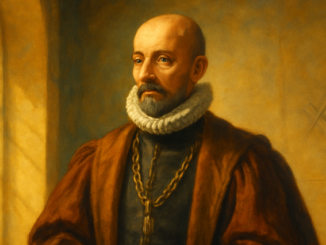
Symbolic bridge representing Masonic connection and Montaigne's philosophy
Michel de Montaigne – Freemasonry & Connection

Montaigne on Ambassadors: The Art of Connection in Masonry

When Michel de Montaigne wrote about diplomats and their conduct in the sixteenth century, he touched on something universal: the art of building connections. How do you convey a message without distorting it? How do you serve as an intermediary without letting your own interests take over? These questions, posed amid political intrigue and religious conflict, find a surprising echo in Freemasonry — a tradition equally concerned with how human beings can connect with one another and with higher values. The Ambassador as a Mirror of Humanity In his brief but incisive essay, Montaigne examines the behavior of ambassadors who interpret their instructions either too literally or too freely. Some cling rigidly to their orders, even when circumstances clearly call for adaptation. Others take so much liberty that they cease to serve their master and begin pursuing their own agenda. Montaigne seeks the middle path: an ambassador must exercise judgment, but always within the boundaries of his commission. This dilemma is timeless. Anyone who carries a message — whether as a diplomat, a friend, or a member of a community — faces the same challenge. How do you remain faithful to the essence of what you are communicating, while also […]

Open book with quill pen symbolizing Montaigne's philosophical essays
Michel de Montaigne – Philosophical Background

Montaigne on Ambassadors: Philosophical Roots of Diplomacy

A letter arrives. A messenger awaits instructions. A prince must decide how much freedom to grant his envoy. What appears to be a straightforward question about diplomatic communication conceals a far deeper philosophical inquiry — one that captivated Michel de Montaigne: how much trust does a person deserve, and where lies the boundary between obedience and independent judgment? The philosophical traditions that shaped Montaigne’s thinking, from Stoicism to Renaissance humanism, cast a remarkable light on this sixteenth essay from his first book. The Stoic Undercurrent When Montaigne writes about the conduct of ambassadors, the voice of Seneca resonates unmistakably through the text. The Roman philosopher, whose letters to Lucilius Montaigne had studied so thoroughly, constantly emphasized the importance of practical wisdom over blind adherence to rules. Seneca warned that those who merely carry out orders without understanding are not truly acting — they are merely moving. This idea saturates Montaigne’s analysis of the envoy who must choose between the literal wording of his instructions and the spirit of his mission. Stoicism taught that the wise person judges situations by their true nature, not by their outward appearance. Marcus Aurelius wrote in his personal meditations that one should ask of every […]

Montaigne essay on envoys and the Masonic balance of obedience and judgment
Michel de Montaigne – Content & Summary

Montaigne on Envoys: When Obedience Falls Short

What happens when a messenger carries out his orders to the letter, without stopping to consider whether circumstances have changed? Michel de Montaigne poses this question in his brief but provocative essay ‘On the Custom of Some Ambassadors.’ His answer touches on a fundamental tension that resonates deeply within Freemasonry: the balance between obedience and personal judgment. What Is This Essay Really About? In the sixteenth essay of Book One of his Essays, Montaigne examines the role of envoys and ambassadors in diplomatic missions. Though it is one of his shorter reflections, the central question is far from simple. Montaigne asks to what extent an envoy has the right — or even the duty — to deviate from his literal instructions when the situation demands it. Should a messenger obey blindly, or should he use his own insight to better serve the intentions of the one who sent him? The essay was written in an age when diplomacy was a perilous affair. Communication was slow, decisions often had to be made on the spot, and a single miscalculation could mean the difference between war and peace. Montaigne knew this world from the inside. As a former mayor of Bordeaux and […]

Stone carving tools on a rough ashlar symbolizing Masonic courage and growth
Michel de Montaigne – Freemasonry & Connection

Montaigne on Cowardice: Courage as a Masonic Virtue

Imagine standing at a crossroads in life where the easy path beckons, but your conscience pulls you in the opposite direction. Michel de Montaigne explored this very tension in his fifteenth essay, which examines the punishment of cowardice. At first glance, it appears to be a military treatise, but look closer and it strikes at the heart of what it means to live a virtuous life. For Freemasons, this essay resonates with particular force — courage and personal accountability are pillars of the Craft. What Montaigne Teaches Us About Cowardice In his short but powerful essay, Michel de Montaigne wrestles with a provocative question: should cowardice on the battlefield be punished by death, or is the disgrace itself punishment enough? He points to the Roman practice of publicly humiliating cowards rather than executing them. Soldiers who fled from battle were forced to walk through the camp dressed in women’s clothing for days on end — a spectacle designed to shame rather than destroy. Montaigne argues that executing someone for cowardice is fundamentally paradoxical. You cannot punish a lack of courage by killing the person, because death eliminates any possibility of redemption or improvement. This is classic Montaigne: he avoids absolute […]

Rough ashlar and chisel symbolizing Montaigne's philosophy of courage and virtue
Michel de Montaigne – Philosophical Background

Montaigne on Cowardice: Philosophical Roots of Courage

When Michel de Montaigne wrote his fifteenth essay on the punishment of cowardice, he touched upon a question that has occupied philosophers for centuries. What makes cowardice such a grievous vice that some societies punished it with death? To truly understand Montaigne’s reflections, we must descend into the philosophical wellsprings from which he drew: the Stoics, the Greek moral philosophers, and the humanist tradition of his own era. In exploring the intellectual background of his thought, we discover not only the roots of his argument but also why these questions still resonate deeply within any brotherhood that places virtue at its center. The Stoic Legacy: Courage as a Cardinal Virtue Montaigne’s thinking about cowardice and courage is deeply rooted in the Stoic tradition. Seneca, whom he read extensively and quoted often, regarded courage as one of the four cardinal virtues — inseparably linked to wisdom, justice, and temperance. For the Stoics, cowardice was not merely a lack of physical bravery; it was a fundamental disturbance of the soul. To flee from danger was ultimately to flee from oneself. Marcus Aurelius wrote in his Meditations that a person must align his actions with nature and reason. From that perspective, cowardice was […]

Open book of Montaigne's Essays symbolising courage and moral reflection
Michel de Montaigne – Content & Summary

Montaigne on Cowardice: Courage as a Practical Virtue

Imagine walking away at the very moment your presence matters most. Not because you are weak, but because fear has overpowered your will. In his fifteenth essay, Michel de Montaigne posed an uncomfortable question: does flight deserve punishment, or is cowardice already its own punishment? Written in the sixteenth century, this brief but penetrating essay remains strikingly relevant for anyone who reflects on courage, character, and the choices we make under pressure. The Heart of the Essay In ‘On the Punishment of Cowardice,’ Montaigne examines a practical moral question: how should society deal with soldiers who flee out of fear? He describes how, in his own time, cowardice on the battlefield was often punished by death. Yet he wonders whether such punishment is truly just. Can a person be punished for something that seems to lie beyond his control? Montaigne draws a crucial distinction. There is a difference between someone who deliberately abandons his post and someone who is overwhelmed by blind panic. The first acts out of free will; the second is a victim of his own nature. This distinction has direct consequences for how we think about responsibility and character — not only in warfare, but in every […]

Open book of Montaigne's Essays beside Masonic square and compasses
Michel de Montaigne – Freemasonry & Connection

Montaigne on Good and Evil: A Masonic Perspective

Two people witness the same event. One sees a disaster; the other sees an opportunity. Michel de Montaigne wrote about this very phenomenon in the sixteenth century, arguing that our perception of good and evil depends not on the facts themselves but on the opinions we hold about them. This idea touches on a fundamental question that also lies at the heart of Freemasonry: how do we arrive at moral judgment? And what connects the reflections of this French essayist to the search for light that Brethren have pursued for centuries? The World Through Montaigne’s Eyes Michel de Montaigne, the sixteenth-century French philosopher and writer, opens his essay with a simple but profound thesis: nothing is inherently good or evil. It is our mind that assigns value to the things around us. Banishment, which one person experiences as punishment, is embraced by another as liberation. Poverty drives some to despair, while others find genuine freedom in a life without possessions. Montaigne drew heavily on the Stoic tradition, particularly the works of Epictetus and Seneca. But he went further than his predecessors by weaving this philosophy into personal experience and concrete examples from his own time. His approach was never abstract […]

Open book with Montaigne essays beside Masonic rough ashlar and square symbol
Michel de Montaigne – Philosophical Background

Montaigne on Good and Evil: Philosophical Roots of Essay 14

Imagine waking up tomorrow under exactly the same circumstances as yesterday, yet suddenly feeling happier. Nothing in the outside world has changed — only the way you look at it. This simple thought experiment strikes at the heart of what Michel de Montaigne explores in his fourteenth essay. But where did this sixteenth-century thinker draw his ideas from? The philosophical sources he tapped into turn out to be remarkably relevant today, shedding light on how Freemasons, too, think about moral truth and personal perception. The Stoic Legacy in Montaigne’s Thought When you read Montaigne’s essay, you immediately taste the influence of Stoic philosophy. Thinkers like Seneca, Epictetus, and Marcus Aurelius shared a central conviction: it is not events themselves that determine our well-being, but our judgments about those events. Montaigne, who frequently quoted and admired Seneca, adopted this starting point and gave it his own distinctive twist. He observed how people experienced the same adversity in completely different ways, depending on their inner disposition. The Stoics drew a clear line between what lies within our control and what does not. You cannot command the weather, but you can choose how you respond to it. Montaigne applied this principle to the […]

Open book of Montaigne's Essays with Masonic rough ashlar and square symbolism
Michel de Montaigne – Content & Summary

Montaigne on Good and Evil: The Power of Our Judgment

What if pain is not an objective evil, but merely what we make of it? In his fourteenth essay from the first book of the Essays, Michel de Montaigne examines a bold proposition: our perception of good and evil does not depend on things themselves, but on the judgments we form about them. Rooted in the Stoic philosophy of thinkers like Epictetus and Marcus Aurelius, this insight strikes at the very heart of human freedom. If we can truly become masters of our own judgments, a path opens toward inner peace — even in the midst of turmoil. The Core Idea of the Essay Montaigne opens this essay with a reference to a classical dictum he attributes to Epictetus: it is not things that disturb us, but our judgments about those things. This thought forms the backbone of the entire argument. Montaigne explores how the very same event can be experienced in completely different ways by different people. What is unbearable suffering for one person turns out to be a challenge — or even a source of pride — for another. The question then arises: where does evil truly reside? In the event itself, or in the lens through which […]

Rough ashlar and working tools symbolizing Masonic self-improvement and compassion
Michel de Montaigne – Freemasonry & Connection

Montaigne on Cruelty: How Compassion Makes You a Better Man

You’re stuck in traffic when someone cuts you off, and irritation flares instantly. At work, a colleague dismisses your idea, and your thoughts drift toward resentment. These are small moments, but they reveal something larger: how quickly we harden ourselves against others. Michel de Montaigne addressed this very mechanism in the sixteenth century in his essay “Of Cruelty.” His conclusion? Cruelty is not a sign of strength — it is a sign of weakness. And compassion is not softness — it is the highest form of human civilization. For Freemasons, who dedicate themselves to moral refinement and brotherhood, Montaigne holds up a practical mirror: how gentle are we, really, in our daily conduct? What Montaigne Teaches Us About Cruelty In his essay, Michel de Montaigne examines why human beings are cruel — not only to one another, but also to animals. He observes that cruelty often grows from habit and indifference. Once a person becomes accustomed to inflicting pain, he argues, the capacity for empathy gradually erodes. This is not some abstract philosophical puzzle. It speaks directly to how we treat colleagues, family members, strangers on the street, and even ourselves. Montaigne notes that hunters who kill animals without hesitation […]

Portrait of Michel de Montaigne with philosophical texts on cruelty
Michel de Montaigne – Philosophical Background

Montaigne and the Law of Cruelty: Philosophical Roots

You have almost certainly experienced it: someone treats another person with unnecessary harshness, and somewhere deep inside you sense that something is fundamentally wrong. Michel de Montaigne, the sixteenth-century French thinker, wrestled with exactly this question. In his essay on cruelty, he digs into the philosophical roots of human violence and compassion. Which thinkers shaped his views? And more importantly — what can those insights still offer us today, particularly as Freemasons committed to the moral improvement of ourselves and society? The Stoic Legacy: Seneca as Teacher When Montaigne writes about cruelty, the voice of Seneca resonates throughout. The Roman philosopher, who lived from 4 BC to 65 AD, regarded cruelty as the very opposite of humanity. For Seneca, brutality was not merely a moral misstep — it was a fundamental assault on human dignity. He championed clementia, a form of mercy that springs from inner strength rather than weakness. Montaigne adopted this idea and applied it to his own turbulent era. Where Seneca wrote amidst the spectacle of Roman gladiatorial games, Montaigne observed the Wars of Religion tearing France apart. Both men witnessed how violence became entertainment, how crowds took pleasure in the suffering of others. The Stoic lesson […]

Rough ashlar stone symbolizing self-improvement through compassion in Freemasonry
Michel de Montaigne – Content & Summary

Montaigne on Cruelty: Why Compassion Makes Us Truly Human

Imagine witnessing needless suffering inflicted by someone who takes pleasure in it. You feel an instinctive revulsion — perhaps even physical disgust. Michel de Montaigne knew that feeling intimately. In his essay “Of Cruelty,” he explores why cruelty repels him so deeply and what this reveals about our shared human nature. More than four centuries later, his reflections still cut to the heart of fundamental questions about compassion, character, and how we treat other living beings — questions that resonate powerfully within the traditions of Freemasonry. Cruelty as the Deepest Vice For Montaigne, cruelty is not simply one vice among many — it is the worst of them all. While other failings spring from weakness, ignorance, or uncontrolled passion, cruelty stems from a deliberate choice to inflict suffering with no purpose beyond the suffering itself. It represents a perversion of human nature that filled Montaigne with genuine horror. Montaigne writes with striking candor about his own sensitivity. He cannot bear to watch a chicken having its neck wrung, and the death cry of a hare caught by his hounds causes him genuine distress. But this is not weakness, he argues. It is the sign of a sensitive soul that recognizes […]

Open book of Montaigne's essays beside Masonic square and compasses symbolizing reflection
Michel de Montaigne – Freemasonry & Connection

Montaigne and Connection: Steadfastness as a Bridge to Others

Picture yourself standing in a room full of strangers. Everyone is wearing a mask — not a literal one, but the invisible masks of social expectation. How often do you find yourself trying to impress rather than genuinely connect? In the sixteenth century, Michel de Montaigne wrote a penetrating essay on constancy that cuts straight to the heart of this question. His insights remain strikingly relevant for anyone reflecting on authentic human connection, and they resonate deeply with what Freemasons have pursued within their brotherhood for centuries. The Paradox of Unyielding Resolve In the twelfth essay of his first book, Montaigne examines what it truly means to be steadfast. He reveals how easily we confuse genuine inner stability with the outward appearance of immovability. That exterior can be deeply deceptive. Montaigne describes how people sometimes seem resolute out of pride or fear, while internally they are crumbling. True constancy, he argues, springs from self-knowledge and the acceptance of our human limitations. This distinction matters enormously for anyone thinking about connection with others. When you know and accept your own weaknesses, there is no need to perform. You can allow yourself to be vulnerable without losing your foundation. Montaigne saw this […]

Rough stone being shaped into a perfect ashlar symbolizing constancy
Michel de Montaigne – Philosophical Background

Montaigne on Constancy: The Philosophical Roots Revealed

A stone that stands unmoved while the storm rages around it. This image, as familiar in the builder’s craft as in philosophy, strikes at the heart of what Michel de Montaigne explores in the twelfth essay of his first book: human constancy. But which thinkers whispered those ideas into his ear? Which philosophical traditions formed the foundation upon which he built his reflections on steadfastness? The answers lie hidden in a rich intellectual heritage reaching back to antiquity. The Stoic Foundation When Montaigne writes about constancy, he is unmistakably walking through the colonnades of the Stoa. Stoic philosophy, founded by Zeno of Citium in the third century BC, placed the imperturbability of the human mind at its center. For the Stoics, true virtue lay in accepting what lies beyond our control while mastering our own reactions. This idea forms the backbone of Montaigne’s approach to the subject. Particularly influential was the work of Seneca, the Roman philosopher and statesman whose letters and essays Montaigne studied with great enthusiasm. Seneca’s De Constantia Sapientis (On the Constancy of the Wise Man) addresses precisely the theme Montaigne would later rework. The wise man, Seneca argued, cannot truly be insulted or harmed, for his […]

Montaigne essay on constancy and its connection to Masonic self-knowledge
Michel de Montaigne – Content & Summary

Montaigne on Constancy: What Essay 12 Teaches Us About Courage

Imagine standing at the threshold of a difficult decision. You feel the tension in your body, the doubt racing through your mind. How do you remain steadfast when circumstances seem to conspire against you? Michel de Montaigne wrestled with precisely this question when he wrote his twelfth essay. In ‘On Constancy,’ he examines what it truly means to be resolute — and why we should not be too quick to congratulate ourselves when we merely appear courageous. The Core Idea of the Essay In this brief but powerful essay, Montaigne poses a surprising question: is constancy really what we think it is? He argues that true constancy does not simply mean standing in the face of danger. What matters is how you respond inwardly to threat. You might appear brave as you stride toward a drawn sword, but if you are trembling with fear on the inside and only pressing forward out of shame, can that really be called courage? Montaigne draws a sharp distinction between outward behaviour and inner disposition. He observes that many people we regard as courageous actually act out of impulse, pride, or even ignorance of the danger they face. The true test of constancy lies […]

Open book with candle light symbolizing Montaigne and Masonic search for truth
Michel de Montaigne – Freemasonry & Connection

Montaigne on Prophecy and the Masonic Search for Truth

Imagine standing at a crossroads. To your left, someone whispers that the stars determine your fate. To your right, another promises that dreams reveal your future. And straight ahead lies a path with no signposts, illuminated only by your own inner light. Michel de Montaigne stood at precisely this crossroads centuries ago. His essay on prophecy is far more than a historical document — it is an invitation to reflect on how we relate to uncertainty, to truth, and to our own capacity to discern what truly matters. The Skepticism of a Searching Mind In his eleventh essay of the first book, Montaigne examines the phenomenon of prophecy with the curiosity that defines his entire body of work. He discusses divination, dream interpretation, and omens — not to condemn or embrace them, but to investigate. He quotes Cicero, who observed that out of a thousand predictions, perhaps two come true, and that people conveniently forget the failures. Montaigne wonders why humans are so eager to believe in a predetermined fate when daily experience teaches them, again and again, that the future refuses to be captured. This attitude of critical inquiry without prejudgment feels remarkably modern. Montaigne does not reject the […]

Open books and classical philosophy texts in a Renaissance tower library
Michel de Montaigne – Philosophical Background

Montaigne’s Philosophical Sources on Divination and Prophecy

Have you ever wondered why some people swear by horoscopes while others dismiss them without a second thought? That tension between belief in predictions and healthy skepticism is nothing new. In the sixteenth century, the French thinker Michel de Montaigne grappled with exactly the same questions — and he did so by drawing on a rich tradition of classical philosophy, from the Roman Stoics to the Greek skeptics. In this article, we explore the philosophical sources that fed Montaigne’s thinking when he wrote his famous essay on divination and prophecy. The Renaissance Humanist in His Tower Library Picture Montaigne in his celebrated tower study, surrounded by thousands of books lining the walls from floor to ceiling. Each volume bore his handwritten inscriptions and annotations. This was no mere decoration — it was a living dialogue with the past. As a true Renaissance humanist, Montaigne believed that the wisdom of the ancients remained profoundly relevant to his own age. He was no passive reader: he questioned, compared, and drew conclusions that often feel strikingly modern. The humanism of the Renaissance was characterized by a return to classical sources. Where medieval scholars had often worked through commentaries and summaries, the humanists read […]

Mosaic Pavement of black and white tiles symbolizing uncertainty and wisdom
Michel de Montaigne – Content & Summary

Montaigne on Predictions: The Wisdom of Uncertainty

In a dimly lit study, a man bends over a manuscript. Outside the wind howls, and somewhere in the distance an astrologer makes his calculations. The man at the desk smiles, sets his quill to paper, and writes: what can we truly know about tomorrow? Michel de Montaigne — the sixteenth-century philosopher who made himself the subject of his own study — turned his attention in his eleventh essay to a question that has haunted humanity for centuries: the value of predictions. The Heart of the Essay In this brief but provocative essay, Montaigne examines the deeply human desire to know the future. He poses a fundamental question: why are we so inclined to place our faith in predictions when the evidence for their reliability is so scarce? At its core, the essay explores the tension between our profound longing for certainty and the inescapable uncertainty of human existence. Montaigne opens with a characteristically sober observation: throughout the ages, people have devised all manner of methods to peer into the future. From studying the flight of birds to interpreting dreams, from reading entrails to casting astrological charts — every era has had its preferred forms of divination. But what, he […]

Open book of Montaigne's essays with Masonic symbols representing silence and wisdom
Michel de Montaigne – Freemasonry & Connection

Montaigne on Eloquence: The Masonic Art of the Right Word

In the sixteenth century, a French thinker penned a brief but striking essay on the art of speaking. His observations about eloquence and the speed with which people choose their words touch on something timeless. Centuries later, we can hear in his thoughts an echo of values that also stand at the heart of Freemasonry: the search for truth, the importance of self-reflection, and the understanding that true wisdom often resides in what we choose not to say. A Renaissance Thinker Speaks Michel de Montaigne lived from 1533 to 1592. After an active career in public life, he withdrew to his estate to write and to think. His collection of essays — written in an intensely personal, searching style — ranks among the most influential works in Western literature. In the tenth essay of his first book, he turned his attention to something seemingly simple: the way people speak. Some, he observed, speak quickly and rashly. Others weigh every word with care. Montaigne himself confessed to being one of the slower speakers, someone whose thoughts only reached full maturity after time had passed. This honest self-observation is characteristic of his method. He did not write to lecture others, but to […]

Open antique book with classical philosophical texts about rhetoric and speech
Michel de Montaigne – Philosophical Background

Montaigne and Rhetoric: Philosophical Roots of the Art of Speech

Why did a sixteenth-century French nobleman devote himself to writing about the art of speech? And perhaps more importantly, which thinkers were whispering in his ear as he put pen to paper? Michel de Montaigne was no isolated mind. He stood on the shoulders of ancient traditions — from Roman orators to Greek philosophers. In this article, we explore the philosophical sources that shaped his thinking on eloquence and the pace of speech, and consider why these ideas remain deeply relevant for those who value reflection, ritual, and the careful use of words. It Begins in the Library Where does such an inquiry begin? In the library, naturally. Montaigne’s famous tower room in his château in the Dordogne was lined with books. It was here that he read the classics, and here that he held conversations with the dead. His essay on eloquence and speed of speech did not emerge in a vacuum — it was born from a dialogue with centuries of rhetorical tradition. The question that presses itself upon us: which voices resonated most? Roman Rhetoric: Cicero and Quintilian as Living Companions To understand Montaigne’s thinking, we must return to the wellspring of Roman rhetoric. Cicero and Quintilian […]