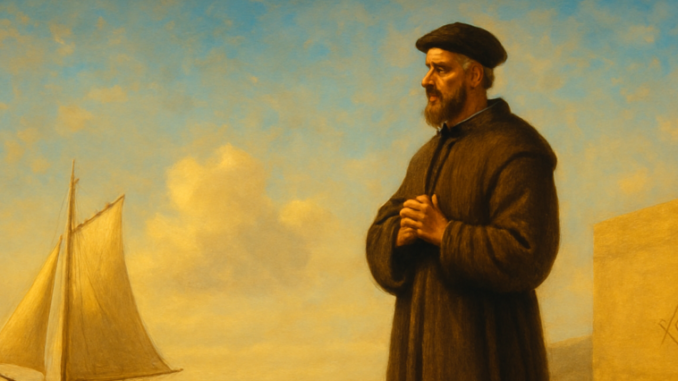
Picture this: you are sitting at a table in the evening, the second glass has been poured, and you notice your boundaries beginning to blur — not just physically, but morally. You say things better left unsaid. You make promises you will never keep. This scenario is universal and timeless. Michel de Montaigne wrote about it in the sixteenth century in his essay “On Drunkenness,” and he did so not merely from personal experience. He drew on a rich philosophical tradition that remains remarkably useful for anyone striving to live a conscious, examined life. This article traces those philosophical roots and shows how they can be applied today — including by those who walk the Masonic path.
The Stoic Call for Self-Mastery
The influence of Stoicism on Montaigne is unmistakable in this essay. Seneca, the Roman philosopher and statesman, wrote extensively about temperance and the dangers of unchecked pleasure. In his letters to Lucilius, Seneca warned that drunkenness is not merely a weakness — it is voluntary madness. That striking formulation echoes through Montaigne’s own text, where he emphasises that excessive drinking causes a person to lose himself entirely. For the Stoics, self-control was never an end in itself. It was a prerequisite for a virtuous life. Whoever surrenders his reason to wine also surrenders his capacity for moral action.
In practical terms, you can apply this Stoic principle directly. When you notice that a second or third glass is clouding your judgment, that is the moment to make a conscious choice: do I continue, or do I preserve my clarity? This choice is not rigidity — it is freedom. Seneca would say that the truly free person is the one who can restrain himself.
Plutarch and the Art of Table Conversation
Montaigne was an avid reader of Plutarch, the Greek writer and moral philosopher whose “Table Talk” served as a direct source for the essay on drunkenness. Plutarch did not treat drinking as reprehensible. He treated it as a social ritual with boundaries. He described how the Greeks used deliberate rules during their symposia: a toastmaster set the pace, and anyone who misbehaved was corrected by the group. The point was community and mutual respect, not abstinence.
Montaigne adopted this nuanced position. He did not condemn drunkenness outright but investigated when and why it becomes harmful. That distinction is surprisingly modern. For anyone who wants to make this practical: ask yourself at every social occasion the question Plutarch implicitly posed. Does my behaviour contribute to the conversation and the community, or does it undermine them? That single question can mark the difference between an evening of genuine connection and one of regret.
Skepticism: Knowing the Limits of Your Own Judgment
Montaigne is often regarded as the foremost representative of Renaissance skepticism, and that is nowhere more evident than in his essay on drunkenness. His famous motto “Que sçay-je?” — What do I know? — resonates powerfully here. He does not pass harsh judgment on drunkards. Instead, he asks questions. How reliable is our judgment in the first place? If we stray so often while sober, what does that say about the value we place on our sober reason?
This skeptical attitude, shaped by the Pyrrhonists and by Sextus Empiricus, does not lead to passivity. It leads to intellectual humility. You can practise this concretely: before pronouncing judgment on someone, ask yourself whether your perspective is truly complete. Do you see the full picture, or are you looking through a narrowed lens — perhaps clouded by fatigue, emotion, or indeed one glass too many?
From the Stoics, the Skeptics, and the Humanists, Montaigne learned that self-knowledge begins with an honest acknowledgment of your own vulnerability — not with condemning that of another.
Renaissance Humanism: The Human Being as a Work in Progress
The broader framework within which Montaigne wrote was that of Renaissance Humanism. Thinkers like Erasmus and Petrarch had paved the way for a view of humanity in which personal development was central. A person was not a fixed entity but a project — a rough block of stone that could be shaped and refined. Montaigne placed drunkenness within that framework: it was not an unforgivable sin but an opportunity for self-examination. Why do I drink? What am I seeking? Which version of myself appears when the brakes come off?
These questions will be instantly recognisable to Freemasons. The ethical tradition within Freemasonry revolves around precisely the same principle: the unceasing labour upon oneself. It is not about perfection but about the process of growing awareness. Aristotle, whom Montaigne also knew well, called this the pursuit of “eudaimonia” — a flourishing life achieved through virtuous action. Not an abstract ideal, but daily practice: at every juncture, choose the golden mean between excess and deficiency.
From Cato to Montaigne: Historical Examples as Mirrors
Montaigne laced his essay with historical anecdotes. He referred to Cato the Elder, who claimed that wine sharpens thought, and to Julius Caesar, who was known for his temperance. By placing these contrasting examples side by side, Montaigne avoided a one-sided moral verdict. He invited his reader to weigh and choose for himself — much as Plato, in his dialogues, let opposing viewpoints collide in order to lead the reader toward personal insight.
You can apply this principle today in any conversation or Lodge evening. When a topic comes to the table, consciously gather multiple perspectives before you take a position. Montaigne demonstrated that wisdom does not lie in having the right answer but in asking the right questions.
Three Concrete Steps for Daily Practice
First, practise the Stoic pause. With every impulse — whether it is reaching for another glass or making a hasty remark — take five conscious seconds before you act. That brief interval restores your agency and prevents reactive behaviour from taking over.
Second, apply the Plutarchian test at social gatherings. Before speaking or acting, ask yourself: does this contribute to the fellowship and the quality of the conversation, or does it diminish them? This simple check connects your personal conduct to the well-being of the group — a principle at the very heart of Masonic practice.
Third, embrace Montaigne’s skeptical humility. Before judging others, examine the limits of your own perception. Recognise that your view may be partial, coloured by mood, tiredness, or circumstance. This habit of honest self-scrutiny is the beginning of genuine self-knowledge — the rough ashlar slowly becoming smooth.
Montaigne’s essay on drunkenness is far more than a historical curiosity. It is a living dialogue with Stoic discipline, Plutarchian community ethics, Skeptical humility, and Humanist faith in personal growth. Each of these philosophical strands offers tools that remain sharp and usable centuries later. For Freemasons especially, the resonance is striking: the commitment to self-improvement, the respect for the gathered community, and the courage to question one’s own certainties are not merely philosophical ideals — they are the daily work of the Craft. The next time you sit at a table with a glass before you, remember Montaigne’s quiet challenge: not to judge, but to understand; not to abstain from life, but to engage with it fully and consciously.
Copyright text & image: devrijmetselaar.nl
Texts are based on the ideas and content of the author of devrijmetselaar.nl, reviewed, corrected, and supplemented with the assistance of OpenAI. Images are created based on the ideas of the author of devrijmetselaar.nl using OpenAI/DALL-E.

Be the first to comment