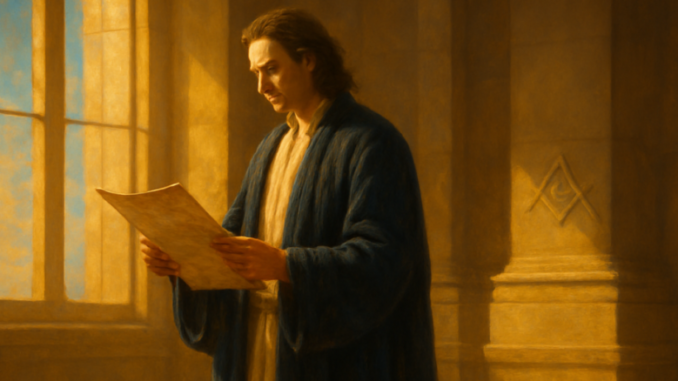
You’ve read Dan Brown’s Origin, or at the very least you’ve heard someone rave about it. A brilliant futurologist claims to have answered humanity’s two greatest questions: where do we come from, and where are we going? It sounds spectacular. But if you’re a Freemason yourself — or you’ve spent time studying the Craft’s actual traditions — something doesn’t quite add up. This article draws a clear line between the fiction Dan Brown weaves around Freemasonry and the way the real Brotherhood thinks and operates.
What Does the Character Edmond Kirsch Actually Claim?
In Origin, Dan Brown introduces the fictional character Edmond Kirsch — a tech genius who uses computer simulations to claim he has found the answer to the origin of life and the future destiny of humankind. The core of his discovery revolves around the idea that life can arise spontaneously from the laws of physics and chemistry, without the intervention of a creator. Kirsch presents this as definitive scientific proof that makes religion obsolete.
For many readers, this plotline creates the impression that organizations like Freemasonry sympathize with such conclusions, or that the Brotherhood is a secret society that elevates science above faith. That impression deserves careful correction, because it touches on one of the most persistent misconceptions about the Lodge.
The Misconception: Freemasonry as an Anti-Religious Project
Dan Brown is a master at weaving real organizations into fictional conspiracies. In Origin, the Palmarian Church serves as an antagonist, and secret societies seem to lurk in the background. The reader gets the sense that a war is being waged between faith and science, with Freemasons firmly on the side of science. But this picture does not match reality.
Freemasonry takes no official position on whether God exists, whether the universe has a creator, or whether science can replace religion. Within the Lodge, believers, agnostics, and freethinkers meet as equals. The only thing most regular Masonic traditions require is the acknowledgment of a Supreme Being — often called the Grand Architect of the Universe — a concept each Brother is free to interpret according to his own conscience. That is something fundamentally different from the position of Kirsch, who explicitly considers religion outdated.
Freemasonry does not fight religion, nor does it embrace science as a substitute faith. It offers a space in which every seeker may form his own answers, without the Brotherhood prescribing what those answers should be.
Where Do We Come From? The Question Inside the Lodge
The question of human origin is nothing new in Freemasonry. On the contrary: the rituals of the Craft constantly play with the themes of birth, death, and rebirth. The initiation ceremony can be understood as a ritual death and resurrection, inspired by ancient mystery schools. Plato wrote about the cave as a metaphor for ignorance, and Freemasonry uses strikingly similar imagery — the candidate enters the Lodge blindfolded and emerges into the light.
The difference from Kirsch is crucial. Where the fictional character presents a definitive, scientific answer, Freemasonry deliberately keeps the question open. The power of ritual lies not in providing answers but in asking better questions. Isaac Newton, himself deeply religious and at the same time a founding figure of modern science, embodied exactly that tension. There is historical evidence suggesting Newton was involved with societies closely related to early Freemasonry. For him, faith and science were not mutually exclusive.
Is Kirsch’s Discovery Scientifically Sound?
From a scientific perspective, it’s worth noting that the ideas Dan Brown incorporates into Origin are partly based on real theories. The concept that the laws of thermodynamics and entropy can spontaneously give rise to complex structures is a serious area of research. Consider the work on dissipative structures in chemistry, which earned a Nobel Prize in the 1970s. However, no serious scientist claims that the origin of life has been fully explained by these findings, let alone that religion is thereby rendered obsolete.
Dan Brown takes genuine scientific building blocks and constructs a fictional conclusion that goes far beyond what the science itself justifies. That is his right as a novelist, but it is not a reflection of scientific consensus.
What Can You Take Away From This as a Reader?
If you’ve read Origin and wonder what Freemasonry really thinks about its themes, here are some concrete insights you can apply right away:
Check claims against primary sources. Dan Brown writes novels, not history books. Enjoy the story, but verify facts about Freemasonry through reliable sources — such as the work of historians who have studied Anderson’s Constitutions of 1723.
Recognize the pattern. Across several of Brown’s books, secret societies are cast as keepers of hidden truths. In reality, Freemasonry is not a secret society but a private fraternity with publicly stated aims: personal growth, ethics, and charity.
Use the questions, not the answers. The power of both good literature and good Freemasonry lies in asking questions. Voltaire and Goethe, both connected to the Craft, emphasized the importance of thinking for yourself rather than blindly accepting someone else’s conclusions.
Respect the tension between faith and science. That tension is productive. The Lodge is one of the few places where it can exist without judgment. Carry that into your daily life: you don’t have to choose between wonder and knowledge.
Why Dan Brown Gets Freemasonry Wrong — and Why That’s Okay
Dan Brown is a storyteller, and a remarkably effective one. His novels have introduced millions of people to the existence of Freemasonry, the Illuminati, and other organizations they might never have encountered otherwise. The fact that his portrayal bends reality is simply part of the craft of fiction writing. A thriller needs tension, mystery, and high stakes — nuanced accuracy about Masonic principles doesn’t exactly make for a page-turner.
The real issue isn’t that Brown gets things wrong; it’s that readers sometimes mistake the fiction for fact. When Origin implies that Freemasonry leans toward atheism or harbors secret scientific agendas, it’s worth remembering that the actual Craft has spent centuries cultivating a space where the deepest questions of existence remain open — not to avoid answers, but to honor the search itself.
Dan Brown’s Origin is an entertaining novel that raises big questions about science, religion, and the future of humanity. But it is fiction — and the Freemasonry it gestures toward is a simplified, dramatized version of a far richer tradition. The real Brotherhood doesn’t claim to have the answers to where we come from or where we’re headed. Instead, it offers something arguably more valuable: a place where those questions can be explored honestly, respectfully, and without a predetermined conclusion. If Origin sparked your curiosity about the Craft, let that curiosity lead you to the actual sources. The truth, as always, is more nuanced — and more rewarding — than fiction.
Copyright text & image: devrijmetselaar.nl
Texts are based on the ideas and content of the author of devrijmetselaar.nl, reviewed, corrected, and supplemented with the assistance of OpenAI. Images are created based on the ideas of the author of devrijmetselaar.nl using OpenAI/DALL-E.
Frequently Asked Questions
Does Freemasonry share the same views as the character Edmond Kirsch in Dan Brown's Origin?
No. While Kirsch claims to have scientific proof that makes religion obsolete, Freemasonry takes no official position on whether God exists or whether science can replace religion. The Brotherhood welcomes believers, agnostics, and freethinkers as equals and does not pit science against faith.
Is Freemasonry an anti-religious secret society that promotes science over faith?
No. This is a persistent misconception often reinforced by fiction like Dan Brown's works. In reality, Freemasonry offers a space where seekers can form their own answers about faith and science. The only requirement is acknowledgment of a Supreme Being—often called the Grand Architect of the Universe—which each member interprets according to his own conscience.
What does Freemasonry actually require of its members regarding religious belief?
Freemasonry does not mandate specific religious beliefs. Most regular Masonic traditions only require acknowledgment of a Supreme Being or Grand Architect of the Universe, which each Brother is free to interpret according to his own conscience. This allows members of different faiths and philosophies to coexist within the Lodge.

Be the first to comment