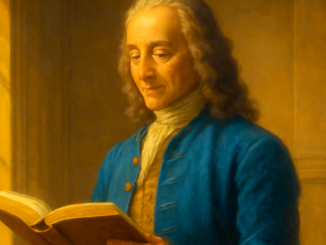
Open book showing Voltaire's Candide with Masonic square and compasses
Symbolism & Rituals

Voltaire’s Candide and Freemasonry: Building a Better World

When Voltaire published his famous satirical novel Candide in 1759, he took aim at one of the most influential philosophical propositions of his era: Gottfried Wilhelm Leibniz’s optimism — the claim that we live in “the best of all possible worlds.” Voltaire dismantled this idea with relentless wit. But what drove him to this attack? And how does his critical thinking relate to the symbolism and values cherished by Freemasonry? This article places Candide in its intellectual context and compares two fundamentally different ways of looking at the world. Leibniz’s Optimism: A World of Divine Perfection To understand Voltaire’s satire, we first need to know its target. Gottfried Wilhelm Leibniz (1646–1716), the German philosopher and mathematician, developed a theodicy designed to explain the existence of evil in a world created by God. His answer was elegant but controversial: God, being omniscient and wholly good, had necessarily created the best of all possible worlds. Every evil we perceive, Leibniz argued, serves a higher purpose within the cosmic whole. This philosophy resonated widely in eighteenth-century Europe. It offered comfort to those struggling with suffering and injustice. In Candide, the tutor Pangloss embodies this optimism in its most caricatured form. He insists that […]

Open book showing Voltaire's Candide with garden and Enlightenment imagery
Symbolism & Rituals

Voltaire’s Candide: The Best of All Worlds as a Mirror

Can a world filled with earthquakes, wars, and relentless human suffering truly be the best that God could have created? Voltaire posed this question with biting wit in his masterwork Candide, a satirical novella that has confronted readers since 1759 with the dangerous limits of naive optimism. This analysis explores the core ideas behind the story and why this eighteenth-century work continues to resonate with anyone searching for genuine meaning without self-deception. The Paradox of Optimism Voltaire wrote Candide as a direct attack on the philosophical optimism of Gottfried Wilhelm Leibniz, who argued that our world — despite all its misery — is the best of all possible worlds. On the surface, this sounds comforting. But Voltaire saw something dangerous lurking beneath: a complacency that kills initiative. If everything is already perfectly arranged by divine providence, why would anyone bother striving for improvement? The paradox Voltaire exposes is deeply unsettling: a philosophy designed to offer hope can easily become an excuse for passivity and moral blindness. In the story, the character Pangloss embodies this optimism in its most absurd form. As tutor to the naive young hero Candide, Pangloss insists that every misfortune ultimately serves the greater good — even […]