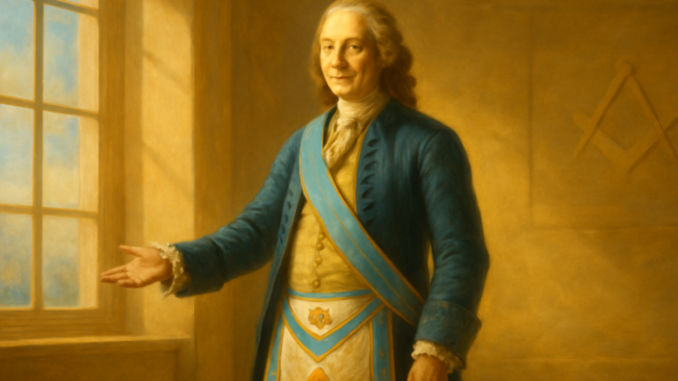
On April 7, 1778, just weeks before his death, the 83-year-old François-Marie Arouet — better known as Voltaire — was initiated into the Parisian lodge Les Neuf Sœurs. This late entry into Freemasonry was not the impulsive act of a dying man. It was the culmination of a life devoted to the very values that the Craft has cherished for centuries. What drew one of history’s most famous philosophers to Freemasonry, and what resonance did he find between his own convictions and the Masonic tradition?
A Historic Initiation in the Paris of 1778
Lodge Les Neuf Sœurs — named after the nine Muses of Greek mythology — was no ordinary Masonic lodge. It attracted the intellectual elite of eighteenth-century Paris: scientists, writers, artists, and philosophers united in their pursuit of enlightenment and progress. When Voltaire entered the lodge room on that April evening, supported by his friend and fellow Brother Benjamin Franklin, he completed a symbolic circle that had spanned his entire life.
The initiation ceremony itself was adapted to accommodate Voltaire’s advanced age and fragile health. Yet he underwent the essential rituals that every candidate must experience: the blindfold, the journey from darkness into light, the symbolic rebirth as a new man. For the Brethren present, the moment carried profound significance. Here stood the man who had spent decades fighting for tolerance and reason, now formally received into a Brotherhood that places those same ideals at its very center.
Voltaire’s Lifelong Fight for Tolerance as a Masonic Value
Anyone familiar with Voltaire’s body of work will immediately recognize the parallels with Masonic values. His famous campaigns for religious tolerance — such as the Calas affair, in which he defended a Huguenot who had been wrongly condemned — mirror the Masonic ideal of brotherhood that transcends religious division. Since its earliest days, Freemasonry has united people of different religious backgrounds around shared moral principles. This is precisely what Voltaire advocated throughout his writings on tolerance.
Voltaire’s initiation confirmed what his life had already expressed: that seeking truth and defending human dignity do not require membership, but that brotherhood strengthens the quest.
The symbolism of light and darkness, so central to Masonic tradition, also resonated deeply with Voltaire’s philosophy. His entire intellectual project was aimed at letting the light of reason shine into the darkness of superstition and ignorance. When a Freemason removes the blindfold and beholds the light, he symbolically experiences what Voltaire pursued throughout his life: the passage from ignorance to understanding.
The Search for Truth as a Unifying Thread
Voltaire was no dogmatist. He questioned, investigated, and revised his positions whenever new insights demanded it. This attitude aligns seamlessly with the Masonic tradition, in which the search for truth matters more than any claim to absolute knowledge. The Freemason works upon his rough ashlar, acknowledges his own imperfection, and strives toward moral perfection while knowing it can never be fully attained.
In his philosophical writings, Voltaire repeatedly emphasized the importance of self-reflection and honest self-knowledge. A person who does not critically examine himself, he argued, cannot form a truthful judgment about the world. This resonates profoundly with the Masonic practice of introspection, in which a Brother regularly pauses to consider his own actions and motivations. Much as Montaigne elevated self-knowledge to the highest form of wisdom in his essays, Voltaire placed honest self-examination at the foundation of all moral progress.
Virtue Over Dogma: A Shared Ideal
Perhaps the strongest bond between Voltaire and Freemasonry is the emphasis on practical virtue over theoretical dogma. Voltaire had little patience for theological hair-splitting but boundless admiration for concrete acts of humanity and justice. Freemasonry shares this pragmatic outlook: what matters is not what a person believes, but how he acts.
Both traditions place human dignity above religious differences. Both emphasize the responsibility of the individual toward the community. Both view knowledge and insight as instruments of moral improvement. And both reject coercion and the suppression of conscience. These shared principles help explain why Voltaire’s entry into the Craft felt less like a conversion and more like a homecoming.
Lessons for Today: Voltaire’s Legacy in a Masonic Light
Nearly 250 years after Voltaire’s initiation, his ideals remain strikingly relevant. In an age of polarization and growing distrust, the combination of Voltaire’s Enlightenment philosophy and Masonic values offers a much-needed counterbalance. Freemasonry continues to demonstrate that people of different backgrounds, beliefs, and stations can meet as Brothers, united by shared moral aspirations.
Voltaire would perhaps smile at the thought that his late entry into the lodge made him a symbol of the connection between intellectual freedom and ritual brotherhood. His initiation was not a conversion but a recognition: the values he had defended throughout his life found a home within the Masonic tradition. That homecoming, so close to the end of his days, gave his life story a sense of completion richer than words alone can express.
Voltaire’s initiation as a Freemason beautifully illustrates how philosophical convictions and Masonic values can reinforce each other. His lifelong battle for tolerance, reason, and human dignity found in Lodge Les Neuf Sœurs a community that cherished those same ideals. For Freemasons today, this historic moment serves as a powerful reminder of the true heart of the Brotherhood: not the keeping of secrets, but the pursuit of light in a world that too often remains trapped in darkness. Voltaire’s legacy invites us to reflect on how we, in our own time, can continue that timeless search for truth, tolerance, and the betterment of humanity.
Copyright text & image: devrijmetselaar.nl
Texts are based on the ideas and content of the author of devrijmetselaar.nl, reviewed, corrected, and supplemented with the assistance of OpenAI. Images are created based on the ideas of the author of devrijmetselaar.nl using OpenAI/DALL-E.

Be the first to comment