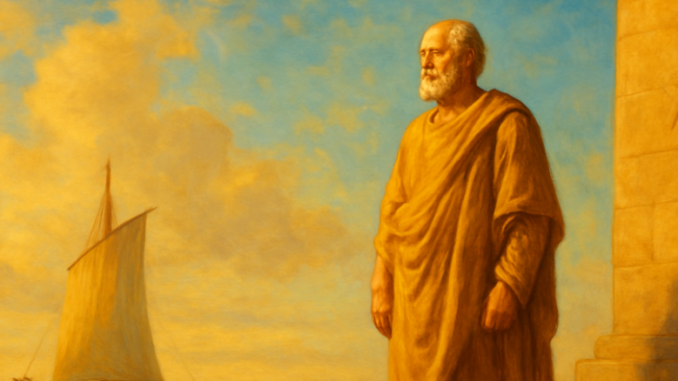
In the year 64 AD, Lucius Annaeus Seneca composed a remarkable letter to his student Lucilius. Amid political upheaval and personal adversity, the Roman philosopher turned his attention to a question that had occupied thinkers for centuries: what is truly real? Letter LVIII, devoted to the nature of things, reveals a surprising dialogue between Stoicism and Plato’s theory of Forms. This intellectual cross-pollination illuminates how ancient wisdom has woven itself through the ages — reaching even into the rituals and symbols of later fraternal traditions.
Plato’s Legacy in Rome
When Seneca composed this letter, Plato’s Academy in Athens had already served as a beacon of philosophical inquiry for more than four centuries. Plato’s distinction between the world of the senses and the world of Ideas had shaped generations of thinkers. In Letter LVIII, Seneca takes his reader through a systematic analysis of the concept of “being,” explicitly drawing on Platonic categories. He identifies six degrees of reality, ranging from the most general — “something that exists” — to the most specific individual things.
This hierarchical approach to reality was no accident. Seneca had thoroughly acquainted himself with Plato’s work, likely through the writings of later Academics and through his own study of the dialogues. The Roman elite regarded philosophical education as an essential element of a proper upbringing, and Plato’s works circulated widely in translation and commentary throughout the educated classes of Rome.
Stoicism as a Grand Synthesis
The Stoicism in which Seneca was trained originated around 300 BC through Zeno of Citium. This school did not develop in isolation but in constant dialogue with other philosophical currents. The Stoa adopted elements from the Cynic way of life, from Aristotle’s logic, and even from certain aspects of Plato’s metaphysics. Seneca’s treatment of “being” in Letter LVIII demonstrates this eclectic approach: he integrates Platonic ontology within an essentially Stoic framework.
The Stoic does not seek the abstract Idea but the living application of wisdom in daily existence.
Where Plato regarded the world of Forms as ultimate reality, the Stoics brought philosophy back to concrete, lived experience. For Seneca, the question of the nature of things was never merely an academic exercise — it was a path toward tranquility of mind. By understanding what holds genuine value, one could free oneself from unnecessary attachment to transient things. This pragmatic turn remains one of Stoicism’s most enduring contributions to Western thought.
Aristotle and the Art of Distinction
Alongside Plato, the influence of Aristotle also plays a significant role in Letter LVIII. The systematic classification of concepts into categories, the precise definitions, the logical construction of the argument — all of this betrays the Aristotelian training Seneca had received. Aristotle had developed a complete system of logic and emphasized the importance of clear conceptual definitions as the foundation for any serious philosophical inquiry.
Seneca’s struggle to find Latin equivalents for Greek philosophical terms illuminates another dimension of his intellectual context. The Latin language was not yet fully equipped for abstract metaphysical discussions. This linguistic wrestling, which Seneca openly discusses in the letter, reveals the practical challenges Roman philosophers faced when translating Greek thought into their own tongue — a challenge not unlike the one faced by later traditions attempting to encode profound truths into ritual and symbol.
The Middle Platonists as a Bridge
By Seneca’s time, pure Platonism had been evolving for centuries. The so-called Middle Platonists, active between the first century BC and the second century AD, had created a synthesis in which Platonic, Aristotelian, and Stoic elements merged together. Thinkers like Antiochus of Ascalon had argued that the various schools were essentially proclaiming the same truths. This conciliatory stance echoes in Seneca’s willingness to quote Plato within a predominantly Stoic discourse.
The philosophical lineage can be traced through several key developments:
- Plato: The world of Forms as the highest reality
- Aristotle: Logical categorization and conceptual analysis
- Zeno and the early Stoa: Ethics as the core of philosophy
- Middle Platonism: A grand synthesis of classical schools
From Ancient Wisdom to Fraternal Symbolism
The search for the essence of things that Seneca describes finds resonance centuries later in the symbolic workshops of Freemasonry. The rough ashlar that must be shaped into a perfect cube embodies precisely what Seneca argued: behind the imperfect appearance lies an ideal form that can be revealed through labor. This symbolism connects Plato’s theory of Forms directly with the Masonic pursuit of self-improvement and moral refinement.
The distinction between appearance and essence, between the transient and the enduring, lies at the heart of both Seneca’s philosophical letter and the ritual practice of the lodge. When a Freemason contemplates the symbols of his Craft, he engages in the same intellectual exercise as the Stoic sage: he seeks beyond the surface for deeper meaning, beyond the material for what is truly essential. The working tools, the geometric symbols, the allegorical journeys — all serve as vehicles for the same ancient inquiry into the nature of reality that Seneca explored in Letter LVIII.
The Historical Context of Personal Crisis
Letter LVIII was written during a period of mounting pressure on Seneca. Emperor Nero, once his pupil, had developed into an unpredictable ruler. The philosopher knew his position at court was precarious. Against this backdrop, his meditation on transience and true reality takes on additional weight. The question of what is real was no longer an abstract puzzle for Seneca — it had become an existential necessity.
In this personal crisis, Seneca demonstrated the strength of the philosophical tradition in which he stood. By reaching back to Plato and the systematic thinking of his predecessors, he found a handhold amid uncertainty. This is what makes Letter LVIII a timeless document: it stands as proof that philosophical formation arms us against the whims of fortune. It is a lesson that still holds true today for anyone who seeks wisdom — whether in the pages of ancient texts or within the sacred space of a lodge room.
Seneca’s Letter LVIII does not stand alone. It forms a vital node in a network of wisdom stretching from Plato’s Academy through the Stoic porch and onward into the symbolic traditions that continue to inspire seekers of light. The Platonic roots of Stoic thought remind us that genuine philosophy has always been a collaborative enterprise — a great chain of thinkers building upon one another’s insights. For the Freemason, this realization carries special significance: the Craft itself is built upon the accumulated wisdom of ages, and every Brother who takes up the working tools joins a lineage that reaches back not merely centuries, but millennia.
Copyright text & image: devrijmetselaar.nl
Texts are based on the ideas and content of the author of devrijmetselaar.nl, reviewed, corrected, and supplemented with the assistance of OpenAI. Images are created based on the ideas of the author of devrijmetselaar.nl using OpenAI/DALL-E.


Be the first to comment