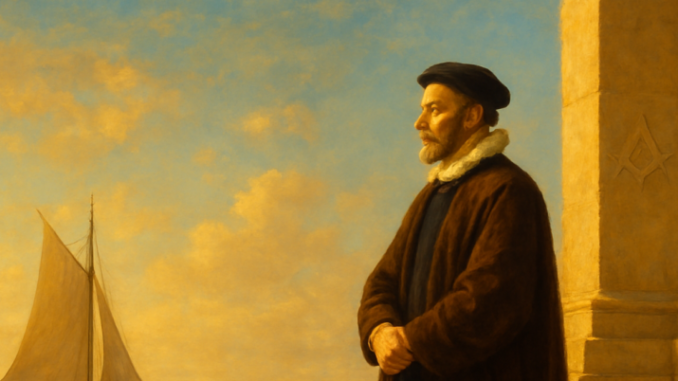
In 1572, as religious wars tore France apart, Michel de Montaigne retreated to the tower room of his château. Surrounded by books and Latin inscriptions carved into the ceiling beams, he began writing a series of essays that would permanently reshape Western thought. In the thirty-third essay of his first book, he examines a paradox that has fascinated generals and philosophers alike: how blind fortune sometimes produces exactly those outcomes that the sharpest human reason could never have devised.
The Core Idea of the Essay
Montaigne opens with a seemingly contradictory proposition: chance — which we typically regard as the very opposite of deliberate action — regularly produces outcomes superior to the most carefully laid plans. This is not a plea for laziness or indifference. It is an invitation to humility. Human reason, however refined, cannot possibly account for every variable in existence. Fortune, on the other hand, operates beyond the constraints of our limited knowledge.
The idea draws heavily on the Stoic tradition that Montaigne loved so well. Thinkers like Seneca and Marcus Aurelius likewise acknowledged that the wise person cannot control everything. Where Montaigne differs is in his lightness of touch: he offers no rigid philosophical system, but rather a collection of anecdotes and reflections that the reader is invited to weigh for themselves.
Historical Examples: Fortune on the Battlefield
Montaigne supports his thesis with a striking array of historical examples. He cites classical authors who recount battles in which random events proved decisive. An arrow that accidentally killed the enemy commander. A sudden storm that saved a fleet. A blunder that turned into a strategic advantage. In each case, it was not human planning but the unforeseen that carried the day.
Particularly compelling are his references to stories from antiquity, including those of Alexander the Great and Julius Caesar. Both men, despite their brilliant strategic minds, acknowledged that fortuna played a role in their victories. Montaigne also draws on Plutarch, whose biographical works are shot through with moments where fate intervened in ways no mortal could have predicted.
The Tension Between Control and Surrender
What makes this essay so enduringly relevant is Montaigne’s refusal to offer simple answers. He advocates neither fatalism nor blind trust in reason. Instead, he sketches a middle path: the wise person prepares as thoroughly as possible, yet accepts that the outcome is never entirely within their own hands. This posture requires a certain inner calm — a trust in the larger scheme of things that the sixteenth-century essayist shared with philosophers from vastly different traditions.
Fortune sometimes acts in the service of reason — not because chance is clever, but because our reason is limited.
This tension between control and surrender resonates powerfully with the symbolism that occupies a central place in Freemasonry. The working tools of the Mason — the square and compasses — represent the human effort to impose order on the rough stone of existence. At the same time, the tradition recognizes that individual labor is part of a greater edifice, the completion of which is not entrusted to any single person.
Fortune as Symbol in the Masonic Tradition
Freemasonry places no blind trust in chance, but neither does it harbor the illusion that human beings can control everything. The symbolism of the temple that is never completed reminds every Brother that his contribution is only a fragment of a larger design. Just as Montaigne points to the limitations of human reason, so the Lodge points to the limitations of individual capacity. The rough stone is worked, but its ultimate place in the building is not determined by the stone itself.
Hiram Abiff, the legendary Master Builder of Masonic tradition, embodies this very tension. His craftsmanship was unrivaled, yet his fate was determined by forces beyond his control. The symbolism surrounding his death and the search for the Lost Word underscores that even the greatest master cannot foresee or prevent everything. It is a story not of defeat, but of the dignity that comes from laboring faithfully within the limits of one’s own mortality.
Lessons for Today
What can we learn from Montaigne’s reflections on fortune and reason, more than four centuries after he wrote them? In an age when technology and data feed the illusion that everything is predictable and controllable, his essay offers a healthy corrective. The essayist invites us to remain humble about our capabilities without falling into apathy.
There are several practical takeaways worth considering. First, acknowledge the limits of planning and prediction. Second, continue to act with dedication, but do not become excessively attached to outcomes. Third, view unforeseen turns not as enemies, but as potential teachers. And finally, cultivate an inner disposition that leaves room for the unexpected.
Montaigne did not write for academics. He wrote for anyone who grapples with the fundamental uncertainty of human existence. His essays are not a recipe book but an invitation to reflection. In that respect, he stands remarkably close to the spirit of Freemasonry, where personal growth and self-knowledge carry more weight than dogmatic answers.
The Relevance of a Sixteenth-Century Insight
It is striking how modern Montaigne’s insights feel. Contemporary psychologists and philosophers likewise point to the limitations of rational control and the value of acceptance. Without invoking the specific names that circulate in academic circles, we can safely say that the core of Montaigne’s message enjoys broad support: the person who seeks to control everything ultimately loses more than they gain.
For anyone interested in the broader sweep of Montaigne’s essay project, this thirty-third essay provides an excellent introduction to his distinctive way of thinking. It is neither dogmatic nor melancholy, but exploratory — a mind thinking aloud, testing ideas against experience, and trusting the reader to draw their own conclusions.
Montaigne’s meditation on fortune and reason remains as vital today as it was in the sixteenth century. His gentle insistence that we cannot master everything — and that this is not a failure but a feature of the human condition — speaks directly to the Masonic ideal of working the rough stone with care, while trusting that the completed temple belongs to something larger than ourselves. In a world obsessed with certainty, his essay is a quiet reminder that wisdom often begins where control ends.
Copyright text & image: devrijmetselaar.nl
Texts are based on the ideas and content of the author of devrijmetselaar.nl, reviewed, corrected, and supplemented with the assistance of OpenAI. Images are created based on the ideas of the author of devrijmetselaar.nl using OpenAI/DALL-E.




Be the first to comment