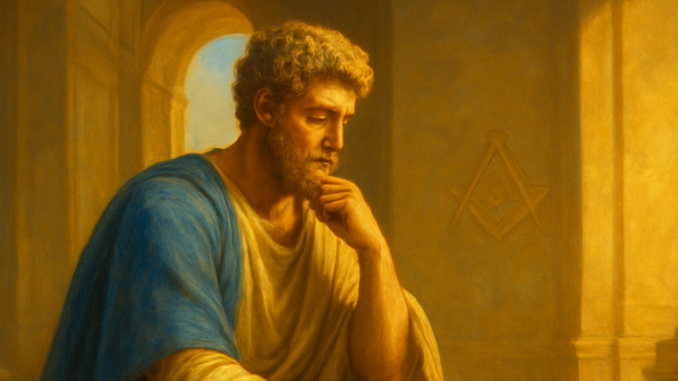
There is a remarkable kinship between the Stoic wisdom of a Roman emperor and the ritual practice of an ancient fraternity. When Marcus Aurelius writes about retreating into oneself in Book IV of his Meditations, he touches upon a theme that also runs deep within Freemasonry. How do these two traditions — separated by nearly two thousand years — relate to one another? And what can they still teach us today about the art of finding inner peace in a restless world?
The Stoic Perspective: The Citadel of the Mind
Marcus Aurelius never intended his Meditations for publication. They were personal notes, often written at the front lines during military campaigns. In Book IV, he unfolds a core idea that underpins his entire philosophy: a person can, at any moment and regardless of circumstances, retreat into their own inner world. He compares the mind to a citadel — an impregnable fortress that can only be surrendered from within. The outside world, with all its chaos and demands, has no real power over our inner state unless we voluntarily hand that power over.
For the Roman emperor, this was no idle philosophical exercise. He ruled a vast empire and faced wars, plagues, and political intrigue on a daily basis. It was precisely in that context that he developed the conviction that true freedom does not lie in escaping responsibilities, but in cultivating an inner space where the mind can find rest. That space is always available, he writes — we need only return to it.
The Masonic Perspective: The Lodge as Symbolic Workshop
Freemasonry has its own distinct tradition of withdrawal, but one practiced in communal form. When brethren enter the lodge, they symbolically leave the profane world behind them. The lodge constitutes an enclosed space where different rules apply than in everyday life: here, the focus is not on the daily grind, but on the quiet labor of shaping the rough ashlar — one’s own character. This ritual seclusion serves a purpose remarkably similar to the inner retreat advocated by Marcus Aurelius: the creation of space for reflection and moral growth.
Yet the Masonic path differs fundamentally from the Stoic method. Where Marcus Aurelius emphasizes individual self-reliance, Freemasonry underscores the value of brotherhood. The lodge is not a place of solitary contemplation, but of shared labor. The brethren support one another in their pursuit of truth and virtue. The inner work is carried out within the context of a community that cherishes shared values.
Where the Two Traditions Meet
Despite these differences, Marcus Aurelius’ Stoicism and Freemasonry share striking common ground. Both recognize that the real work takes place within. Both point to the importance of self-reflection as the foundation for ethical action. And both regard the outside world not as an enemy, but as a training ground where internally acquired wisdom is put into practice.
The true retreat is not a flight from the world, but a return to one’s own conscience in order to act more powerfully from that place of clarity.
Marcus Aurelius would likely have recognized himself in the Masonic ideal of the unfinished stone. The Stoics spoke of the continual improvement of character — of chiseling away at one’s own soul until it is brought into harmony with universal reason. Freemasonry uses virtually identical imagery: the rough ashlar that is patiently shaped into a perfect cube, fit to be incorporated into a greater structure.
The Tension Between Individual and Community
Here, a fruitful tension reveals itself. Marcus Aurelius wrote primarily for himself and emphasized the autonomy of the individual mind. Freemasonry, by contrast, places the individual firmly within a network of brethren who hold one another accountable and offer mutual support. Neither approach excludes the other. On the contrary, they complement each other beautifully.
The Stoic retreat offers a method for finding inner stability at all times — even when no lodge is at hand. The Masonic gathering provides a structure in which that inner work is shared, tested, and deepened. Those who are familiar with both traditions possess a double set of tools: the art of silent introspection and the strength of fraternal connection.
Lessons for the Present Day
In our age, where distraction lurks everywhere and silence has become a scarce commodity, the message of Marcus Aurelius sounds more urgent than ever. His call to regularly return to an inner sanctuary is not a call to passivity. It is an invitation to consciously step back from the noise, to reconnect with one’s own values, and to act from that grounded place.
Freemasonry offers a complementary wisdom: that inner journey does not have to be undertaken alone. The search for light and knowledge becomes richer when it is shared with others who walk the same path. The lodge functions as a protected space where brethren inspire, correct, and encourage one another.
Consider the key principles these traditions share:
- Self-reflection as the foundation for ethical action
- The mind as an impregnable fortress that can only be surrendered from within
- Brotherhood as an amplifier of individual growth
- The rough ashlar and the ongoing labor of character development
Both traditions remind us that the real battle does not take place outside of us. The Stoic wisdom of a Roman emperor and the ritual practice of an ancient fraternity point toward the same truth: those who know themselves and work on themselves contribute to a better world — not through grand gestures, but through the quiet, steady labor upon their own soul. The dialogue between Marcus Aurelius and Freemasonry teaches us that inner retreat and fraternal connection are not opposites, but two sides of the same coin — each strengthening the other on the path toward a more examined and purposeful life.
Copyright text & image: devrijmetselaar.nl
Texts are based on the ideas and content of the author of devrijmetselaar.nl, reviewed, corrected, and supplemented with the assistance of OpenAI. Images are created based on the ideas of the author of devrijmetselaar.nl using OpenAI/DALL-E.
Frequently Asked Questions
What is the main connection between Marcus Aurelius's philosophy and Freemasonry?
Both traditions emphasize the importance of inner retreat and self-reflection as paths to personal growth and peace. Marcus Aurelius describes the mind as an impregnable citadel that can be accessed at any moment, while Freemasonry uses the lodge as a symbolic space where brethren withdraw from the profane world to work on shaping their character and moral development.
How does Marcus Aurelius's concept of inner retreat differ from the Masonic approach?
While Marcus Aurelius emphasizes individual self-reliance and solitary mental discipline, Freemasonry approaches inner work through brotherhood and community. The Masonic lodge is a shared space where brethren support one another in their pursuit of truth and virtue, rather than a solitary practice of retreating into one's own mind.
Why did Marcus Aurelius develop his philosophy of inner retreat?
Marcus Aurelius developed this philosophy while ruling the Roman Empire and facing constant challenges including wars, plagues, and political intrigue. He believed that true freedom comes not from escaping responsibilities, but from cultivating an inner space where the mind can find rest and maintain peace regardless of external circumstances.


A thoughtful comparison between Marcus Aurelius’ Stoic philosophy and Freemasonry. I especially like the idea that inner retreat and brotherhood can complement each other, encouraging self-reflection, character development, and a more purposeful life.