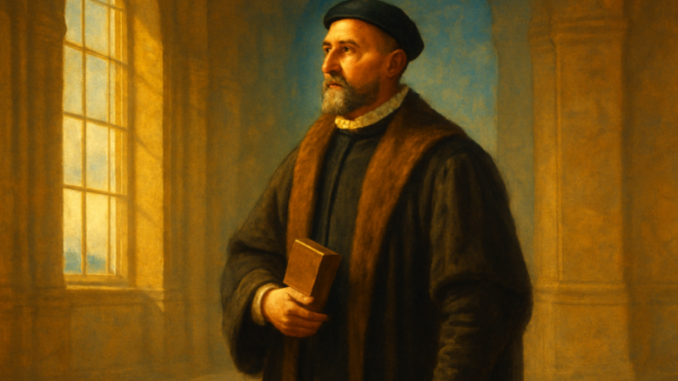
What does it mean to be recognized for your actions — and at what point does that recognition become more important than the action itself? Michel de Montaigne posed this question in his essay on the rewards of honor, touching on something that still resonates deeply within the Masonic lodge centuries later. Two traditions, two perspectives on the same human tendency: the need for connection through appreciation. This article places Montaigne’s world alongside that of Freemasonry and explores where both paths converge.
Montaigne’s World: Honor as a Mirror of the Soul
Michel de Montaigne wrote his essay on the rewards of honor from a place of deep suspicion toward outward display. In sixteenth-century France, honor was a form of currency: knights, nobles, and statesmen competed for titles, distinctions, and public praise. Montaigne observed that this pursuit of recognition alienated people from their inner compass. Those who allow themselves to be guided by the gaze of others, he reasoned, lose sight of their own character. Honor imposed from the outside is like a garment you wear without having woven it yourself.
In this, Montaigne drew on a tradition stretching back to the Greek philosophers. Aristotle distinguished in his ethics between genuine virtue and its mere appearance. Seneca warned that fame is a master who chains its slaves with applause. Montaigne added his own nuance: honor is not inherently contemptible, but it must be a consequence of sincere action, never the goal. The reward of honor is only pure when it arrives unexpectedly — as an echo of something the recipient had already forgotten doing.
The Masonic World: Connection Beyond Recognition
Within Freemasonry, a similar tension plays out, but it is handled differently. The lodge is a space where titles and social positions are left at the door. Brethren meet on the level — a principle that presents equality not as a political ideal but as a spiritual reality. Recognition does exist in the form of degrees and ritual progression, but it is explicitly tied to inner growth rather than outward prestige.
The connection that emerges in the lodge is therefore fundamentally different from the social honor Montaigne described. Where the sixteenth-century courtier sought the judgment of his audience, the Freemason seeks the stillness of his own conscience. The rituals invite self-reflection: who am I truly, stripped of the roles the world imposes on me? In that question lies the foundation of brotherhood. It is not the recognition of others that forges the bond, but the shared awareness that every person is unfinished and must be willing to work on themselves.
What the Philosopher and the Brother Share
At first glance, Montaigne’s solitary reflections in his tower study and the communal ritual of the lodge seem like polar opposites. The essayist withdraws to reach insight; the Freemason enters a community. Yet both traditions touch the same core truth: genuine connection only arises when the need for external validation is released. Montaigne articulated this as a philosophical principle. Freemasonry gives it shape as a lived experience.
There is a deeper parallel still. Montaigne emphasized that true honor is not sought but received. In Freemasonry, this is reflected in the principle that a candidate does not recruit himself — he is found. The seeker knocks at the door, but it is the community that opens it. This mutual receptivity — the ability to give without demanding and to receive without claiming — forms the very fabric of what Brethren call connection.
True honor is never a goal but always a consequence: it arises where sincere action and genuine connection coincide, without anyone having asked for recognition.
Virtue as a Bridge Between Two Worlds
What can we learn from this comparison? First and foremost, that the tension between inner worth and outward recognition is universal. Montaigne experienced it at the court of the Valois, but it is the same tension felt by every person who wonders whether their efforts are truly seen. Freemasonry offers an answer that doesn’t remain theoretical: through ritual, through the shared work of shaping the rough stone, a form of recognition emerges that does not depend on applause. It is the quiet glance of a Brother that says: I see that you are growing.
Montaigne would perhaps have appreciated this form of connection. In his essays, he revealed himself as a thinker who loved nothing more than removing the mask of convention to study the face beneath it. That is precisely what the lodge asks of its members. Not the face the world knows, but the face you show yourself when no one is watching. In that honesty lies the highest form of honor: not the reward others bestow upon you, but the dignity you grant yourself by remaining faithful to your own moral compass.
Three Shared Principles
Self-reflection as a foundation: Both Montaigne and Freemasonry regard the honest examination of one’s own character as the first step toward genuine virtue. Without the willingness to look inward, all outward displays of goodness remain hollow performances.
Detachment from outward show: The philosopher distrusted the pursuit of fame; the lodge requires that worldly ranks be set aside at the temple door. In both traditions, the stripping away of external markers is not a loss but a liberation — a clearing of space for something more authentic to emerge.
Connection through vulnerability: True brotherhood and true honor arise where people are willing to reveal their imperfections. It is not strength that binds us most deeply, but the shared courage to acknowledge that we are all works in progress.
Montaigne’s essay on the rewards of honor is far more than a historical meditation. It is an invitation that still echoes — in the quiet of the reading room and in the ritual space of the lodge. Where do you seek your recognition? And what might change if you released that search, choosing instead to trust in the connection that emerges when you show yourself without a mask? Perhaps the greatest honor of all is not in being seen by others, but in having the integrity to see yourself clearly — and still choosing to grow.
Copyright text & image: devrijmetselaar.nl
Texts are based on the ideas and content of the author of devrijmetselaar.nl, reviewed, corrected, and supplemented with the assistance of OpenAI. Images are created based on the ideas of the author of devrijmetselaar.nl using OpenAI/DALL-E.
Frequently Asked Questions
What was Montaigne's main concern about the pursuit of honor?
Montaigne believed that pursuing recognition and honor alienated people from their inner compass and moral character. He argued that those guided by the gaze of others lose sight of their own values, and that honor imposed from outside is like wearing a garment you didn't weave yourself. He maintained that honor should be a consequence of sincere action, never the goal, and is only pure when it arrives unexpectedly.
How does Freemasonry's approach to recognition differ from Montaigne's view of honor?
While Montaigne warned against external recognition, Freemasonry acknowledges recognition through degrees and ritual progression, but explicitly ties it to inner growth rather than outward prestige. The Masonic lodge operates on the principle of equality, where members meet on the level regardless of social position. The connection sought is to one's own conscience and self-reflection, not to audience judgment or social status.
What is the central question that connects Montaigne and Freemasonry?
Both traditions grapple with the question: at what point does recognition become more important than the action itself? They share the ideal that genuine value comes from sincere character and inner growth, with recognition serving as an echo or consequence rather than the primary goal. Both seek authentic connection—Montaigne through alignment with one's inner compass, and Freemasonry through brotherhood based on spiritual equality.

Be the first to comment