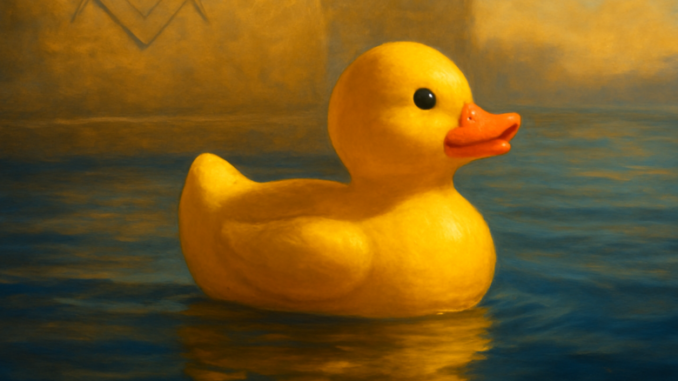
Some objects are so ordinary, so quietly present in our everyday lives, that no one would ever think to look for deeper meaning in them. The rubber duck is one such object — yellow, hollow, bobbing along on the surface of bathwater. And yet, for those willing to look a little longer, this innocent thing reveals something profound about the way human beings relate to one another, about the courage required to start a real conversation, and about the very essence of what Freemasons have pursued for centuries.
A Yellow Object on Still Water
Picture a rubber duck — not as a toy, but as a symbol. It floats on water without sinking, without resistance. It moves with the ripples created when someone disturbs the surface. It makes no sound unless you squeeze it. It is vulnerable because it is hollow. And yet that very hollowness is precisely the reason it stays afloat.
In many traditions, water represents emotion, the subconscious, everything that lives beneath the surface. When we engage in a conversation that truly matters, we enter those same waters. We allow ourselves to float on what the other person says; we are moved by words we didn’t expect to hear. The rubber duck, in all its simplicity, shows us the cost of staying afloat: you must dare to be hollow. You must allow emptiness within yourself in order not to sink.
Hollowness as a Precondition for Connection
In Freemasonry, there is an ancient principle that encourages the Entered Apprentice to come into the lodge as a rough ashlar — unpolished, imperfect, but willing to be shaped. That willingness presupposes an inner openness, a kind of emptiness that wants to be filled with insight, with the words of others, with experiences that only gain meaning when they are shared. It is precisely this attitude that makes an open conversation possible.
Aristotle wrote that the human being is by nature a social creature — a zoon politikon — who only truly flourishes in community with others. But community is not the same as proximity. Two people can sit side by side without ever genuinely speaking to one another. Brotherhood, the ideal that Freemasonry cherishes, demands more than physical presence. It asks you to set aside your armor, to acknowledge the hollowness within yourself, and to invite another person to fill that space with honesty.
Brotherhood does not arise from simply being in the same room. It emerges when people break the silence together with a conversation that allows vulnerability.
Conversation as a Ritual Act
Anyone who has ever entered a lodge knows that the ritual does not consist solely of words spoken for centuries. It also lives in the moments between those words — the pause when a Brother reflects before answering, the split second when eye contact conveys more than any speech ever could. In the tradition of the Festive Board, where Brethren share a meal and conversation after the formal work is done, the most valuable exchanges often take place. Not because they are planned, but because the right space has been created for them.
Montaigne, that great essayist whose writings on friendship and self-knowledge form part of the bedrock of Western thought, wrote that true conversation only begins when we stop trying to impress. When we, like the rubber duck, stop trying to appear bigger than we are and simply float in the moment, receptive to whatever comes. It is no coincidence that Montaigne described his friendship with Étienne de La Boétie as a bond that reached beyond words — yet one that had come into being precisely through words.
The Courage to Begin
An open conversation always starts small. Sometimes it begins with a joke, an unexpected question, or even an absurd object placed on the table. Imagine someone setting a rubber duck on the table during a lodge meeting without any explanation. The first reaction might be laughter, perhaps bewilderment. But then something happens: curiosity. Why this object? What is the speaker trying to say? That disruption of expectations is exactly what is needed to open a deeper conversation. The unexpected disarms. It compels those present to set aside their assumptions and truly listen.
Johann Wolfgang von Goethe — himself a Freemason and one of the greatest minds European culture has produced — understood the power of the unexpected image like few others. In his novel Wilhelm Meister’s Journeyman Years, he describes a society whose members approach one another not with grand declarations but with small, meaningful gestures. It is this attention to the seemingly insignificant that makes the difference between superficial contact and genuine brotherhood.
Floating Without Drowning
The rubber duck knows no fear of the water. It was made for it. And perhaps that is the lesson it teaches us about brotherhood: that we need not fear the depth of a real conversation. That floating is not the same as sinking. That being hollow — that is, being receptive and open — is not a weakness but a necessary quality for forging a genuine connection with another human being.
In Freemasonry, the compasses are used to keep our passions within due bounds, and the square to direct our actions toward justice. But there is a third, invisible tool that is at least as important: the ability to listen. To be silent when a Brother speaks. To suspend your own convictions for a moment and truly hear what the other person is saying. This ability is not innate. It is practiced, time and again, in the privacy of the lodge and in the openness of daily life.
The Everyday as a Mirror
Perhaps the rubber duck is ultimately nothing more than a piece of rubber. But for those who have learned to look beyond the surface of things, it becomes an invitation — an invitation not to take the everyday for granted, to seek the extraordinary within the ordinary, and to recognize in the simplicity of a small object the outlines of something far greater.
Freemasonry has always taught its members to find meaning in symbols, to see in the working tools of a stonemason the moral architecture of a well-lived life. The rubber duck may never find its way into a lodge room, but the principle it embodies — openness, buoyancy, the willingness to be moved — is at the heart of every meaningful Masonic experience. All it asks is that we look a little longer and dare to start the conversation.
Brotherhood is not built through grand gestures or eloquent speeches alone. It is built in small moments of genuine openness — in the willingness to be hollow enough to receive what another person has to offer, and brave enough to share what lies within. The next time you see a rubber duck, let it remind you that the deepest connections begin with the simplest of things: the courage to be present, to listen, and to let a conversation carry you wherever it needs to go.
Copyright text & image: devrijmetselaar.nl
Texts are based on the ideas and content of the author of devrijmetselaar.nl, reviewed, corrected, and supplemented with the assistance of OpenAI. Images are created based on the ideas of the author of devrijmetselaar.nl using OpenAI/DALL-E.


Be the first to comment