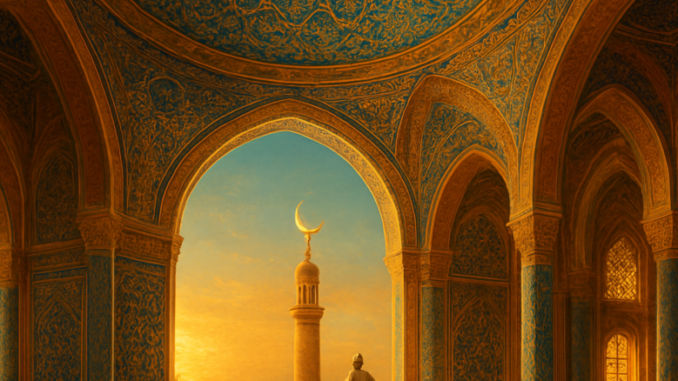
In the year 627 CE, during the Battle of the Trench around Medina, a crisis emerged that was not fought with swords. Within the ranks of the young Muslim community, there were men who professed loyalty while secretly undermining it — men who believed with their lips but betrayed with their hearts. This experience gave rise to one of the most penetrating chapters of the Quran: the sixty-third, known as Al-Munafiqun — The Hypocrites. The warning it delivers touches on a theme deeply rooted in Freemasonry as well: the duty of inner sincerity.
Historical Context: Hypocrisy in Medina
To grasp the full force of this chapter, we need to transport ourselves to seventh-century Medina. After his departure from Mecca, the Prophet Muhammad had established a new community — but not everyone who joined did so out of genuine conviction. A group of inhabitants, referred to in Islamic historiography as the hypocrites, outwardly aligned themselves with the community of believers while secretly pursuing their own interests and undermining its unity. Their leader is named in classical sources, but it is the dynamic itself that proves timeless: people who wear the mask of devotion for personal gain.
Surah Al-Munafiqun consists of just eleven verses, yet each one cuts like a scalpel through the façade of false piety. The chapter opens by noting that the hypocrites testify that the Messenger is truly God’s envoy — only to immediately add that God knows they are liars. It is not their words that are weighed, but the truth of their hearts. The surah warns that wealth and children will be of no benefit to those whose inner life is hollow, and it calls for genuine generosity before it is too late.
The Heart of the Surah: The Mask and What Lies Beneath
What makes this chapter so distinctive within the Quranic tradition is that it does not take aim at external enemies but at an internal disease. Hypocrisy is presented not as a clever strategy but as a spiritual affliction. The text describes how the hearts of the hypocrites have become sealed, rendering them incapable of recognizing truth. This is a remarkable psychological insight for a seventh-century text: whoever wears a mask long enough eventually loses contact with their own face.
The surah draws a clear distinction between three levels of human conduct: the spoken word, the outward deed, and the inner intention. Only when all three are in alignment can there be genuine sincerity. This threefold test is reminiscent of the ethical traditions of both Aristotle — who defined virtue as an inner disposition expressed through consistent action — and the later reflections of Immanuel Kant on the purity of moral motivation.
Parallels with Freemasonry: Working the Rough Stone
Freemasonry harbors a deep-seated distrust of outward display without inner substance. As early as James Anderson’s Constitutions of 1723, it is emphasized that a Freemason should be a “good and true” man. The word “true” is no decorative adjective here — it is the very heart of the matter. In the ritual of the First Degree, the candidate is led in as one who “seeks the light.” This search for light is not merely an intellectual exercise; it is a moral pledge to stand honestly before oneself and one’s brethren.
The working of the rough ashlar — one of the central metaphors in Freemasonry — presupposes that the Mason is willing to acknowledge imperfections in himself. Anyone who dissembles, who presents a polished surface while the core remains porous, is building a temple that will sooner or later collapse. This is precisely the warning that echoes through Al-Munafiqun: outward appearance without inner truth inevitably leads to decay.
Sincerity is not a quality you project outward to others — it is a foundation you lay in silence beneath your own temple.
The Mirror of the Lodge: When Words and Deeds Diverge
Within the enclosed space of the lodge, brethren are expected to speak without masks. The secrecy of Freemasonry does not serve to conceal truth but to create a safe space in which truth can exist. This distinction is essential. Where the hypocrites in Medina exploited the intimacy of the community to hide their true faces, the Freemason uses that same intimacy to reveal his. It is a mirror image of the same dynamic: identical circumstances can facilitate either honesty or deceit, depending on the intention of the individual.
Jean-Jacques Rousseau wrote in the eighteenth century that man is naturally good but corrupted by society. Whether one agrees with that claim or not, the observation that social pressure can lead to hypocrisy is hard to deny. Both the surah and Freemasonry share the insight that the battle against insincerity is not primarily a social struggle but an inner one. Voltaire, who himself moved in Masonic circles, repeatedly emphasized that the worst form of deception is self-deception.
Five Shared Lessons on Sincerity
When we place the teachings of Al-Munafiqun alongside the moral framework of Freemasonry, five shared lessons emerge with striking clarity:
1. Words unsupported by deeds lose their meaning. Both traditions insist that professions of belief or brotherhood are hollow without corresponding action. A Mason who recites his obligations but ignores them in daily life is no different from the hypocrite who testifies to faith he does not possess.
2. Material wealth offers no protection against inner poverty. The surah explicitly warns that neither riches nor children will avail those whose hearts are empty. Freemasonry, too, reminds its members that the true treasures are moral and spiritual, not material.
3. Community requires trust, and trust requires authenticity. The hypocrites of Medina eroded the bonds of community by feigning allegiance. In the lodge, trust among brethren is the mortar that holds the edifice together. Without it, the entire structure crumbles.
4. Self-knowledge is the first step toward sincere action. The Delphic injunction to “know thyself” resonates in both traditions. The surah describes how the hypocrites’ hearts became sealed precisely because they refused self-examination. The Masonic journey begins in the Chamber of Reflection — a confrontation with oneself before all else.
5. It is never too late to remove the mask — but there comes a moment when it grows into the skin. Both the Quran and Masonic teaching warn that habitual insincerity eventually becomes irreversible. The mask, worn long enough, ceases to be a disguise and becomes the face itself.
Authenticity as a Spiritual Practice for Today
In an age when social media invites us to curate idealized versions of ourselves, when public displays of virtue sometimes serve more as performance than principle, the ancient warnings of both the Quran and Freemasonry feel more urgent than ever. Authenticity is not a destination one arrives at — it is a daily practice, a continual act of chipping away at the rough stone.
The Masonic lodge and the Quranic text both remind us that the hardest person to be honest with is ourselves. The external world may be satisfied with appearances, but the inner temple knows its own foundations. To build well, we must build true — and that begins not with grand declarations but with the quiet, unglamorous work of confronting who we really are.
Surah Al-Munafiqun and the moral teachings of Freemasonry converge on a single, enduring truth: sincerity is not ornamental but structural. It is the foundation upon which everything else is built. Whether we frame it in the language of scripture or in the symbolism of the Craft, the message remains the same — a life built on pretense is a temple built on sand. The rough stone waits for the honest chisel, and the only question that ultimately matters is whether we have the courage to use it on ourselves.
Copyright text & image: devrijmetselaar.nl
Texts are based on the ideas and content of the author of devrijmetselaar.nl, reviewed, corrected, and supplemented with the assistance of OpenAI. Images are created based on the ideas of the author of devrijmetselaar.nl using OpenAI/DALL-E.

Be the first to comment