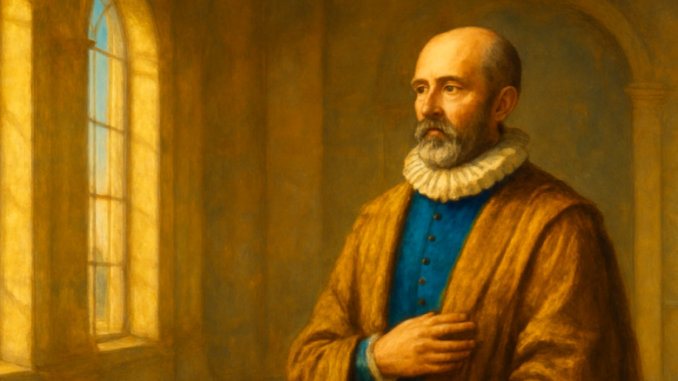
In 1580, Michel de Montaigne published his famous Essays — a collection of introspective reflections that would permanently shape Western philosophy. In one remarkable essay, “On Equality Among Us,” he made an observation that still resonates today: beneath all outward differences between people lies a fundamental equality that connects us. Written in a tower study in the Dordogne more than four centuries ago, this idea proves strikingly relevant when placed alongside the principles that would come to define Freemasonry over a hundred years later.
Montaigne’s Sixteenth-Century Insight
Montaigne wrote his essay during an era of deep social inequality. French society was rigidly stratified into estates — the nobility, the clergy, and the common people. Yet this nobleman had the audacity to argue that even the most powerful prince and the humblest peasant shared the same fundamental human condition. Both experience hunger, fatigue, fear, and joy. Both will eventually die. In his time, this insight was nothing short of revolutionary, though Montaigne chose to present it not as a political manifesto but as a personal observation.
Montaigne drew heavily on classical sources. The Stoics — particularly Seneca and Marcus Aurelius — had already written about universal human nature. Aristotle explored what truly makes people equal. But where the Greeks and Romans approached these ideas primarily in theoretical terms, Montaigne made them personal and accessible. He described how he himself, despite his noble status, was not fundamentally different from the servants in his own household.
The Birth of a Brotherhood
More than 140 years after Montaigne’s death, a remarkable event took place in London. In 1717, four lodges united to form the first Grand Lodge, marking the formal beginning of modern Freemasonry. The men who gathered came from vastly different social backgrounds: craftsmen, merchants, intellectuals, and aristocrats. Within the lodge, they left their social rank at the door. The apron worn by every brother symbolized this equality — whether you were a duke or a carpenter, all wore the same working tool.
James Anderson, who drafted the first Constitutions of Freemasonry in 1723, articulated this principle explicitly. Brethren were to meet “on the level” — a symbolic expression indicating that all members stand as equals. This was neither coincidence nor passing fashion. The early Freemasons were well versed in their classical sources, including Montaigne’s essays, which were widely read among the educated classes of the time.
Virtue as Common Ground
Both Montaigne and Freemasonry place virtue above birth or wealth. For Montaigne, a virtuous life mattered more than a distinguished one. He admired the wisdom of Socrates over the power of Alexander the Great. This same attitude runs through Freemasonry, where moral perfection represents the highest aspiration. It is not what you possess, but who you are and how you act, that determines your worth as a person and as a brother.
True equality does not arise from erasing differences, but from recognizing our shared humanity and striving toward virtue together.
This shared starting point explains why Freemasonry has brought together men of diverse backgrounds throughout the centuries. Wolfgang Amadeus Mozart, himself a Freemason, composed side by side with brethren from commerce and science. Johann Wolfgang von Goethe, also a member of the Craft, saw the lodge as a space where social conventions were temporarily suspended in favor of a collective pursuit of truth and wisdom.
Self-Reflection as the Path to Connection
Montaigne is widely regarded as the father of the modern essay — a form characterized by self-reflection and honest introspection. His famous motto “Que sais-je?” (“What do I know?”) expresses a fundamental humility. By critically examining himself, Montaigne discovered his own limitations and weaknesses. This did not diminish him; it made him more human and more relatable.
Freemasonry practices something remarkably similar. The work of shaping the “rough ashlar” — the symbolic refinement of one’s own character — demands honest self-reflection. A brother who does not know himself cannot grow. The mirror the lodge holds up reflects not the exterior but the interior of a person. In this respect, Montaigne and the Freemason walk the same path: both seek truth by first looking inward.
From Past to Present
What can we, in 2026, learn from this historical interplay between a sixteenth-century philosopher and an eighteenth-century brotherhood? First, that the idea of fundamental human equality is not a modern invention but has deep historical roots. Montaigne articulated it; the early Freemasons institutionalized it in their rituals and customs.
Second, this history teaches us that connection is built on shared values, not shared backgrounds. The lodge brings together people who might never cross paths in everyday life. Montaigne’s essays reached readers from all walks of life because they spoke to universal human experiences. In both cases, the recognition of equality forms the foundation for authentic encounter.
The key principles that emerge from this centuries-spanning dialogue remain as relevant as ever: equality as the starting point for brotherhood rather than its end goal; virtue elevated above social status; self-reflection as a prerequisite for genuine connection; and the acknowledgment of our shared human vulnerability.
The parallel between Montaigne and Freemasonry is no coincidence. It is a powerful example of how wisdom is passed down through the centuries, taking new forms while preserving its essence. Montaigne wrote for himself, yet in doing so, he touched upon universal truths — truths that the Craft would later enshrine in ritual, symbol, and brotherhood. In a world that often emphasizes what divides us, both Montaigne and Freemasonry remind us of something far more enduring: what unites us.
Copyright text & image: devrijmetselaar.nl
Texts are based on the ideas and content of the author of devrijmetselaar.nl, reviewed, corrected, and supplemented with the assistance of OpenAI. Images are created based on the ideas of the author of devrijmetselaar.nl using OpenAI/DALL-E.
Frequently Asked Questions
What was Montaigne's revolutionary idea about equality in the 16th century?
Montaigne argued in his 1580 essay "On Equality Among Us" that beneath all outward differences between people lies a fundamental equality connecting us. He observed that even the most powerful prince and the humblest peasant share the same human condition—both experience hunger, fear, joy, and mortality. This was revolutionary for the era of rigid social stratification in France, though Montaigne presented it as a personal observation rather than a political manifesto.
How did early Freemasonry incorporate the principle of equality?
When the first Grand Lodge was formed in London in 1717, it brought together men from vastly different social backgrounds—craftsmen, merchants, intellectuals, and aristocrats. Within the lodge, members left their social rank at the door and met "on the level," symbolizing equality. Every brother wore the same apron, representing that all members stood as equals regardless of their external status.
What was the connection between Montaigne's ideas and Freemasonry?
Though Montaigne died in 1592, over 140 years before modern Freemasonry's formal establishment in 1717, early Freemasons were well versed in classical sources including Montaigne's essays. The foundational principle that Freemasons meet "on the level" and share fundamental equality reflects Montaigne's sixteenth-century insight about our common human nature transcending social differences.

Be the first to comment