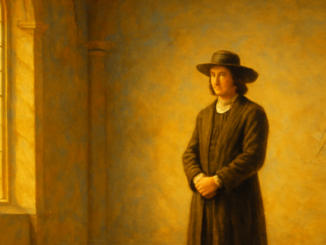
Quakers and Freemasons: Silence as a Shared Path
An empty chair in a circle. No minister, no liturgy, no prescribed words. Just people sitting together, waiting for whatever may arise from within. This image of a Quaker meeting evokes something that Freemasons instinctively recognize: the conviction that truth does not come from outside, but must be discovered in the depths of one’s own being. Today we explore the roots of the Religious Society of Friends and examine the threads that connect this movement to Freemasonry — as well as the places where their paths clearly diverge. A Spark in Seventeenth-Century England The Religious Society of Friends emerged in the 1640s, in the midst of an England torn apart by religious and political upheaval. George Fox, a restless young man from Leicestershire, found no answers in the churches of his day. In 1647, he experienced what he described as an inner revelation: there is no need for an outward priest or church building, because every human being carries an inner light directly connected to the divine. This was a revolutionary insight. Fox traveled across the country, gathering like-minded seekers around him. They called themselves “Friends of the Truth.” The nickname “Quakers” came from their opponents, who described how these […]