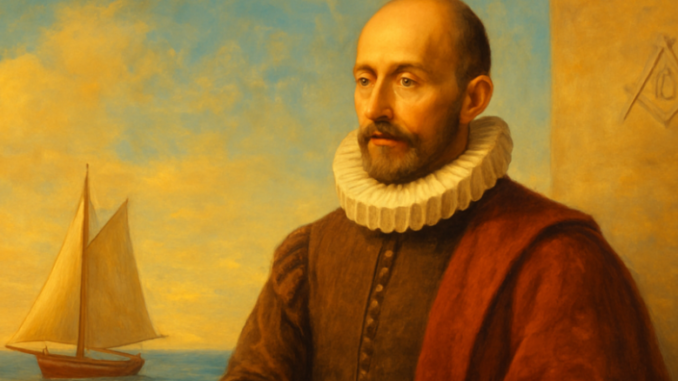
Imagine sitting across the table from someone whose daily habits are the complete opposite of yours. The way they eat, the way they greet, the way they mourn — everything is different. Do you feel resistance, or curiosity? Michel de Montaigne posed exactly this question in his essay “Of Custom,” and the answer he arrived at offers surprisingly practical guidance for anyone seeking genuine human connection — inside and outside the lodge.
The Mirror of Unfamiliar Customs
In Book 1, Essay 49 of his celebrated collection, Montaigne takes the reader on a dizzying tour of customs from every corner of the world. He describes peoples who consumed their dead as a form of tribute, and societies where nudity was the accepted norm. His purpose is not to shock. It is to make a very concrete point: what you consider self-evident is not self-evident to someone else — and vice versa.
This might sound obvious, but try applying it in your own life. Think of the last time you were irritated by the behavior of a colleague, a neighbor, or a family member. How quickly did you pass judgment? Montaigne shows us that custom runs so deep we no longer even recognize it as custom. We confuse it with truth, with the only correct way to live. And that is precisely the moment when genuine connection becomes impossible.
Connection Begins by Suspending Judgment
This is where Montaigne’s thinking intersects with a core value of Freemasonry: self-reflection. In the lodge, every Brother and Sister is continually invited to look inward, to examine personal convictions, and to recognize prejudice. Montaigne did exactly the same — albeit from his study in the Dordogne countryside. He wrote that we grow so accustomed to what is familiar that anything foreign feels threatening, when in reality it could enrich us.
You can put this principle into practice today. Choose a moment when you catch yourself judging someone else. Pause. Ask yourself: is what I am condemning truly wrong, or is it simply different from what I am used to? This single act — the suspension of judgment — is one of the most powerful tools for connection that exists. In Freemasonry, it is practiced through ritual, in the silence of the temple, and in listening to a Brother whose worldview differs radically from your own.
True connection does not arise when we agree with each other, but when we dare to suspend judgment about our differences.
Brotherhood Beyond Your Own Custom
Freemasonry has always been a brotherhood that brings together people of diverse backgrounds. When James Anderson published his Constitutions in 1723, he emphasized that the lodge should be a meeting place where religious beliefs and social rank created no division. This ideal is closely related to what Montaigne argues. When you acknowledge that your customs are not universal, you create room for the other person — not as a concession, but as an enrichment.
You can practice this concretely at your next social encounter, whether that is in a lodge, at work, or around the dinner table:
Ask an open question about a custom you don’t understand, instead of offering an opinion about it. Listen without mentally formulating your response. Actively look for what you have in common, rather than what separates you. Reflect afterward: what automatic judgment arose, and where did it come from?
These are not abstract philosophical exercises. They are concrete steps you can take today. Montaigne would recognize them immediately. He described himself as someone who constantly tried to unmask his own bias — not to condemn it, but to become free of it.
The Search for Truth Behind Custom
One of the deepest parallels between Montaigne and Freemasonry is the search for truth. In the lodge, this quest is described as the pursuit of light and knowledge. In his essay, Montaigne describes how custom acts as a veil that prevents us from seeing reality clearly. We look, but we do not see — because we filter everything through what we already know. The Freemason who enters the ritual is invited to lift precisely this veil, not by receiving answers, but by learning to ask better questions.
Voltaire, himself a Freemason, wrote about the importance of doubt as a driving force for progress. Montaigne was in many ways his predecessor. Where Voltaire wielded doubt as a weapon against intolerance, Montaigne used it as an instrument for inner growth. Both approaches lead to the same place: whoever dares to question their own customs opens the door to a deeper understanding of themselves and of others.
From Insight to Daily Practice
The beauty of Montaigne’s thinking is that it never exists apart from daily life. He does not philosophize from an ivory tower. He writes about what he sees, feels, and experiences. This makes his work exceptionally suited to practical application. Freemasonry shares this practical orientation. It is not only about grand ideals like moral perfection or virtue — it is about the question: how will you behave differently tomorrow than you did today?
A useful exercise is keeping a short journal — even just three lines a day — in which you note the automatic assumptions you have made about others. After a week, you will begin to see patterns. Patterns that Montaigne described four hundred years ago. Customs so self-evident that they become invisible — until you consciously shine a light on them. That conscious illumination is what both Montaigne and Freemasonry mean by seeking light.
Anyone who takes this exercise seriously will discover that connection is not an abstract ideal. It is a skill — a skill you can train, every single day, by examining your own customs and the judgments that flow from them.
Montaigne’s essay on custom, written over four centuries ago, remains a remarkably relevant guide for anyone walking the Masonic path — or simply seeking deeper human connection. His message is deceptively simple: recognize that your way is not the only way, and you create space for understanding. Suspend your judgment, and you open the door to brotherhood. The lodge offers a structured setting for this practice, but the real work happens outside it — in every conversation, every encounter, every moment of quiet self-reflection. Light is not something you receive once; it is something you seek, continuously, by daring to question the customs you have always taken for granted.
Copyright text & image: devrijmetselaar.nl
Texts are based on the ideas and content of the author of devrijmetselaar.nl, reviewed, corrected, and supplemented with the assistance of OpenAI. Images are created based on the ideas of the author of devrijmetselaar.nl using OpenAI/DALL-E.

Be the first to comment