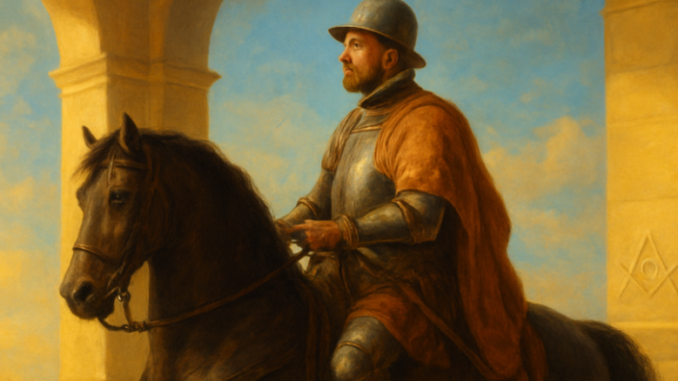
Imagine you are about to step into a difficult conversation, resolve a conflict, or walk an unfamiliar path. You feel resistance, uncertainty, perhaps even fear. It is precisely in moments like these that an unexpected source offers surprisingly practical guidance. In the sixteenth century, Michel de Montaigne wrote a short essay about horses in wartime — seemingly a piece about animals and battlefields. But read closely, and you will find a powerful lesson about connection, trust, and inner growth. These are themes that also stand at the very heart of Freemasonry.
What Montaigne Really Wrote About Horses and War
In Essay 48 of the first book of his famous Essays, Michel de Montaigne examines the role of the horse in the art of war. He references commanders from antiquity — Julius Caesar, Alexander the Great — and describes how they maintained an extraordinary bond with their mounts. Bucephalus, the legendary horse of Alexander, is presented as the ultimate example of an animal that did not merely obey but truly merged with its rider. Montaigne makes it clear that a horseman’s strength does not reside solely in his own ability, but in his relationship with the horse beneath him.
But Montaigne would not be Montaigne if he stopped at the anecdotal. Beneath the surface of historical examples, he poses a deeper question: what makes a bond between two beings truly strong? Is it control, or is it mutual trust? The answer he suggests touches on a universal human theme that reaches far beyond the battlefield.
Trust as Foundation: From the Battlefield to the Lodge
In Freemasonry, trust is the invisible cement that holds the brotherhood together. When a candidate enters the lodge for the first time, he does so literally blindfolded. He entrusts himself to strangers and steps into an unknown space. That moment of surrender is not fundamentally different from the trust a rider places in his horse as he charges onto the battlefield. In both cases, the outcome is uncertain, but the willingness to trust makes the difference between paralysis and progress.
Montaigne emphasizes that the greatest horsemen were not those who forced their horses the hardest, but those who cultivated a quiet understanding. This principle applies directly to everyday life. Think of your workplace, your family, your circle of friends: the strongest relationships are not built on control, but on the capacity to allow vulnerability and to genuinely trust the other person.
True connection does not come from controlling others, but from finding the trust to walk an uncertain path together.
Three Practical Lessons You Can Apply Today
Together, Montaigne’s essay and the Masonic tradition offer a surprisingly concrete framework for action. Here are three lessons you can put into practice right away.
1. Give Space Instead of Taking Control
The commanders Montaigne admired gave their horses room to make their own decisions in the heat of battle. In your own life, you can translate this into a simple exercise: choose one situation this week where you would normally take charge, and consciously give space to someone else. That might be a colleague who approaches a project differently than you would, or a child searching for their own solution to a problem. Observe what happens when you offer trust instead of direction.
2. Seek Silence Before the Conversation
The bond between rider and horse was not forged in the noise of battle, but in the quiet hours of care and training. In Freemasonry, there is the silence of the lodge — the moment of reflection before the ritual begins. Apply this to your own conflicts or difficult conversations: take five minutes of deliberate silence beforehand. Breathe, listen to your own thoughts, and only then enter the dialogue. You will find that you speak from connection rather than reaction.
3. Appreciate the Invisible Work
Montaigne observes that most spectators only noticed the spectacular — the cavalry charge, the victory, the display. But the real power lay in the invisible preparation. This aligns seamlessly with the Masonic principle of inner growth. Take time this week to thank someone in your life for work that normally goes unnoticed. A cleaner, a quiet colleague, a partner who always makes sure everything is taken care of. Recognizing the invisible strengthens every bond.
The Bridge Between Montaigne and the Search for Light
Freemasonry describes its journey as a path from darkness to light, from ignorance to knowledge, from roughness to refinement. Montaigne walked that same path in his own way. He did not write his Essays as definitive truths, but as an ongoing exercise in self-reflection. Like the Freemason who labors on his rough ashlar, Montaigne continually refined his own insights. His essay on war horses is a striking example: it begins as a historical survey and ends as a meditation on human nature.
The philosopher Plutarch, whom Montaigne frequently drew upon as a source, had already written about the bond between humans and animals as a mirror of virtue. Aristotle, whose ethics profoundly influenced Freemasonry, emphasized that true virtue cannot exist in isolation but always in relation to others. Montaigne’s essay stands in that long tradition: it reminds us that our worth as human beings is revealed in how we relate to those who are entrusted to our care.
Why This Matters Now
In a world that increasingly emphasizes individual achievement and visibility, the lesson of Montaigne and Freemasonry runs counter to the current — but it is more necessary than ever. Connection is not weakness; it is the most demanding form of strength. It requires you to set your ego aside, to listen before you speak, and to trust before you demand proof. Whether you are a Freemason, a student of philosophy, or simply someone striving to live more consciously, this ancient wisdom offers a practical compass for modern challenges.
The war horse no longer charges across battlefields, and the lodge may seem like a relic of a different age. But the principles they embody — trust, quiet preparation, the recognition of invisible labor — remain as vital today as they ever were. The question is not whether these lessons are relevant. The question is whether we are willing to apply them.
Montaigne’s seemingly simple essay about war horses opens a window onto some of the most profound values in Freemasonry: trust, connection, and the patient work of inner transformation. The greatest commanders did not conquer through force alone but through the bonds they cultivated in silence. In the same way, the Mason’s work is not measured by outward display but by the invisible refinement of the self. Next time you face uncertainty, remember the rider and his horse — and choose trust over control.
Copyright text & image: devrijmetselaar.nl
Texts are based on the ideas and content of the author of devrijmetselaar.nl, reviewed, corrected, and supplemented with the assistance of OpenAI. Images are created based on the ideas of the author of devrijmetselaar.nl using OpenAI/DALL-E.


Be the first to comment