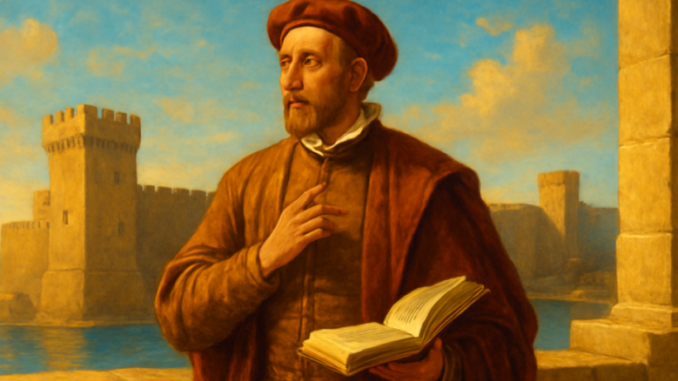
When you face a difficult choice, where do you turn for guidance? In the sixteenth century, a French nobleman asked himself the very same question. Michel de Montaigne wrote his fifth essay about military commanders who had to decide whether to negotiate during a siege. Behind this seemingly practical question lies a rich philosophical tradition that remains surprisingly useful today — not least for those who walk the path of self-improvement and moral reflection.
The Question Beneath the Question
At first glance, Montaigne is dealing with a military problem: is it honorable for a commander to launch a sortie while negotiations are underway? But read a little deeper, and you discover a timeless ethical puzzle. How do you act with integrity when circumstances are uncertain? When does caution become wisdom, and when does it slide into cowardice?
These questions connect directly to everyday life. Imagine you are in conversation with someone about a conflict, and you suddenly discover new information that changes the game entirely. Do you use that knowledge? Do you hold back? The dilemma of the besieged commander is recognizable to anyone who has ever had to choose between tactical advantage and personal integrity.
Stoic Roots of the Virtuous Choice
Montaigne was steeped in Stoic philosophy. Thinkers like Seneca and Epictetus had taught him that external circumstances lie beyond our control, but our inner disposition is entirely our own. This idea resonates throughout his essay. The commander cannot determine the outcome of the war, but he can determine how he conducts himself.
The Stoics drew a sharp distinction between what lies within our power and what does not. Your reputation, your honor, your character — these are things you shape yourself. Montaigne applies this principle to practice: regardless of the siege’s outcome, a commander preserves his dignity by acting with integrity. This is not an abstract ideal but a daily discipline.
It is not what happens to you that defines who you are, but how you respond to it.
Plutarch as a Guide Through Concrete Examples
Montaigne was a passionate reader of Plutarch, the Greek writer who chronicled the lives of famous Greeks and Romans. In his Parallel Lives, Plutarch showed how character traits manifest themselves in concrete actions. Montaigne adopted this method wholeheartedly: he illustrates his philosophical points with historical anecdotes rather than dry abstractions.
This is precisely what makes his essays so accessible. You are not reading about lofty principles detached from reality — you are reading about real people who made real decisions under pressure. It works as a mirror: you recognize the situations, weigh the choices, and draw conclusions for your own life. Try it yourself. Think of a moment when you had to choose between what was convenient and what felt right. What did you do? What would you do differently now?
Renaissance Humanism: The Individual as Measure
Montaigne lived in an era of sweeping change. Renaissance humanism had shifted attention away from divine prescription toward human experience. No longer were sacred texts the sole authority; the wisdom of classical antiquity and one’s own observation now carried weight as well.
This explains why Montaigne writes with such nuance. He offers no absolute answers but instead weighs different perspectives. One commander acts this way, another acts differently — and both have their reasons. It falls to the reader to judge. This approach is an invitation to self-examination: what are your criteria for a good decision?
Consider these guiding principles drawn from Montaigne’s humanistic method:
• Examine your own assumptions before passing judgment.
• Weigh multiple perspectives against one another.
• Accept that certainty is often an illusion.
• Act with conviction nonetheless.
Skepticism as Liberation
Later in life, Montaigne leaned increasingly toward Pyrrhonian Skepticism, a philosophical tradition that questions all certainties. His famous motto was “Que sais-je?” — What do I know? This skepticism was not nihilism; it was an invitation to intellectual humility.
In the essay on the besieged commander, you can already see the seeds of this outlook. Montaigne acknowledges that situations are rarely black and white. The commander who enters negotiations cannot know for certain what the enemy will do. That uncertainty is not a weakness — it is reality. Accepting it paradoxically makes you stronger, because you are no longer paralyzed by the need for absolute certainty before you act.
Practical Application in Your Own Life
How do you translate these philosophical insights into daily practice? Start by recognizing the moments when you negotiate — literally or figuratively. Every conflict, every collaboration, every relationship contains moments of negotiation. Then ask yourself the question Montaigne implicitly poses: am I acting out of integrity, or out of fear?
The Stoic lesson is clear: focus on what you can influence. You cannot control how the other person reacts, but you can control how you behave. The humanistic lesson adds a layer: trust your own judgment, but test it against the wisdom of others. And the skeptic’s lesson reminds you that you are fallible — and that this is perfectly fine.
In traditions that place great value on personal growth and ethical development — such as Freemasonry — these principles are practiced ritually. The symbolism of building refers to building oneself. Just as Montaigne made classical wisdom his own, Masonic symbolism invites us to keep ancient insights alive in our daily choices. The rough ashlar is shaped not by a single blow, but by consistent, patient effort guided by moral intention.
Montaigne’s short essay on the besieged commander opens a window onto centuries-old philosophical traditions. From Stoic self-mastery to humanistic curiosity, from Plutarch’s life lessons to skeptical humility — these sources are not dusty relics but living tools for a well-examined life. The next time you face a difficult choice, ask yourself: what would a wise commander do? Not to win the battle, but to remain true to the person you aspire to be.
Copyright text & image: devrijmetselaar.nl
Texts are based on the ideas and content of the author of devrijmetselaar.nl, reviewed, corrected, and supplemented with the assistance of OpenAI. Images are created based on the ideas of the author of devrijmetselaar.nl using OpenAI/DALL-E.
Frequently Asked Questions
How does Montaigne's philosophy relate to Masonic principles of self-improvement?
Montaigne's emphasis on personal integrity and moral reflection aligns perfectly with Freemasonry's core focus on self-improvement and ethical development. Both traditions teach that character is shaped by how we respond to circumstances rather than by external events, encouraging members to cultivate virtue through disciplined reflection and conscious choice. This philosophical foundation makes Montaigne's work particularly valuable for Masons seeking deeper wisdom in their personal journey.
Why did Montaigne study Stoic philosophy, and what can Freemasons learn from it?
Montaigne studied Stoic thinkers like Seneca and Epictetus to understand how to maintain dignity and honor in uncertain circumstances—a principle that resonates deeply within Freemasonry's commitment to virtue. Freemasons can apply the Stoic distinction between what we control (our character and actions) and what we cannot control (external outcomes) to strengthen their moral resolve and integrity. This timeless wisdom helps members navigate difficult decisions while preserving their honor and personal dignity.
How does Montaigne's use of historical examples strengthen philosophical teaching?
Montaigne borrowed from Plutarch's method of using real historical anecdotes to illustrate abstract philosophical principles, making complex ideas accessible and practical. Freemasonry similarly employs symbolic narratives and historical references to teach moral lessons that members can apply to their own lives. This approach transforms philosophical ideals into concrete, recognizable situations that help individuals understand virtue in action.
What does Montaigne teach about maintaining integrity when facing moral dilemmas?
Montaigne teaches that true honor comes from acting with integrity regardless of circumstances or potential tactical advantages—a principle that directly supports Freemasonry's emphasis on unwavering moral principles. His work demonstrates that character is proven not when things are easy, but when pressured to compromise, making it essential reading for those committed to the Masonic path of ethical self-development. This timeless wisdom reinforces that personal honor is the ultimate victory, even when external circumstances are uncertain.

Be the first to comment