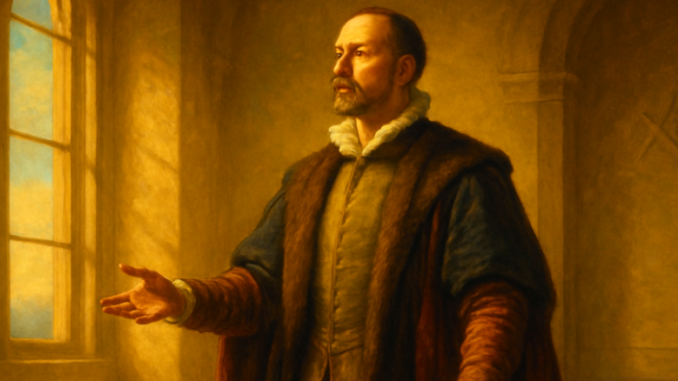
Why do we sometimes direct our deepest emotions at things that don’t actually matter? And more importantly, how do we recognize the moment our passions deceive us? These are questions the sixteenth-century philosopher Michel de Montaigne posed in his essay on how the soul projects its emotions onto false objects. They are also questions that resonate powerfully within the ritual space of the Masonic lodge, where brethren gather to examine themselves and seek authentic human connection.
What Did Montaigne Mean by “False Objects”?
Montaigne identified a peculiar yet universal human tendency. When we are overwhelmed by powerful emotions — anger, grief, frustration — we instinctively seek an outlet that has nothing to do with the real source of our distress. A man who receives bad news kicks a chair. A person in mourning lashes out at the messenger. The soul, Montaigne argued, simply cannot bear the full intensity of its passions, and so it desperately searches for something — anything — to direct them toward, even if that target is entirely innocent.
This insight is not a judgment but an observation about human vulnerability. Montaigne draws our attention to the fact that we often deceive ourselves by pouring emotional energy into things that offer no real resolution. The question that naturally follows is profound: if we can recognize this pattern in ourselves, can we also learn to direct our feelings toward what truly matters?
Why This Resonates with Freemasons
Freemasonry has a long and rich tradition of self-reflection and the examination of one’s inner motivations. Within the lodge, every brother is continually invited to look inward — not to condemn himself, but to come to know himself more deeply. The ritual provides a safe and sacred space for this work, free from the noise and distractions of everyday life. Here, questions that might otherwise go unasked can finally be confronted.
“Know thyself” — the ancient inscription above the Temple of Delphi — stands at the very heart of the Masonic endeavor.
Freemasons learn that uncontrolled passions are obstacles on the path toward inner growth. This does not mean that emotions should be suppressed — quite the opposite. Feelings are valuable signals. But the wise person examines his emotions before acting on them. He asks himself: is my anger directed at the right source? Is my grief a response to an actual loss, or am I reacting to something I’ve constructed in my own mind?
How Brotherhood Supports Self-Examination
Here is where Montaigne’s philosophy and Freemasonry meet in a particularly meaningful way. Montaigne wrote about the need for a mirror — someone who honestly shows us who we really are. The Masonic lodge provides exactly this. Brethren serve as mirrors for one another, not by judging or correcting, but by being present in an atmosphere of mutual respect and trust.
Within this brotherhood, vulnerability is possible. A man can admit that he struggles with misdirected anger or misplaced expectations. The response is not condemnation but recognition — because every brother knows this struggle from personal experience. This shared humanity creates a bond that runs far deeper than casual friendship. It is connection built on a common pursuit of truth and self-improvement.
Practical Lessons for Daily Life
The lesson that both Montaigne and Freemasonry offer us is fundamentally one of awareness. When we notice our emotions latching onto an object that is truly innocent, we can pause. We can ask ourselves: what is the real source of this feeling? This requires courage, because the true cause is often more painful to confront than the false target we’ve instinctively chosen.
Consider these practical steps drawn from this combined wisdom:
- Take time before reacting to intense emotions.
- Ask yourself whether your anger or grief is truly directed at the right target.
- Seek out a trusted confidant who can serve as an honest mirror.
- Be gentle with yourself when you discover you’ve been mistaken.
This practice of self-reflection is not a sign of weakness — it is a mark of inner strength. It takes far more courage to examine your own errors than to blame someone else. In Freemasonry, this pursuit of self-knowledge is understood as a path toward light and wisdom — a lifelong journey that is never completed but is always worth walking.
Is True Connection the Ultimate Goal?
Yes — and this may be the deepest lesson of all. When we direct our passions at false objects, we don’t merely waste energy. We also miss the opportunity for genuine connection. The anger we unleash on an innocent bystander prevents us from addressing the real problem. The grief we project onto trivial matters keeps us from processing our actual loss.
By directing our emotions toward their true source, we open the door to authentic encounter — with ourselves, with others, and with the world around us. This is what both Montaigne and Freemasonry teach us: that self-knowledge is the key to real connection. And that we need not walk this path alone.
Montaigne’s observation about false objects remains strikingly relevant four centuries after he wrote it. In an age saturated with distraction, where instant reactions are constantly encouraged, his wisdom offers a powerful counterbalance. Freemasonry provides a practical framework for putting that wisdom into action: a brotherhood of like-minded seekers who walk the path of self-knowledge together. Ultimately, the question is not whether we have passions — of course we do. The question is whether we have the courage to investigate where those passions truly come from. Only then can real connection emerge.
Copyright text & image: devrijmetselaar.nl
Texts are based on the ideas and content of the author of devrijmetselaar.nl, reviewed, corrected, and supplemented with the assistance of OpenAI. Images are created based on the ideas of the author of devrijmetselaar.nl using OpenAI/DALL-E.
Frequently Asked Questions
What is the connection between Montaigne's philosophy and Freemasonry?
Both Montaigne and Freemasonry emphasize self-examination and understanding our true motivations, particularly how we sometimes direct our emotions at things that don't truly matter. The Masonic lodge provides a sacred space where the philosophical insights of thinkers like Montaigne can be practiced through ritual and brotherhood, helping men recognize and redirect their passions toward what genuinely matters.
How does Freemasonry help members deal with overwhelming emotions?
Freemasonry teaches that uncontrolled passions can be obstacles to inner growth, and the lodge provides a supportive environment for examining emotions before acting on them. Rather than suppressing feelings, Masons learn to understand their emotions as valuable signals and to question whether their responses are directed at the actual source of their distress.
What does 'Know thyself' mean in Freemasonry?
This ancient inscription from the Temple of Delphi stands at the heart of the Masonic endeavor, inviting every brother to look inward and come to know himself more deeply. The Masonic ritual creates a safe, sacred space where men can honestly confront questions about their true motivations and character without fear of judgment.
How do Masonic brethren serve as 'mirrors' for one another?
In the lodge, brethren support each other's self-examination through mutual respect and trust rather than judgment or correction. This brotherhood creates an atmosphere of vulnerability where men can openly admit their struggles and be honestly reflected back to themselves, helping each other recognize when passions are misdirected.

Be the first to comment