
When Voltaire set foot in England in 1726, he encountered a community that fascinated him profoundly: the Quakers. His first Philosophical Letter is far more than a traveler’s curiosity piece about an unusual religious group. It is a carefully constructed mirror held up to French society — and, by extension, to any society that confuses outward ceremony with genuine virtue. For anyone interested in the deeper currents of Freemasonry, Enlightenment thought, and the quest for authentic inner truth, Voltaire’s encounter with the Quakers remains remarkably relevant.
The Encounter: A Philosopher Among the Quakers
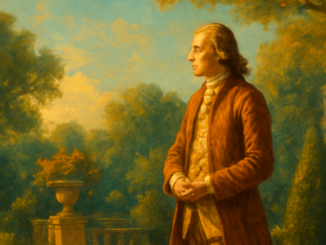
Voltaire opens his letter with a vivid scene. He visits an elderly Quaker at his home, perhaps expecting an exotic encounter with an eccentric. Instead, he finds a man of modest prosperity — calm, receptive, and entirely free of the customary social formalities. The Quaker does not remove his hat. He addresses Voltaire with the familiar “thou” rather than the formal “you.” There is no trace of deference or subservience. For Voltaire, accustomed to the rigid hierarchical etiquette of the French court, the experience is both refreshing and unsettling.
These seemingly trivial details form the heart of Voltaire’s argument. The hat that stays on is not a sign of rudeness — it is a symbol of inner equality. The Quakers refuse to use outward display to mark distinctions between people. Their clothing is plain, their homes unadorned, their worship free of priests and ritual. Voltaire recognizes in all of this a purity he finds sorely lacking elsewhere.
The Inner Light as a Guiding Principle
At the center of Quaker belief stands what they call the “inner light” — the conviction that every human being has direct access to divine inspiration, without the mediation of church, priest, or sacrament. Voltaire describes how the Quaker explains to him that baptism and communion are merely outward signs, while the true baptism is that of the spirit. This is not casual mysticism; it is a radical rejection of institutional power over the individual conscience.
The inner light of the Quakers points toward a universal truth: genuine spirituality does not begin with external forms, but with the quiet work of conscience.
For Voltaire, this inner light is not only a religious concept but a philosophical principle. It represents the human capacity for independent thought, free from dogma and authority. In an era when the Catholic Church and the French monarchy were deeply intertwined, this was a subtle but powerful critique. The Quaker becomes a symbol of intellectual independence — a living argument for the sovereignty of the individual mind.
Simplicity as Symbolic Language
Voltaire devotes remarkable attention to the material simplicity of the Quakers. Their grey clothing, their refusal to swear oaths, their aversion to titles and ranks — these are not arbitrary eccentricities. They are symbols carrying a deeper message. The grey coat declares: I refuse to participate in the vanity of social distinction. The rejected oath declares: my word is my word, without needing to invoke God as a witness.
This symbolism resonates strongly with the tradition in which Freemasonry also stands. Those familiar with Masonic thought will recognize the emphasis on inner dignity over outward rank, on personal integrity over social convention. The rough ashlar that must be shaped into a perfect cube is not so different from the inner light that must be purified of worldly attachment. Voltaire articulates here, without naming it explicitly, a universal symbolic vocabulary — one that speaks to anyone engaged in the work of self-improvement and moral refinement.
Tolerance as a Revolutionary Ideal
What seems to impress Voltaire most deeply is the religious tolerance he finds in England. The Quakers live peacefully alongside Anglicans, Presbyterians, and numerous other denominations. This stands in stark contrast to the France of Louis XIV, where the revocation of the Edict of Nantes had forced Protestants into conversion or exile. In England, Voltaire sees a model for a society in which difference does not lead to persecution.
The Quakers also refuse to wage war or bear arms. Voltaire does not dismiss this as naivety. Instead, he presents it as a consistent application of their principles. If all people are equal before the inner light, how can one kill one’s brother? This pacifist stance is simultaneously impractical and philosophically compelling. Voltaire allows the tension to stand without resolving it — a hallmark of his intellectual honesty.
Irony and Admiration Interwoven
Voltaire’s tone throughout the letter is characteristically gentle in its irony, but never cynical. He gently mocks the Quakers when they claim that Christianity only became pure again with their movement, but his mockery is that of a friend, not an adversary. At the same time, his admiration is unmistakable. These people have achieved something that powerful institutions have not: a way of life in which form and substance are genuinely aligned.
Several key themes emerge from this interplay of wit and respect. The rejection of outward display becomes a sign of inner freedom. The inner light serves as a wellspring of independent thought. Tolerance is positioned as the foundation of any truly civilized society. And simplicity functions as a symbolic critique of hierarchy and vanity — concerns that echo through Masonic philosophy as well.
The Mirror Voltaire Holds Up
Ultimately, this letter about the Quakers is a mirror for Voltaire’s French readers — and for us. He is not simply describing an unusual sect. He is presenting an alternative to everything that troubles him about his own country: the religious intolerance, the rigid class society, the hollow rituals of a church that pursues power rather than truth. The Quaker stands as a living symbol of what becomes possible when one has the courage to let go of externalities and turn inward.
Voltaire’s first Philosophical Letter is far more than a travel account or a description of a religious minority. It is a meditation on the relationship between form and substance, between outward show and inner truth. The grey coat of the Quaker, his quiet refusal to bow or flatter, his insistence on the sufficiency of the inner light — these are not curiosities from a distant era. They are challenges that remain as vital today as they were in the eighteenth century, for anyone who seeks to distinguish the essential from the merely decorative in matters of belief, conduct, and self-knowledge.
Voltaire’s encounter with the Quakers reminds us that the most profound truths are often found in the simplest forms. The inner light, the refusal of empty ceremony, the commitment to equality and tolerance — these ideals transcend any single tradition. They speak to the heart of Freemasonry, to the Enlightenment project, and to the perennial human search for authenticity. In a world still crowded with titles, rituals, and outward distinctions, the quiet Quaker in his grey coat continues to ask the question that matters most: what lies beneath?
Copyright text & image: devrijmetselaar.nl
Texts are based on the ideas and content of the author of devrijmetselaar.nl, reviewed, corrected, and supplemented with the assistance of OpenAI. Images are created based on the ideas of the author of devrijmetselaar.nl using OpenAI/DALL-E.
Frequently Asked Questions
What did Voltaire find significant about the Quaker's refusal to remove his hat?
For Voltaire, the hat that stayed on was not a sign of rudeness but a symbol of inner equality. The Quakers refused to use outward displays to mark distinctions between people. This challenged the rigid hierarchical etiquette of French court society and represented their belief that genuine virtue comes from within, not from external ceremonies and social formalities.
What is the Quaker concept of the 'inner light' and why did it appeal to Voltaire?
The inner light is the Quaker conviction that every human being has direct access to divine inspiration without requiring mediation from a church, priest, or sacrament. Voltaire was captivated by this concept because it represented both genuine spirituality rooted in conscience and the philosophical principle of independent thought free from dogma and institutional authority—ideals central to Enlightenment thinking.
How does Voltaire's encounter with the Quakers serve as a critique of French society?
Voltaire uses his description of the Quakers as a carefully constructed mirror held up to French society. By highlighting how the Quakers embody authentic virtue through simplicity, equality, and inner conviction—rather than through outward ceremony and hierarchical display—Voltaire implicitly criticizes French culture for confusing external ritual with genuine spirituality and moral worth.

Be the first to comment