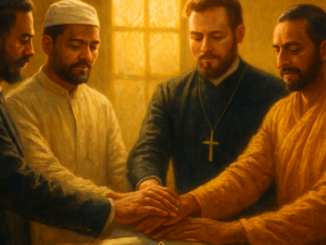
Voltaire reflecting on religious tolerance and Freemasonry in England
Symbolism & Rituals

Voltaire on the Anglicans: Religious Freedom and Brotherhood

What happens when one of history’s sharpest minds flees his homeland and discovers, in exile, a society where religious diversity leads not to chaos but to prosperity? François-Marie Arouet — better known as Voltaire — had exactly that experience in England. He wrote about it in his Letters on the English, and his second letter, devoted to the Anglicans, paints a religious landscape that filled him with both astonishment and admiration. For those familiar with Freemasonry, his observations resonate in a remarkably powerful way. Voltaire touches on values the Craft has cherished for centuries: tolerance, the art of living together, and the ability to bridge differences without erasing them. The Paradox of a State Church Voltaire opens his letter with an apparent contradiction. England has a state church — the Church of England — which officially claims to represent the one true faith. Yet at the same time, he observes a society in which dissenters, Catholics, Quakers, and Jews live and trade alongside one another. How can a state church exist without producing the tyranny Voltaire knew so well from France? This question forces us to reconsider the very nature of religious institutions. Is a church by definition an instrument […]
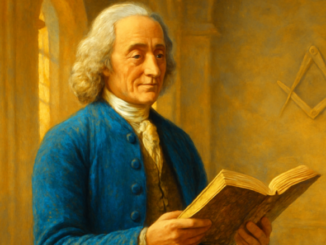
Voltaire writing at a desk with philosophical texts and Anglican church in background
Symbolism & Rituals

Voltaire on the Anglicans: Philosophical Roots and Influences

When Voltaire fled to England in 1726, forced into exile by political circumstances, he carried more than just his razor-sharp pen. He brought with him a mind shaped by the great thinkers of his era. His observations on the Anglican Church, recorded in his famous Letters on the English (also known as the Philosophical Letters), were far more than superficial travel writing. They revealed a deeply rooted philosophical vision of religion, tolerance, and human freedom. What intellectual currents and thinkers shaped that vision? And what can modern seekers of wisdom — including those who walk the Masonic path — learn from the sources Voltaire drew upon? The Legacy of John Locke: Reason as the Measure of All Things No thinker influenced Voltaire’s view of religion more profoundly than John Locke. The English philosopher, whose works Voltaire studied extensively during his exile, had put forward a revolutionary thesis: religious convictions must be able to withstand the test of reason. In his Letter Concerning Toleration, Locke argued that the state has no right to impose matters of conscience. Voltaire embraced this principle wholeheartedly and saw in Anglican practice an embodiment of this rational approach. Where the Catholic Church of Voltaire’s homeland based […]

Voltaire reflecting on the Anglican Church and religious tolerance in England
Symbolism & Rituals

Voltaire on the Anglicans: Tolerance as a Religious Virtue

In his second philosophical letter, Voltaire turns his sharp gaze toward the Anglican Church. Having already shared his observations on the Quakers, he now examines an established state church that, despite its official status, displays a remarkable degree of religious tolerance. By placing two worlds side by side — the rigid French Catholicism of his era and the pragmatic English approach to faith and state power — Voltaire reveals not only differences in ecclesiastical organization, but touches on deeper questions about freedom, hierarchy, and the symbolic meaning of religious institutions. The Heart of Voltaire’s Argument Voltaire describes the Anglican Church as a curious blend of Protestant theology and Catholic aesthetics. The bishops still wear their mitres, the cathedrals retain their grandeur, and the liturgy carries a solemnity reminiscent of Rome. Yet the doctrine is fundamentally different. The monarch stands at the head of the church, not the Pope. This institutional break with Rome, Voltaire argues, has not led to chaos but rather to a workable order in which religious disagreements are far less likely to result in bloodshed. The central theme of this letter is the relationship between state power and religious authority. Voltaire observes that the English have found […]

Voltaire meeting a Quaker in a simple English home, symbolizing Enlightenment ideals
Symbolism & Rituals

Voltaire on the Quakers: Philosophy, Simplicity & Tolerance

When Voltaire set foot in England in 1726, he encountered a community that fascinated him profoundly: the Quakers. His first Philosophical Letter is far more than a traveler’s curiosity piece about an unusual religious group. It is a carefully constructed mirror held up to French society — and, by extension, to any society that confuses outward ceremony with genuine virtue. For anyone interested in the deeper currents of Freemasonry, Enlightenment thought, and the quest for authentic inner truth, Voltaire’s encounter with the Quakers remains remarkably relevant. The Encounter: A Philosopher Among the Quakers Voltaire opens his letter with a vivid scene. He visits an elderly Quaker at his home, perhaps expecting an exotic encounter with an eccentric. Instead, he finds a man of modest prosperity — calm, receptive, and entirely free of the customary social formalities. The Quaker does not remove his hat. He addresses Voltaire with the familiar “thou” rather than the formal “you.” There is no trace of deference or subservience. For Voltaire, accustomed to the rigid hierarchical etiquette of the French court, the experience is both refreshing and unsettling. These seemingly trivial details form the heart of Voltaire’s argument. The hat that stays on is not a […]

Freemasonry symbols representing unity and respect among world religions
Religion

Freemasonry and Religion: A Bridge of Connection and Respect

Freemasonry is an ancient fraternity built on universal values such as truth, brotherhood, and morality. While it is not a religion, it maintains a unique and fascinating relationship with religions around the world. How does Freemasonry position itself in relation to faith traditions, and what makes its spiritual vision so distinctive? Freemasonry: Not a Religion, But Deeply Spiritual One of the most common misconceptions about Freemasonry is that it is a religion. It is not. Freemasonry does not require its members to hold any specific religious belief. What it does ask is that members believe in a Supreme Being — often referred to as the “Grand Architect of the Universe” — a universal concept of a higher power that transcends any single faith tradition. This openness allows people from all religious backgrounds to participate and find common ground. The rituals and symbols used in Freemasonry are not religious in the traditional sense. Instead, they serve as tools for self-reflection and moral growth. This approach provides a shared foundation for members who may hold vastly different religious convictions, creating a space where spiritual exploration is encouraged without imposing any doctrine. How Freemasonry Relates to World Religions Respect for Diversity: Freemasonry recognizes […]