
What betrays a person more than their own conscience? In the fifth essay of the second book of his famous Essays, Michel de Montaigne tackles a question that has preoccupied judges and philosophers for centuries: can a suspect’s conscience serve as evidence of guilt? The answer Montaigne offers is far more nuanced than one might expect — and it touches on themes that resonate deeply within Freemasonry. This article provides an accessible summary of this compact but powerful essay and places its core idea alongside the perspective of the Craft.
The Core Idea of the Essay
Montaigne opens with a seemingly simple observation: people who feel guilty often betray themselves through their own behavior. A sudden blush, a trembling voice, a restless gaze — the conscience, he argues, is an inner prosecutor that needs no lawyer. He invokes the Latin saying that the first trial takes place in the heart of the guilty, long before any judge passes sentence.
But Montaigne wouldn’t be Montaigne if he left it there. Beneath the apparent clarity of this premise lurks a danger. The essay revolves around the ambiguity of outward signs: are they truly reliable evidence of guilt? Or can an innocent person tremble before a judge just as easily, simply out of fear of the proceedings themselves?
Montaigne’s Examples: From Torture to Self-Betrayal
Montaigne supports his argument with a series of historical examples, characteristic of his method. He draws on stories from classical antiquity, including anecdotes about the practice of torture as a means of discovering truth. He demonstrates that the rack can just as easily drive an innocent person to a false confession as it can unmask someone who is genuinely guilty. The body, he contends, is an unreliable witness. Pain makes every person weak, regardless of guilt or innocence.
He also recounts cases in which people came forward to confess crimes without any external pressure. Their conscience had tormented them so relentlessly that the punishment of the outside world seemed almost a relief compared to the inner torture. In one striking example, a man who overheard a casual remark at dinner suddenly turned pale and ultimately confessed to a murder he had committed. Here, conscience operated as an invisible force more powerful than any interrogation.
Two Perspectives: The Judge and the Philosopher
The essay can be read as a comparison between two fundamentally different ways of looking at conscience. On one hand, there is the perspective of the judge — the outsider searching for visible signs of guilt. For the judge, a suspect’s blushing, stuttering, or averted gaze provides clues that shape the verdict. The outward appearance is read as a mirror of the inner self.
On the other hand, there is the perspective of the philosopher — and above all, Montaigne himself — who warns against the fallibility of these same signs. A blush can just as easily stem from shyness, from the pressure of the moment, or from a sensitive temperament. Montaigne is not defending the guilty here; he is protecting the innocent. He argues for recognizing the difference between what the body reveals and what the soul truly carries.
The conscience is the strictest judge a person will ever face, but its verdict is invisible to outsiders.
Conscience in Freemasonry
Anyone who reads this essay from a Masonic perspective will recognize a kindred theme. The Craft has a long tradition of inner self-examination that does not depend on the judgment of others. The Chamber of Reflection, where a candidate is left alone with his thoughts before initiation, is a space designed precisely for the purpose of encountering one’s own conscience. There is no judge, no prosecutor — only the individual facing himself.
Where Montaigne warns that the outside world can misread the conscience, Freemasonry emphasizes that conscience is an inner compass that only its bearer can calibrate. The square and compasses — two of the most recognizable working tools in the lodge — symbolize the ability to measure one’s own actions against an internal standard. It is not the judgment of another that determines one’s moral course, but the quiet conversation a person conducts with his own conscience.
What Both Traditions Share
Montaigne’s essay and Freemasonry share a deep-seated distrust of superficial judgments. Both acknowledge that the true state of a person is not revealed by what is visible, but by what unfolds in silence. Montaigne calls the conscience the first and last judge. Freemasonry speaks of the rough ashlar that can only be shaped by the individual himself. In both traditions, honesty with oneself is the indispensable precondition for any moral life.
At the same time, they differ in approach. Montaigne writes as a skeptic who observes and doubts. He offers no solution, no method, no ritual. Freemasonry, by contrast, provides a structured path: a series of rituals and degrees designed to help the practitioner become step by step more familiar with his own inner world. Where Montaigne leaves the question open, the lodge offers a framework for seeking the answer yourself.
What This Essay Teaches Us
The most important lesson from Montaigne’s essay on conscience is one of humility. We are inclined to interpret other people’s behavior as evidence of their inner state, when that same behavior may have countless other causes. The judge who thinks he sees guilt in a trembling hand may be just as mistaken as the friend who reads indifference into a silence.
Conscience is an inner force that cannot be fully measured or read from the outside. Its workings are deeply personal, often irrational, and always beyond the reach of an observer’s certainty. For Freemasons, this insight serves as a powerful reminder: the work on the self is never finished, and the most meaningful judgments are the ones we make about ourselves — in the stillness of our own reflection.
Montaigne’s short essay on conscience remains remarkably relevant, both for those interested in philosophy and for Freemasons who understand that moral growth begins with honest self-examination. The conscience needs no courtroom, no witnesses, and no external authority. It operates quietly, relentlessly, and — as Montaigne so vividly illustrates — sometimes with more force than any judge could ever command. In the lodge, as in Montaigne’s study, the most important question is always the one you ask yourself.
Copyright text & image: devrijmetselaar.nl
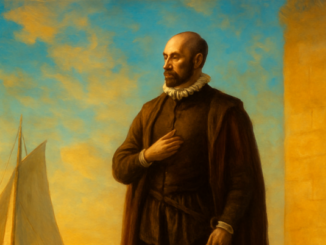
Texts are based on the ideas and content of the author of devrijmetselaar.nl, reviewed, corrected, and supplemented with the assistance of OpenAI. Images are created based on the ideas of the author of devrijmetselaar.nl using OpenAI/DALL-E.
Frequently Asked Questions
What is Montaigne's main argument about conscience as evidence of guilt?
Montaigne argues that while a guilty conscience often betrays itself through physical signs like blushing, trembling, or restless behavior, these outward signs are not reliable evidence of guilt. An innocent person may exhibit the same symptoms simply out of fear of judicial proceedings, making it dangerous to assume that visible signs of distress confirm culpability.
What examples does Montaigne use to support his essay?
Montaigne draws on historical examples from classical antiquity, including cases of torture as a means of extracting truth. He demonstrates that torture is unreliable—it can force innocent people to confess false crimes as easily as it can unmask the guilty. He also recounts cases where people voluntarily confessed to crimes because their conscience tormented them more severely than any external punishment.
How does Montaigne's essay relate to Freemasonry?
The article suggests that Montaigne's nuanced perspective on conscience resonates with Masonic principles. His exploration of the tension between inner moral judgment and external evidence touches on themes central to Freemasonry, such as personal integrity, self-examination, and the development of conscience as a guide to moral behavior within the Craft.



Be the first to comment