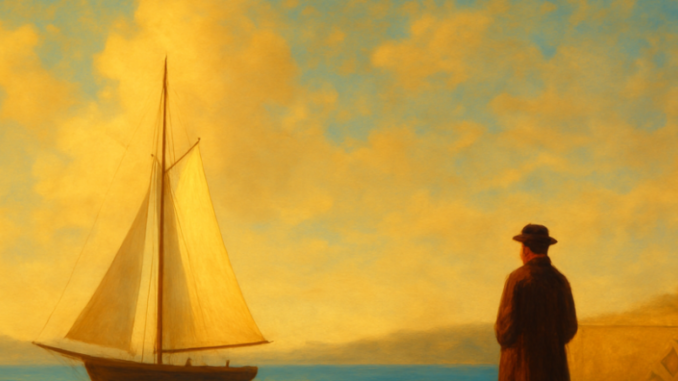
A letter lies on a desk. It has been written, the wax seal is ready, but the hand that should seal it hesitates. It is an ordinary scene — familiar to anyone who has ever postponed something they knew needed to be done. Yet behind that simple gesture of hesitation lies a world of meaning. Michel de Montaigne saw in procrastination not merely a human weakness, but a mirror in which we can read our relationship to others, to time, and to ourselves. It is precisely in that mirror where his thinking touches the heart of what Freemasonry strives for: conscious living, genuine connection, and acting from inner truthfulness.
The Unsealed Letter as a Mirror
Picture a desk in sixteenth-century France. Michel de Montaigne sits in his tower study, surrounded by books, with Latin and Greek inscriptions carved into the beams above his head. Before him lies a letter to a friend. The words have been chosen carefully, the intention is sincere, but something holds him back. Not the content, not uncertainty about the right phrasing, but something subtler: the feeling that there is always a tomorrow.
In his essay “On Procrastination,” Montaigne examines exactly this mechanism. He describes how people tend to postpone important actions — not out of laziness, but out of a false trust in the future. The unsealed letter becomes more than a practical oversight. It becomes an image of everything we neglect in our relationships, our responsibilities, and our inner lives.
What We Postpone, We Postpone Within Ourselves
In this essay, Montaigne cites the Roman philosopher Seneca and the poet Horace, both of whom warned against the illusion that the future belongs to us. Tomorrow is promised to no one. But Montaigne goes further than a simple call for efficiency. He poses a deeper question: what does our habit of procrastination reveal about the way we are connected to others?
When we fail to send a letter, to have a conversation, or to make a gesture of reconciliation, we do not merely break an appointment with another person — we break a promise to ourselves. We postpone who we want to be.
This insight resonates deeply with a fundamental Masonic idea. In the lodge, Masons speak of working the rough ashlar — the continuous process of self-improvement. But a stone that is never touched remains rough. Tools left unused in the corner lose their purpose. The compass and the square call for hands willing to act.
Brotherhood as Action, Not Intention
One of the pillars of Freemasonry is brotherhood. The word sounds warm and self-evident, but anyone who looks honestly at themselves knows that real connection never happens by itself. Brotherhood demands active commitment: listening when you would rather speak, forgiving when you would rather hold on, being present when you would rather keep your distance.
Montaigne understood this. His essays are filled with examples of human relationships that withered through neglect, not through malice. He writes of friendships lost because no one took the initiative, of chances for reconciliation that evaporated in the heat of daily life. His profound friendship with Étienne de La Boétie, who died young, forms the unspoken undercurrent of his entire body of work. That loss taught him that connection cannot wait.
Brotherhood is not a feeling you cherish — it is an act you carry out. To postpone connection is to postpone the best in yourself.
Ritual as an Antidote to Procrastination
Freemasonry possesses a powerful remedy against the human tendency to postpone: ritual. In the lodge, a fixed pattern of actions, words, and gestures returns each time. This rhythm is not routine — it is a deliberate exercise in presence. The ritual compels the participant to act now, to listen now, to reflect now on the question of who they are and who they wish to become.
Marcus Aurelius, the Stoic emperor and philosopher, wrote in his Meditations that every morning should be lived as if it were the last — not out of fear, but out of reverence for life itself. This idea runs like a thread through both Stoic philosophy and the ritual practice of Freemasonry. Montaigne, who admired and frequently quoted Marcus Aurelius, translated that same conviction into the domain of personal relationships: do not wait to show your true face to those you hold dear.
Three Masonic Values That Resonate With Montaigne
Self-reflection: Montaigne invites us to honest self-examination. Just as the Masonic candidate enters the Chamber of Reflection to confront himself, Montaigne forces himself to face what he has been avoiding.
Virtue as practice: For Montaigne, virtue is not an abstract ideal but a daily choice. Freemasonry shares this conviction: moral growth comes through deeds, not through good intentions alone.
Brotherly connection: The essay reminds us that the bonds we share with others require maintenance. In the lodge, this becomes visible in the collective work toward a shared ideal — stone by stone, meeting by meeting.
The Sealed Letter: Acting as a Deed of Connection
Let us return to the image with which we began. The letter on the desk, the wax seal waiting. What changes when we finally seal and send it? In practical terms, very little: a piece of paper changes hands. But in reality, everything changes. By acting, we acknowledge that the other person matters, that the moment matters, that we ourselves matter.
Montaigne shows us that procrastination is no innocent pastime — it is a subtle form of detachment from life itself. Freemasonry offers an answer to that detachment. Not through grand gestures or heroic deeds, but through the quiet, repeated decision to be present. In the ritual, in the chain of brotherhood, in the conversation that follows the labor of the evening.
Every time a Freemason enters the lodge, he answers the question that Montaigne posed centuries ago: will you act today, or will you leave it for a tomorrow that may never come?
Montaigne’s unsealed letter is more than a historical curiosity — it is a living challenge. It asks each of us whether we are willing to close the gap between intention and action, between who we are and who we aspire to be. Freemasonry, with its rituals, its brotherhood, and its call to work the rough stone, provides both the tools and the sacred space to answer that challenge. The seal is in your hand. The moment is now.
Copyright text & image: devrijmetselaar.nl
Texts are based on the ideas and content of the author of devrijmetselaar.nl, reviewed, corrected, and supplemented with the assistance of OpenAI. Images are created based on the ideas of the author of devrijmetselaar.nl using OpenAI/DALL-E.
Frequently Asked Questions
What is the connection between Montaigne's essay on procrastination and Freemasonry?
Montaigne's examination of procrastination as a failure to act on our intentions mirrors Freemasonry's core principle of conscious living and self-improvement. Both emphasize that postponing actions—whether writing a letter or pursuing personal growth—represents a broken promise to ourselves. In Freemasonry, this relates to 'working the rough ashlar,' the continuous process of self-improvement that requires active engagement rather than mere intention.
What does Montaigne mean by 'the unsealed letter' as a metaphor?
The unsealed letter represents more than a practical oversight. It symbolizes all the neglected aspects of our lives—relationships left unattended, responsibilities deferred, and our inner potential left undeveloped. When we fail to send a letter or take meaningful action, we are not just breaking an appointment with another person; we are postponing who we want to be and breaking a promise to ourselves.
How does Montaigne's philosophy challenge the common view of procrastination as mere laziness?
Montaigne argues that procrastination stems not from laziness but from a false trust in the future—a belief that tomorrow is guaranteed to us when it is not. He cites ancient philosophers like Seneca and Horace to show that this illusion has long been recognized. This deeper understanding reveals procrastination as a disconnection from our authentic selves and our relationships, rather than simply poor time management.


Be the first to comment