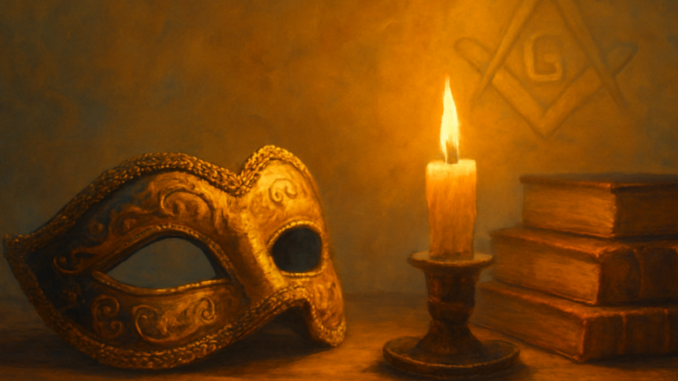
Few films have sparked as much speculation about secret societies as Stanley Kubrick’s final masterpiece from 1999. Eyes Wide Shut presents a nocturnal ritual filled with masked figures, mysterious passwords, and an impenetrable hierarchy. Since its release, the film has been linked to Freemasonry, occult lodges, and hidden power structures. But how accurate is that portrayal? And what does the real history of brotherhood and ritual tell us about the fascination lurking behind these powerful images?
The Venetian Mask: From Carnival Tradition to Film Icon
The scene that burns most vividly into memory takes place at a country estate where participants wear Venetian masks. This was no arbitrary artistic choice. The Venetian mask has a history stretching back to the thirteenth century, when it was worn during the Carnival of Venice to temporarily dissolve social rank. Behind the mask, the nobleman was equal to the merchant, the physician equal to the servant. It was a ritual of equality — however fleeting.
That tradition resonates with one of the oldest principles of Freemasonry: within the lodge, all brethren are equal, regardless of social standing, profession, or background. In the film, however, the masks are not used to create equality but to conceal identity and enforce exclusion. That distinction is crucial, and it deserves closer attention.
Kubrick, Schnitzler, and the Shadow of Vienna
Eyes Wide Shut is based on Traumnovelle (Dream Story), a novella by Arthur Schnitzler published in 1926. Schnitzler was a Viennese physician and writer who moved in the intellectual circles surrounding Sigmund Freud. His story is set in Vienna around 1900 — a city steeped in secret societies, student fraternities, and lodges. The Habsburg capital was once home to dozens of Masonic lodges, until Empress Maria Theresa and later Emperor Francis II severely curtailed their activities. By the time Schnitzler was writing, those lodges had officially ceased to exist in Austria, but the cultural memory of them was very much alive.
Schnitzler did not describe a Masonic lodge. He depicted an anonymous society more reminiscent of the libertine salons of the eighteenth century, where sexual freedom and secrecy went hand in hand. Kubrick translated this into a contemporary setting and added visual elements that deliberately evoke associations with ritualistic societies. The result is a collage of cultural references that reveals more about our fear of the unknown than about any actual organization.
What Eyes Wide Shut Gets Wrong About Real Brotherhood
The film’s power lies in the unease it conjures. But that very unease distorts the picture of what brotherhood truly means. In Freemasonry, ritual is not intended to intimidate outsiders or disguise power structures. Ritual serves as a mirror: it confronts the participant with himself — with his own shortcomings and his potential for growth. Wolfgang Amadeus Mozart, himself a Freemason and member of the Viennese lodge Zur Wohltätigkeit, channeled that experience into his opera The Magic Flute, in which Tamino’s initiation journey follows a path of trial, self-knowledge, and ultimate enlightenment.
Brotherhood in Freemasonry is not an exclusive society of power. It is a voluntary bond among men who help each other become better people.
Where the film presents a closed world built on secrecy and threat, Masonic brotherhood is founded on trust and mutual responsibility. The difference between secrecy and discretion is fundamental. A Masonic lodge keeps its rituals private not to hide something sinister, but to provide a safe space for genuine self-reflection.
The Enduring Appeal of the Hidden
Why does the film continue to captivate audiences nearly three decades after its release? The answer lies partly in a deeply human pattern. Since the Eleusinian Mysteries of ancient Greece — where initiates submitted under oath of secrecy to rituals honoring Demeter and Persephone — the hidden has exerted an almost magnetic pull on the human imagination. Plato referred to these mysteries as formative for understanding the soul. Aristotle described the experience not as knowledge gained, but as something undergone.
That fascination has not disappeared. In an age when information seems limitlessly available, there is a paradoxical hunger for the inaccessible. Popular culture feeds that hunger with images of sinister rituals and powerful shadow figures. Films like Eyes Wide Shut function as modern myths: they give shape to anxieties we struggle to name.
Myth Versus Practice
It is useful to place the film’s imagery alongside historical reality. James Anderson, who compiled the first Constitutions of Freemasonry in 1723, emphasized that the brotherhood should be a place where men of different faiths and backgrounds could meet in mutual respect. Jean-Théophile Desaguliers, a natural philosopher and one of the founders of the Grand Lodge of England, envisioned the lodge as a laboratory for moral improvement — not an instrument of power.
Several key distinctions separate Masonic practice from its fictional portrayals. Ritual serves as a pedagogical tool, not an instrument of domination. Discretion protects the personal growth of brethren, not their identities from the outside world. And brotherhood is rooted in voluntariness and equality, not in coercion or externally imposed hierarchy.
The film’s title contains a paradox: the eyes are wide open and yet closed. It describes a state of conscious blindness — of seeing what you want to see. That paradox is recognizable in our broader culture. We live in a world that suspects conspiracies everywhere while simultaneously losing sight of the true meaning of connection. Real brotherhood does not ask for blind obedience or hidden agendas. It asks for open eyes, honest self-examination, and the courage to grow alongside others. Perhaps the most important lesson Eyes Wide Shut inadvertently teaches us is this: the difference between mystery and mystification is the difference between seeking light and choosing to remain in the dark.
Copyright text & image: devrijmetselaar.nl
Texts are based on the ideas and content of the author of devrijmetselaar.nl, reviewed, corrected, and supplemented with the assistance of OpenAI. Images are created based on the ideas of the author of devrijmetselaar.nl using OpenAI/DALL-E.
Frequently Asked Questions
Is Eyes Wide Shut actually about Freemasonry?
While the film has been linked to Freemasonry due to its masked rituals and hierarchical society, Kubrick did not depict an actual Masonic lodge. The story is based on Arthur Schnitzler's novella, which portrayed an anonymous society more reminiscent of libertine eighteenth-century salons. Kubrick added visual elements that deliberately evoke ritualistic societies, creating a collage of cultural references rather than an accurate portrayal of Freemasonry.
What is the historical significance of Venetian masks in the film?
Venetian masks date back to the thirteenth century and were worn during the Carnival of Venice to temporarily dissolve social rank, creating equality among different classes. This tradition aligns with Freemasonry's principle that all brethren are equal regardless of social standing. However, in Eyes Wide Shut, the masks serve the opposite purpose—concealing identity and enforcing exclusion rather than promoting equality.
Why did Kubrick choose to adapt Schnitzler's novella for a contemporary setting?
Schnitzler's Traumnovelle was set in Vienna around 1900, a city with a rich history of secret societies and lodges that had been officially suppressed. By translating the story to a contemporary setting, Kubrick tapped into enduring cultural fascination with hidden power structures and secret rituals. The adaptation reveals more about our collective fear of the unknown than about any actual secret society.

Be the first to comment