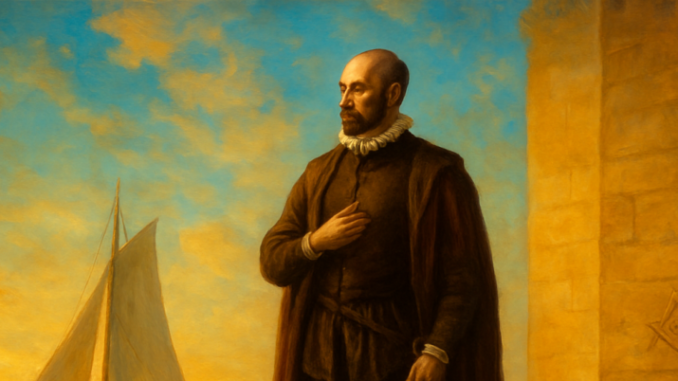
There is a feeling most of us recognize: you achieve something you are genuinely proud of, but the moment you share that pride, the shine seems to fade. Or perhaps you notice a reluctance to share credit with others, even when they contributed just as much. It is a deeply human tendency, and it is precisely this theme that Michel de Montaigne explores in his brief but penetrating essay “On Not Sharing One’s Honor.” What he wrote centuries ago speaks with surprising directness to the heart of what Freemasons strive for — honesty with oneself, humility in dealing with others, and the question of what honor truly means when it is shared.
What Montaigne Really Meant
In Essay 41 of the first book of his famous Essays, Michel de Montaigne poses a deceptively simple question: why are we so reluctant to share our honor? He observes that generals and leaders habitually claim personal glory for victories that are, in reality, the result of collective effort. The soldiers on the battlefield, the advisors behind the scenes, the fortunate circumstances that aligned — all of them fade into the background the moment the laurel wreath is handed out.
Montaigne does not criticize this tendency with a wagging finger. Instead, he uses the gentle, inquiring tone that defines his writing. He holds up a mirror and asks: is your honor truly yours alone?
What makes this essay remarkable is that Montaigne does not argue for renouncing all personal honor. He acknowledges that individual merit exists. But he points out that clinging to honor — guarding it anxiously as though it were a scarce resource — reveals something about our own insecurity. The truly honorable person does not need to protect their glory from being shared, because their inner worth does not depend on external recognition.
The Freemason and the Temptation of Personal Glory
Imagine being part of a group working together on something of real value — not a building made of stone, but an edifice of character, of mutual connection, of shared principles. That is essentially what Freemasons do when they gather in their lodge. The work of the lodge is collective by definition. No single brother can claim to have built the temple alone.
Yet even within Freemasonry, the very human desire to stand out, to be seen, to receive recognition for one’s contribution is always present. Montaigne would have nodded knowingly. He understood that temptation, and he knew it was unavoidable.
Freemasonry, however, offers a powerful counterweight to this tendency. The ritual constantly reminds the brethren that the work is greater than the individual. The rough ashlar that is shaped and refined is not meant to be a showpiece for the sculptor — it is a building block for something larger. In this sense, the Masonic tradition aligns seamlessly with what Montaigne argued: true honor does not arise from claiming it, but from earning it quietly, through service, through connection with others.
Honor as a Mirror of Inner Growth
What Montaigne saw so clearly — and what Freemasons recognize in their own tradition — is that how we handle honor is a mirror of our inner development. Someone who desperately protects their honor reveals that their self-image depends on the outside world. Someone who can freely share their honor demonstrates that their foundation lies elsewhere: in their own conscience, in their dedication to virtue, in the quiet satisfaction of work well done.
This is what the Stoic philosophers, whom Montaigne so admired, had proclaimed centuries earlier. Marcus Aurelius wrote in his Meditations that fame is fleeting, and that the true measure of a person lies in how they act when no one is watching.
True honor does not need to be protected from being shared — it actually grows by being divided.
In Freemasonry, this principle becomes visible in the way brethren interact. The Worshipful Master of a lodge receives respect, but he knows that his authority is temporary and that it springs from the trust of his brethren, not from his own greatness. The newly initiated Entered Apprentice contributes just as much to the whole as the most experienced brother, for without new stones, no temple can grow. This awareness of mutual dependence is exactly what Montaigne means when he writes about sharing honor: it is not a loss, but an acknowledgment of the truth.
Connection as the Antidote to Vanity
There is a deeper layer in Montaigne’s argument that holds particular relevance for Freemasonry. Holding on to personal honor is ultimately a form of isolation. Whoever claims all credit for themselves places themselves outside the community. They become the hero of their own story, but they lose connection with the people who helped write that story.
Montaigne — who spent a lifetime navigating the tension between his need for solitude and his longing for friendship — understood this like few others. His celebrated friendship with Étienne de La Boétie taught him that the most beautiful experiences in life are precisely those in which the distinction between “my” merit and “your” merit dissolves entirely.
For Freemasons, connection is not an abstract ideal but a lived practice. The chain of union, in which all present hold each other’s hands, is perhaps the most powerful example. In that chain, there is no first and no last. No brother contributes more to the strength of the chain than any other. It is a physical expression of the insight Montaigne captured in words: shared honor is not diminished honor — it is honor amplified.
What You Can Take Away from This
You do not need to be a Freemason to put these insights into practice. Montaigne wrote for everyone willing to look honestly at themselves. The next time you achieve something meaningful, pause and consider who else contributed. When you feel the impulse to guard your accomplishments, ask yourself what that impulse reveals. And when you find the courage to share credit generously, notice how it does not diminish your satisfaction — but deepens it.
In a world that constantly encourages personal branding and individual achievement, the wisdom of Montaigne and the practice of Freemasonry both point toward the same quiet truth: the most enduring form of honor is the kind that binds us to others rather than setting us apart.
Montaigne’s essay on not sharing honor may be short, but its implications run deep — especially for anyone committed to self-improvement and genuine brotherhood. Whether within the walls of a Masonic lodge or in everyday life, the willingness to share honor is not a sign of weakness. It is a mark of maturity, of inner strength, and of the understanding that we are all rough stones being shaped together into something far greater than any one of us could build alone.
Copyright text & image: devrijmetselaar.nl
Texts are based on the ideas and content of the author of devrijmetselaar.nl, reviewed, corrected, and supplemented with the assistance of OpenAI. Images are created based on the ideas of the author of devrijmetselaar.nl using OpenAI/DALL-E.
Frequently Asked Questions
What is Montaigne's main argument about sharing honor?
Montaigne argues that our reluctance to share honor reveals personal insecurity. He observes that leaders and generals often claim sole credit for collective achievements, but points out that truly honorable people do not need to protect their glory from being shared because their inner worth does not depend on external recognition. He does not advocate for renouncing personal honor entirely, but rather questions whether clinging to it anxiously demonstrates genuine honor or merely insecurity.
How does Montaigne's essay relate to Freemasonry?
The article connects Montaigne's ideas to Freemasonry by noting that lodge work is inherently collective—no single brother can claim to have built the temple alone. Yet Freemasons, like all humans, experience the temptation to seek personal recognition and stand out. Montaigne's philosophy speaks directly to the Masonic values of honesty with oneself, humility in dealing with others, and understanding what honor truly means when shared among brothers.
Does Montaigne believe people should give up all personal honor?
No. Montaigne acknowledges that individual merit exists and does not argue for renouncing all personal honor. Rather, he challenges the anxious guarding of honor as though it were a scarce resource. His point is that holding honor loosely—being willing to share credit and recognition—does not diminish true honor but rather reflects genuine inner worth that does not depend on external validation.



Be the first to comment