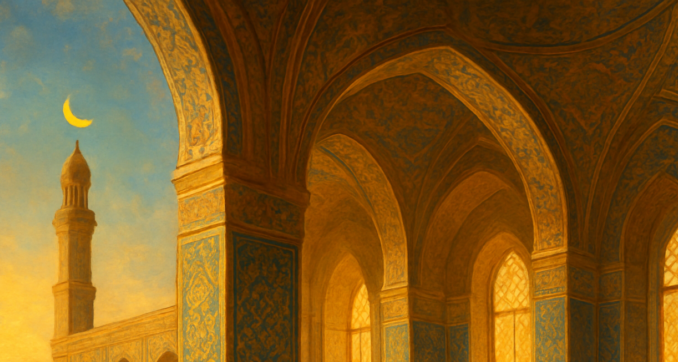
In the year 250 AD, according to an ancient tradition, seven young men fled the Roman city of Ephesus and sought refuge in a mountain cave. They were escaping religious persecution, but what they found there would transcend the centuries — a story of faith, steadfastness, and divine protection that continues to inspire millions to this day. This story lies at the heart of Surah Al-Kahf, the eighteenth chapter of the Quran, known in English simply as The Cave. For Freemasons, who have long been drawn to the spiritual traditions of humanity, this surah offers surprisingly rich connections.
The Historical Roots of the Cave Story
The legend of the sleepers in the cave, known in Arabic as Ashab al-Kahf, has deep roots in the late ancient world. The story had already been circulating in Christian sources since the fifth century and was committed to writing by the Syriac bishop Jacob of Serugh around 500 AD. The young men — later venerated by Christians as the Seven Sleepers of Ephesus — are said to have slept for more than three hundred years in their cave, protected by the hand of God, only to awaken in a world that had finally embraced their faith.
When the Quran was revealed in the seventh century, Surah Al-Kahf incorporated this story and imbued it with universal spiritual significance. The cave became a symbol of protection and spiritual purification — a place where the soul withdraws from the confusing world to draw closer to the Divine. This theme resonates remarkably with what Freemasons know as the Chamber of Reflection: the space of contemplation that precedes initiation.
The Four Great Narratives of The Cave
Surah Al-Kahf contains not one but four interwoven stories, each conveying a fundamental lesson about human existence. Beyond the tale of the youths in the cave, we encounter the parable of two garden owners — one who attributes his wealth to his own merit, and another who acknowledges that all blessings come from God. The third narrative describes the journey of Moses with a mysterious guide known as Al-Khidr, who teaches him that divine wisdom often remains hidden from human understanding. Finally, the surah tells of Dhul-Qarnayn, a righteous ruler who uses his power to protect the weak.
Each of these stories addresses a core human challenge. The cave represents spiritual withdrawal and divine protection. The two gardens teach humility and the recognition of our limitations. Moses and Al-Khidr embody the search for hidden knowledge. And Dhul-Qarnayn stands as the ideal of just leadership. Together, they form a comprehensive guide to the spiritual life — one that speaks across traditions and centuries.
Parallels with the Masonic Experience
The spiritual themes of Surah Al-Kahf bear striking resemblances to the symbolic journey that Freemasons undergo during their initiation. The cave as a place of darkness and reflection calls to mind the Chamber of Reflection, where the candidate is invited to step back from the outer world and turn inward toward deeper values. Just as the youths in the cave placed their trust in a higher power, the Freemason is asked to place his trust in the Grand Architect of the Universe — however one may understand that concept.
The story of Moses and Al-Khidr speaks with particular force to the Masonic spirit. The search for knowledge, the recognition that true wisdom is often concealed from immediate understanding, and the necessity of a guide or master to show the way — these are themes that stand at the very center of the Masonic tradition. The Freemason begins as an Entered Apprentice, not knowing what he does not know, and gradually grows toward greater understanding. This posture of intellectual humility — of knowing that one cannot know everything — is precisely what Moses must learn during his journey with Al-Khidr.
In all traditions, the cave serves as a symbol of the inner journey: a temporary withdrawal from the world that leads to deeper insight and moral renewal. Whether it is Plato’s allegory, the Quranic narrative, or the Masonic Chamber of Reflection, the pattern is the same — descent before ascent, darkness before light.
Light Emerging from Darkness
One of the most striking elements of Surah Al-Kahf is its symbolism of light and darkness. The youths enter the dark cave, yet ultimately awaken into the light of a new era. This theme of transformation through darkness is universally recognizable. The philosopher Plato described in his Allegory of the Cave how human beings must rise from the shadows of ignorance toward the light of knowledge. The Church Father Augustine, who lived in the same period as the Seven Sleepers, wrote about the journey of the soul from darkness into divine light.
For Freemasons, this symbolism of light emerging from darkness is the very foundation of their ritual experience. The candidate begins blindfolded in the Chamber of Reflection and ultimately receives the light during initiation. This is no coincidental parallel — it points to a deep human experience recognized across all great traditions: genuine growth first requires a period of uncertainty, of not-knowing, of surrender to something greater than ourselves.
The journey from darkness to light is not merely symbolic decoration. It reflects a psychological and spiritual truth that mystics, philosophers, and initiatory traditions have understood for millennia. We cannot truly appreciate the light unless we have first sat in the darkness. We cannot fully grasp wisdom unless we have first confronted our own ignorance.
The Enduring Relevance of an Ancient Story
What can we learn today from a story told more than a thousand years ago in the deserts of Arabia? Surah Al-Kahf reminds us that spiritual growth is not a straight line. Sometimes we must withdraw in order to move forward. Sometimes we must acknowledge that we do not understand everything in order to arrive at deeper comprehension. The cave is not a destination — it is a passageway, a place of transformation.
For Freemasons, this message carries particular weight. The Craft has always taught that wisdom is not acquired all at once but revealed gradually, degree by degree, through experience, reflection, and the willingness to be guided. The Entered Apprentice does not understand what the Master Mason understands — and this is not a failure but a necessary stage of growth. Surah Al-Kahf, read through Masonic eyes, affirms this ancient truth in a voice that comes from a different tradition but speaks the same universal language.
In a world that grows ever faster and louder, the image of the cave offers a powerful counterpoint. It invites us to seek moments of stillness, to interrupt the constant stream of distraction, and to make space for inner growth. This is not an escape from the world but a preparation to meet the world with greater wisdom and compassion — precisely as the youths emerged from the cave as witnesses to a deeper truth. Whether we find our cave in the pages of sacred scripture, in the silence of the Chamber of Reflection, or in the quiet of our own contemplation, the invitation remains the same: withdraw for a time, so that you may return transformed.
Copyright text & image: devrijmetselaar.nl
Texts are based on the ideas and content of the author of devrijmetselaar.nl, reviewed, corrected, and supplemented with the assistance of OpenAI. Images are created based on the ideas of the author of devrijmetselaar.nl using OpenAI/DALL-E.
Frequently Asked Questions
What is the connection between Surah Al-Kahf and Freemasonry?
Surah Al-Kahf, the eighteenth chapter of the Quran, contains spiritual themes that resonate with Masonic teachings. The cave serves as a symbol of spiritual protection and purification, which parallels the Masonic Chamber of Reflection—a space of contemplation that precedes initiation. Freemasons, drawn to humanity's spiritual traditions, find rich symbolic connections in the surah's exploration of faith, steadfastness, and divine wisdom.
Who were the Seven Sleepers of Ephesus and why is their story significant?
The Seven Sleepers were seven young men who, according to ancient tradition around 250 AD, fled religious persecution in the Roman city of Ephesus and sought refuge in a mountain cave. They are said to have slept for over three hundred years, protected by God, awakening in a world that had embraced their faith. While the story circulated in Christian sources since the fifth century, the Quran incorporated it in Surah Al-Kahf, transforming it into a universal symbol of spiritual protection and divine providence.
What are the four main narratives contained in Surah Al-Kahf?
Surah Al-Kahf contains four interwoven stories: (1) the youths in the cave, representing spiritual withdrawal and divine protection; (2) the parable of two garden owners, teaching humility and recognition of divine blessings; (3) the journey of Moses with Al-Khidr, illustrating that divine wisdom often remains hidden from human understanding; and (4) the story of Dhul-Qarnayn, a righteous ruler who protects the weak. Each narrative addresses fundamental human challenges and spiritual lessons.

Be the first to comment