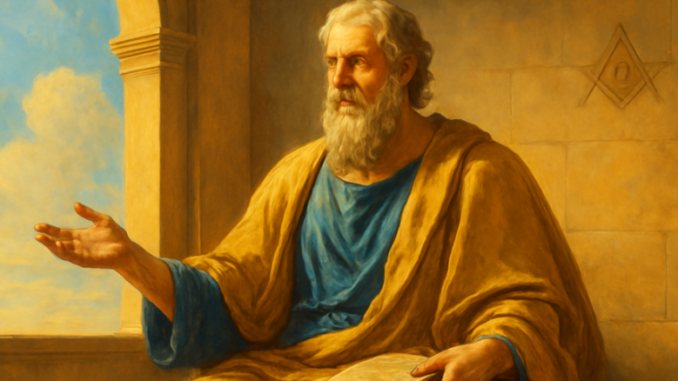
In fifth-century Athens, where democracy and philosophy flourished side by side, a young thinker posed a question that has never been abandoned since: what is justice, really? Plato did not write his dialogue The Republic in an intellectual vacuum. His struggle with this concept was rooted in decades of philosophical debate, political upheaval, and the tragic fate of his teacher Socrates. To understand why the first book of The Republic still resonates within the rituals and principles of Freemasonry, we must travel back to the sources that shaped Plato’s thought.
The Sophistic Legacy: Justice as Convention
Plato’s dialogue opens with a confrontation that exposes the intellectual heart of his era. Thrasymachus, a sharp-tongued Sophist, provocatively declares that justice is nothing more than the advantage of the stronger. This was no idle intellectual fancy. The Sophists — travelling teachers who sold rhetoric and wisdom — had fundamentally transformed Greek thought in the decades before Plato. Figures such as Protagoras and Gorgias undermined belief in absolute truths. Their relativism held that laws and morality were merely human conventions, malleable to the wishes of whoever held power.
Plato grew up in this intellectual arena. His family belonged to the Athenian aristocracy, and he witnessed firsthand how Sophistic rhetoric was weaponized in political power struggles. The Peloponnesian War, which overshadowed his youth, had demonstrated how fragile Athenian democracy became when self-interest took the lead. The execution of Socrates in 399 BCE — under the pretext of corrupting the youth — proved to Plato that a society without a solid foundation for justice ultimately destroys itself.
Socrates as Cornerstone: The Dialectical Method
What set Plato apart from his contemporaries was the legacy of Socrates. Where the Sophists sold answers, Socrates asked questions. His elenchus — the art of investigative dialogue — was designed to unmask false knowledge. In the first book of The Republic, we see this method in action as Socrates interrogates Cephalus, Polemarchus, and Thrasymachus in turn about their definitions of justice.
Cephalus, a wealthy old man, defines justice as speaking the truth and repaying debts. Socrates refutes this with a simple counterexample: would you return a weapon to a friend who had gone mad? Polemarchus refines the definition to giving each person what is owed to them, but this too crumbles under Socratic examination. The dialectic was never meant to destroy — it was meant to purify, to free the interlocutor from unexamined assumptions.
Justice begins where the unexamined life ends: in the willingness to test every conviction against the standard of reason.
For Freemasons, this resonates deeply. The Masonic tradition places great value on self-examination and the continual refinement of one’s character. Just as Socrates challenged his companions to question what they thought they knew, the Masonic journey encourages each Brother to chip away at the rough ashlar of unexamined beliefs and assumptions.
Pythagorean Influences: Harmony and the Soul
Less visible but no less important in Plato’s thinking was the influence of the Pythagoreans. A century and a half before Plato, Pythagoras of Samos had founded a brotherhood in which philosophy, mathematics, and spiritual purification were intertwined. The Pythagoreans believed that the cosmos was ordered according to mathematical proportions, and that the human soul could mirror this cosmic harmony.
Plato visited the Pythagorean communities in southern Italy and was profoundly impressed. In The Republic, justice ultimately appears as a form of inner harmony: each part of the soul fulfills its own function without disturbing the others. This architectural idea — that a just society mirrors the structure of a just soul — bears the unmistakable stamp of Pythagorean thought.
Freemasonry would later embrace remarkably similar principles of inner order and cosmic harmony. In the Masonic tradition, the temple is not merely a building — it is a symbol of the human soul in the process of becoming. The square, the compass, the perfect ashlar: these are all tools and symbols of the same aspiration toward inner balance that Plato articulated through his Pythagorean inheritance.
The Polis as Laboratory: Political Context
The Republic is inseparable from the crisis of the Greek city-state. During Plato’s lifetime, Athens experienced both the glory days of Pericles and the humiliation of defeat at the hands of Sparta. The oligarchic rule of the Thirty Tyrants — which included members of Plato’s own family — was brief but bloody. The restored democracy that condemned Socrates to death was, for Plato, not an ideal but a symptom of deeper decay.
Against this backdrop, the question of justice was no academic exercise — it was an existential necessity. Plato was not searching for a definition that could withstand debate; he was seeking a foundation upon which a truly just community could be built. The parallel with Freemasonry is striking: there, too, the work centers on building a better world, stone by stone, beginning with the rough stone of one’s own character.
Both traditions recognize that the outer world cannot be reformed until the inner world has been set in order. For Plato, this meant the philosopher’s ascent toward the Form of the Good. For the Freemason, it means the ongoing labor of moral and spiritual self-improvement — working the rough ashlar into a perfect one, fit to take its place in the greater edifice.
From Athens to the Lodge: An Enduring Resonance
The philosophical traditions that shaped the first book of Plato’s Republic converge on a question that has defied the centuries. Sophistic relativism returns in every generation; the Socratic method of fearless inquiry remains its antidote. The Pythagorean vision of harmony and order finds its echo in rituals that strive for inner transformation.
Consider the key threads that run through this ancient tapestry and into the modern lodge:
The Sophists taught that power determines morality — Plato contested this with the power of reason. Socrates introduced the dialectical method as an instrument of self-examination. The Pythagoreans demonstrated that harmony is both cosmic and deeply personal. The Athenian political crisis turned justice from an abstract concept into a matter of survival.
Each of these threads is woven into the fabric of Freemasonry. The insistence on truth over expediency, the commitment to self-knowledge through reflection, the pursuit of harmony within the self and the community, and the conviction that building a just society begins with building a just individual — these are the shared pillars of both Platonic philosophy and the Masonic craft.
Freemasons who ask today what justice truly means are entering a conversation that Plato began more than two thousand years ago. The symbolism of architecture, the pursuit of enlightenment through knowledge, the brotherhood that transcends differences — all of these find their philosophical roots in the fertile soil of ancient Athens. Plato’s Republic reminds us that the question of justice is never settled once and for all. It must be asked anew by each generation, examined with courage, and lived with conviction. In this sense, every lodge meeting that opens with a call to self-improvement is a continuation of the dialogue Socrates started in the house of Cephalus — a conversation that, if we are faithful to its spirit, will never end.
Copyright text & image: devrijmetselaar.nl
Texts are based on the ideas and content of the author of devrijmetselaar.nl, reviewed, corrected, and supplemented with the assistance of OpenAI. Images are created based on the ideas of the author of devrijmetselaar.nl using OpenAI/DALL-E.
Frequently Asked Questions
What is the main philosophical question that Plato explores in The Republic?
Plato's central question in The Republic is 'What is justice, really?' This inquiry was shaped by his experiences in fifth-century Athens, including political upheaval, the execution of his teacher Socrates, and decades of philosophical debate about the nature of justice and morality.
How did the Sophists influence Plato's thinking about justice?
The Sophists, who were travelling teachers of rhetoric, argued that justice and morality were merely human conventions without absolute truth, claiming that justice was simply the advantage of the stronger. Plato witnessed how this relativistic philosophy was weaponized in political power struggles and Athenian democracy, which motivated him to establish a solid philosophical foundation for justice.
What is the Socratic method and how does it appear in The Republic?
The Socratic method, or elenchus, is an investigative dialogue technique that asks questions to unmask false knowledge rather than providing direct answers. In the first book of The Republic, Socrates uses this method to interrogate Cephalus, Polemarchus, and Thrasymachus about their definitions of justice, systematically refuting each incomplete definition through counterexamples.


Be the first to comment