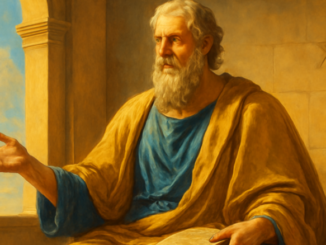
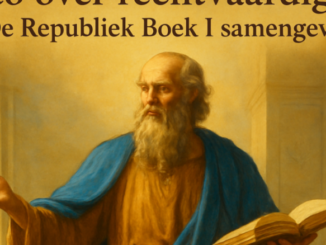
Ancient Greek temple columns symbolizing Plato's Republic and Masonic philosophy
Plato – Philosophical Background

Plato’s Republic and Justice: Philosophical Roots Explored

In fifth-century Athens, where democracy and philosophy flourished side by side, a young thinker posed a question that has never been abandoned since: what is justice, really? Plato did not write his dialogue The Republic in an intellectual vacuum. His struggle with this concept was rooted in decades of philosophical debate, political upheaval, and the tragic fate of his teacher Socrates. To understand why the first book of The Republic still resonates within the rituals and principles of Freemasonry, we must travel back to the sources that shaped Plato’s thought. The Sophistic Legacy: Justice as Convention Plato’s dialogue opens with a confrontation that exposes the intellectual heart of his era. Thrasymachus, a sharp-tongued Sophist, provocatively declares that justice is nothing more than the advantage of the stronger. This was no idle intellectual fancy. The Sophists — travelling teachers who sold rhetoric and wisdom — had fundamentally transformed Greek thought in the decades before Plato. Figures such as Protagoras and Gorgias undermined belief in absolute truths. Their relativism held that laws and morality were merely human conventions, malleable to the wishes of whoever held power. Plato grew up in this intellectual arena. His family belonged to the Athenian aristocracy, and he […]

Ancient Greek columns symbolizing Plato's Republic and Masonic philosophy
Plato – Content & Summary

Plato on Justice: The Republic Book I and Its Masonic Echoes

What does it mean to be just? This seemingly simple question opens one of the most influential philosophical works in the Western tradition. In the first book of The Republic, Plato sends his teacher Socrates into dialogue with three interlocutors, each defending a different definition of justice. None of them manages to convince Socrates — and yet this is no tale of intellectual defeat. It is a shared search for truth, the kind of quest that has inspired Freemasons for centuries. The Setting: An Encounter at the Piraeus The conversation takes place in the harbor of Athens, the Piraeus, where Socrates is stopped by Polemarchus after attending a religious festival. Polemarchus invites him to the home of his elderly father Cephalus, a wealthy arms dealer. What begins as a polite exchange about old age and wealth quickly transforms into a profound philosophical exploration. Cephalus remarks that wealth allows him to be honest and pay his debts. In doing so, he implicitly suggests a definition of justice: speaking the truth and returning what you owe. Socrates immediately exposes the weakness of this definition with a striking example. Suppose you have borrowed a sword from a friend who has since gone mad. […]