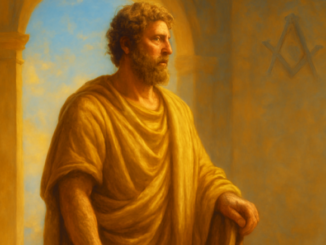
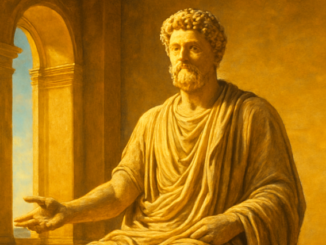
Marble bust of Marcus Aurelius with Masonic square and compass symbolism
Marcus Aurelius – Meditations

Marcus Aurelius on Judgment: Philosophical Roots of Masonry

What if our worst enemy doesn’t dwell outside us, but inhabits the silent space between perception and conclusion? Marcus Aurelius — the Roman emperor who philosophized amid war and plague — proposed a radical thesis in the eighth book of his Meditations: it is not events that torment us, but the judgments we pass upon them. This idea, deceptively simple on the surface, carries the weight of centuries of philosophical tradition and casts a surprising light on the ethical quest that Freemasons know well. The Stoic Legacy of Judgment To understand the intellectual world of Marcus Aurelius, we must travel back to the Stoa of Zeno of Citium, the philosophical school that emerged in Athens around 300 BCE. The Stoics developed a psychology of judgment that was revolutionary for their time. They drew a sharp distinction between phantasia — the initial impression that reality makes upon us — and synkatathesis — the assent we choose to give or withhold from that impression. Epictetus, the freed slave whose lectures Marcus Aurelius studied as a young man, refined this doctrine into a practical art of living. His famous distinction between what lies within our power and what does not forms the backbone […]

A balanced scale symbolizing moderation and Masonic wisdom
Michel de Montaigne – Content & Summary

Montaigne on Moderation: The Art of Finding the Middle Way

A scale rests in perfect stillness when both pans are precisely balanced. Add even a single grain to one side, and the equilibrium is lost. Michel de Montaigne saw in this simple image a profound truth about human life: even the most exalted virtue can become a vice when it exceeds its proper measure. In his essay “Of Moderation,” he examines how excess can lead us astray — even when we are pursuing what is good. The Core Idea: Even Virtue Has Its Limits The central theme of this essay is surprising and counterintuitive. Montaigne argues that even virtuous behavior becomes dangerous when practiced to an extreme. This seems paradoxical at first. How can something good go too far? Yet through numerous examples, Montaigne demonstrates that excessive devotion to a principle or practice ultimately achieves the opposite of what was intended. The virtue of moderation, he insists, must also govern how we practice all other virtues. Montaigne draws on the wisdom of antiquity to make his case. Aristotle taught that virtue lies at the mean between two extremes. Plato warned against the danger of unbridled passions, even when they are directed toward the good. These classical philosophers understood what many […]

Sunlight filtering into the deep blue ocean symbolizing Masonic self-discovery
Personal Development & Leadership

The Ocean as Mirror: What Deep-Sea Research Teaches Us

News broke recently that the European Union and Canada have joined forces to continue international ocean research after the United States drastically cut its contributions. At first glance, this seems like a purely scientific or political story. But anyone who pauses to consider the ocean — its depths, its mysteries — discovers a mirror that reveals something profound about the human personality. Freemasons understand this principle well: every concrete object, every act can become a window into deeper self-knowledge. The Depths We Do Not Know The ocean covers more than seventy percent of the Earth’s surface, yet the vast majority of it remains uncharted territory. Scientists estimate that we know more about the surface of the moon than we do about the floor of our own seas. This fact touches on something fundamental about human nature. We tend to look outward — toward stars and distant horizons — while the depths close at hand remain unexplored. The same is true of personality: we present our surface to the world, but rarely understand the deeper layers of our own inner life. The decision by Europe and Canada to rescue this research is therefore more than a scientific necessity. It is a […]

Vrijmetselarij - Seneca over reizen als vlucht: filosofische wortels ontdekt
Lucius Annaeus Seneca – Letters to Lucilius

Seneca on Travel as Escape: Philosophical Roots Explored

Why do we sometimes feel compelled to leave, even when we know deep down that no destination will change a thing? Lucius Annaeus Seneca posed this very question nearly two thousand years ago in his twenty-eighth letter to Lucilius. His answer strikes at the heart of Stoic philosophy and echoes a wisdom that also runs through the traditions of Freemasonry: the inward journey is the only journey that truly matters. What Was Seneca Really Saying in Letter XXVIII? In Letter XXVIII, Seneca addresses his friend Lucilius, who has apparently been traveling from place to place in search of peace of mind. Seneca’s message is unequivocal: you carry yourself wherever you go. The problem does not lie in the place where you happen to be — it lies in the restlessness you bring with you. This is no casual observation. It is rooted deeply in the Stoic tradition that Seneca inherited from his predecessors and refined into a living philosophy. The Stoics held that external circumstances are inherently neutral. It is our judgment of situations that produces suffering or joy. When someone travels to escape problems, they merely change the scenery — not the inner drama. Seneca reminds Lucilius that Socrates […]

Symbolic Masonic temple with light representing Voltaire's vision of tolerance
Symbolism & Rituals

Voltaire’s Prayer for Tolerance and Its Masonic Resonance

In a world that often seems fractured by misunderstanding and prejudice, it is remarkable that a text written in the eighteenth century can still move us so deeply. Voltaire’s prayer for tolerance, found in his Treatise on Tolerance, expresses a universal longing for mutual understanding that transcends centuries. For Freemasons, this prayer is far more than a historical curiosity — it touches the very heart of what the Craft has pursued for generations: a world where people of every background can meet one another as brothers. A Philosopher’s Prayer for All Humanity Voltaire did not address his prayer to the god of any single religion. Instead, he directed it to the Supreme Being who might unite all people. “You did not give us hearts to hate one another,” he wrote, “nor hands to murder one another.” These words grew from his deep revulsion toward religious fanaticism. The Calas affair — in which an innocent Protestant father was wrongfully sentenced to death — had shaken him to the core. His prayer was no theological treatise; it was a cry from the heart for human dignity. For Voltaire, tolerance was never passive acceptance. It was an active, deliberate choice. He acknowledged that […]

Dan Brown Inferno book with Masonic and Dante Alighieri symbolism
Inferno

Dan Brown’s Inferno: Symbolism Through Two Different Eyes

When Dan Brown brings the rich symbolic world of Dante Alighieri to life in his thriller Inferno, a fascinating question emerges: how differently do people read these layers of meaning? The casual reader sees an exciting story peppered with historical references. The Freemason may recognize a much deeper structure. Both perspectives deserve attention — and together, they reveal why symbolism has captivated humanity for centuries. The Outsider’s Perspective: Thrills and Historical Decoration For most readers of Inferno, the symbolism functions primarily as atmosphere. Dan Brown guides his protagonist Robert Langdon through the streets of Florence, Venice, and Istanbul, where he solves riddles rooted in Dante’s Divine Comedy. The casual reader experiences these symbols as decorative elements that enrich the narrative. The concentric circles of Hell, the mysterious death masks, and the hidden messages in artworks all serve to drive the plot forward. This type of reader enjoys the intellectual treasure hunt without necessarily seeking deeper layers of meaning. The symbols are puzzle pieces, not windows into inner transformation — and that is a perfectly valid way to read the book. Dan Brown himself has said in interviews that he deliberately uses symbols as narrative tools to make complex themes accessible […]

Open copy of Marcus Aurelius Meditations beside Masonic rough ashlar stone
Marcus Aurelius – Content & Summary

Marcus Aurelius Book V: Overcoming Obstacles as an Art

Imagine waking up and facing the day ahead like a mountain you must climb. Everything inside you resists. Your mind searches for excuses, and the warm blankets feel like a safe harbour. It is precisely in moments like these that the Roman Emperor Marcus Aurelius addressed himself with words that still resonate nearly two thousand years later. In the fifth book of his Meditations, he explores how we need not see obstacles as enemies — but as the path itself. The Context of Book V Marcus Aurelius never wrote his Meditations for publication. They were personal exercises in the art of living — private reflections set down during some of the most turbulent years of the Roman Empire. Book V was most likely composed during military campaigns along the Empire’s northern frontiers, amid war, plague, and personal loss. These circumstances make the text all the more powerful: this is not a philosopher speaking from an ivory tower, but a man confronting the harshest realities of existence on a daily basis. The book opens with a passage that almost everyone can relate to. Marcus describes the moment of waking, when the temptation to stay in bed is at its strongest. He […]

Rough ashlar stone with hammer and chisel symbolizing Masonic character building
Marcus Aurelius – Freemasonry & Connection

Marcus Aurelius on Duty: The Stone as a Symbol of Character

Every morning, before the first light slips through the window, every human being faces the same inner struggle. The warmth of the bed pulls at us while the day and its obligations wait. In Book V of his Meditations, Marcus Aurelius describes exactly this moment — the instant when character is forged. For Freemasons, this struggle resonates with a deeply rooted symbol: the working of the rough stone. Both traditions understand that the fulfillment of duty is not a burden but the very hammer with which we shape ourselves into something enduring. Waking Up as a Moral Turning Point Marcus Aurelius opens Book V with a scene every reader recognizes. He addresses himself at the break of day: rise, for you were made for the work that befits a human being. The emperor does not philosophize from an ivory tower but from the mud of military campaigns and the weight of administrative burdens. His words carry the gravity of lived experience. In his writing, this daily act of waking becomes a metaphor for a greater awakening. Not only must the body rise, but the mind must orient itself toward its true calling. In Freemasonry, we find a kindred idea: the […]

Prism splitting white light into a spectrum symbolizing Masonic enlightenment
Symbolism & Rituals

Voltaire on Newton: Light as a Symbol of Insight

When a ray of light passes through a prism and splits into a rainbow of colors, we witness more than a physical phenomenon — we witness a revelation. Voltaire understood this profoundly when he introduced Isaac Newton’s ideas to continental Europe in his fourth Philosophical Letter. What he described was not merely science, but an entirely new way of seeing reality — one that resonates deeply with the symbolic language of Freemasonry. The Context of Voltaire’s Admiration Voltaire wrote his Philosophical Letters after a period of forced exile in England between 1726 and 1729. Those years changed his thinking fundamentally. Back in France, the natural philosophy of René Descartes still held sway, with its vortex theories and mechanistic explanations of the universe. Newton offered a radically different perspective: no speculation about invisible matter, but measurable forces and mathematical laws. Voltaire saw in Newton far more than a scientist — he saw a liberator of the human mind. His fourth letter reads as a tribute, but one that consistently invites the reader to investigate for themselves. What made Voltaire’s approach remarkable was his ability to make Newton’s complex work accessible without oversimplifying it. He described the discovery of gravity, the laws […]

Stoic philosopher's hammer and rough ashlar stone on a Masonic workbench
Lucius Annaeus Seneca – Letters to Lucilius

Seneca on Body Care: Philosophical Roots of Letter XIV

A hammer rests on a workbench. To most, it is simply a tool. To a Freemason, it represents something far greater — the capacity to work upon oneself, to shape the rough ashlar into something refined. Lucius Annaeus Seneca would have recognized this image immediately. In his fourteenth letter to Lucilius, he addresses a theme that is as concrete as it is symbolically rich: the care of the body. Behind this seemingly practical advice lies a deep philosophical tradition stretching from the early Stoics to the Masonic conviction that every person is both temple and builder. The Stoic Foundation of Body Care Seneca’s views on the body are rooted in the teachings of the early Stoa, founded by Zeno of Citium around 300 BCE. The Stoics divided all things into three categories: the good, the bad, and the indifferent. Health, wealth, and physical well-being fell into the category of adiaphora — indifferent things. This did not mean, however, that the body could simply be neglected. Chrysippus, one of the most influential early Stoics, argued that certain indifferent things could be classified as “preferred indifferents” — things that do not constitute virtue in themselves but are instrumentally valuable for living a […]

Open Torah scroll with Masonic square and compasses symbolizing holiness
Judaism

Leviticus: The Call to Holiness and Masonic Symbolism

What does it mean to be called? This question opens the third book of the Torah, known in Hebrew as Vayikra — Leviticus. The book begins with the words “And He called,” a divine summons inviting Moses to draw near. But is this call reserved solely for a biblical prophet, or does it also speak to us — modern seekers of meaning and purpose? In this article, we explore the deeper layers of this remarkable book and discover how its themes of purification, sacrifice, and holiness resonate powerfully with the symbolism of Freemasonry. Why Does Leviticus Begin with a Call? The Hebrew word Vayikra literally means “And He called.” In Jewish tradition, great significance is attached to this opening word because it sets the tone for the entire book. The call is personal and intimate. God does not speak in abstract terms but addresses Moses directly with an invitation. According to rabbinical commentators, including the medieval scholar Rashi, this phrasing expresses affection. It is not a command from a distant authority but a loving summons to draw closer to the sacred. For Freemasons, this theme is immediately recognizable. In the Lodge, too, the journey begins with a call — an […]

A sunlit garden symbolizing Voltaire's Candide and Masonic ideals of shared labor
Symbolism & Rituals

Voltaire’s Candide: The Garden as a Masonic Ideal

What did Voltaire really mean by that famous closing line? “Il faut cultiver notre jardin” — we must cultivate our garden. Is it a call to withdraw from the world, a retreat into comfortable isolation? Or does it point to something deeper, something that touches the very heart of what Freemasons strive for: connection through shared labor? Let’s sit with this question as if gathered around a table with a good glass of wine and an open mind. Why Does Candide End in a Garden? Candide has crossed the entire world. He has witnessed wars, survived earthquakes, listened to philosophers, and won and lost fortunes. And where does he ultimately end up? On a small farm on the outskirts of Constantinople, tilling the earth alongside his companions. Voltaire — who was deeply connected to Enlightenment thinkers and moved in circles where Freemasons were well represented — chose this ending deliberately. No triumph, no palace, no philosophical certainty. Just a garden. This raises an essential question: is the garden a retreat, or is it actually a starting point? For Voltaire, the answer seems carefully nuanced. The garden is not an escape from the world but a redefinition of what meaningful action […]

Open Book of Revelation with Masonic symbols and candlelight
Christianity

The Book of Revelation: Visions of Light in Freemasonry

The candles flicker softly as a Freemason, after the night’s labor, opens an ancient biblical text. His eye falls on John’s words describing a city of light — twelve gates, streets of pure gold. For a moment, the symbols of his own initiatory journey seem to come alive in this vision from thousands of years ago. What Is the Book of Revelation? The Book of Revelation, also known as the Apocalypse, is the final book of the New Testament. Attributed to John and likely written during his exile on the island of Patmos around 95 AD, it contains a series of visions about the end of times, the battle between good and evil, and the ultimate triumph of light. The word “apocalypse” derives from the Greek apokalypsis, which literally means “unveiling” or “revelation.” It is not primarily about destruction — it is about making visible what was hidden. The text speaks in a language of symbols: seven seals, seven trumpets, a dragon, a lamb, and ultimately a radiant city descending from heaven. For its original readers — Christians enduring Roman persecution — these images offered hope and comfort. For later generations, they became an inexhaustible source of interpretation, ranging from […]

Solar eclipse casting shadow symbolizing the Masonic journey from darkness to light
Symbolism & Rituals

Solar Eclipse and Freemasonry: Light That Fades to Return

Today, August 12, 2026, the moon slides in front of the sun and casts its shadow across the earth. Millions of people gaze upward, captivated by this rare celestial event. But what does it mean when light temporarily yields to darkness? For Freemasons, this cosmic spectacle carries a profound symbolic resonance — because at the very heart of the Royal Art lies the journey from darkness to light. A solar eclipse invites us to contemplate what happens when that light appears to be absent. The Sun as an Eternal Symbol Across virtually every culture and tradition, the sun stands as the ultimate symbol of light, truth, and consciousness. In Freemasonry, the sun occupies a prominent place within the lodge. It represents Providence — the source of all illumination, both physical and spiritual. When you enter a lodge room, you are reminded of the cosmic order: the sun in the East, the moon in the West, and the stars filling the heavens above. This celestial triangle reflects the very architecture of the universe. Plato wrote in his Allegory of the Cave about the sun as the highest Good, the source of all that is visible and knowable. For him, leaving the […]

Hourglass and rough ashlar symbolizing Stoic philosophy and Freemasonry
Marcus Aurelius – Content & Summary

Marcus Aurelius Book II: The Art of Living in the Present

When you turn an hourglass, every grain of sand falls irreversibly downward. No single grain returns, no moment ever repeats itself. In the second book of his Meditations, Roman Emperor Marcus Aurelius confronts himself with this unforgiving truth. He wrote these reflections during a military campaign along the Danube, far from the comforts of Rome, surrounded by death and impermanence. It was precisely there, in those raw and unrelenting circumstances, that a philosophy crystallized — one that still resonates powerfully today: the art of being truly present in the only moment we ever possess. The Morning as a Mirror of Life Book II opens with a remarkable passage in which Marcus Aurelius mentally prepares himself for the day ahead. He warns himself that he will encounter difficult people — the meddlesome, the ungrateful, the jealous. But rather than arming himself with resentment, he chooses understanding. These people act the way they do out of ignorance about what is truly good and evil. With this morning reflection, Marcus sets the tone for the entire book: each new day is an exercise in conscious living. This morning ritual takes on a symbolic dimension. Just as the sun appears on the horizon each […]

Hourglass in a Masonic lodge symbolizing Seneca's philosophy of time
Lucius Annaeus Seneca – Letters to Lucilius

Seneca’s First Letter: The Philosophy of Time in Freemasonry

A candle flickers in the early morning as a Freemason opens his journal. Before him lies a translation of Seneca’s letters, turned to the very first one. He reads words written nearly two thousand years ago and feels an uncanny recognition: time slipping away unnoticed, the urgent need to claim every moment. In the stillness of the lodge, where the hourglass stands prominently displayed, these ancient words take on an unexpected immediacy. The Stoic Roots of Time Awareness Lucius Annaeus Seneca wrote his first letter to Lucilius around 63 AD, during a period when he was withdrawing from political life at the court of Emperor Nero. That this letter on the use of time opens his entire correspondence is no accident. Seneca immediately lays the foundation of Stoic philosophy as a way of life: the realization that time is our only true possession, and simultaneously our most vulnerable one. The Stoic school, founded by Zeno of Citium around 300 BC, regarded time as an ethical category. Where other philosophical traditions focused on knowledge or happiness as the highest good, the Stoics saw virtuous action in the here and now as the essence of a life well lived. Seneca inherits this […]

Ancient Greek temple columns symbolizing Plato's philosophy and Masonic self-knowledge
Plato – Philosophical Background

Plato’s Apology: The Philosophical Roots of Self-Knowledge

There is a paradox at the very heart of Western philosophy: the wisest man in Athens claimed to know nothing. When Socrates stood before the court, he was not so much defending his life as defending a way of life. The Apology that Plato recorded is far more than a legal document — it is a philosophical manifesto whose influence has echoed through the centuries, from the Stoics to Freemasonry. The question it raises still lingers: what does it truly mean to know yourself? The Legacy of Delphi Above the entrance to the Temple of Apollo at Delphi stood the famous inscription: “Know Thyself.” This oracle would become the starting point for Socrates’ entire philosophical quest. When his friend Chaerephon asked the oracle whether anyone was wiser than Socrates, the priestess answered that no one was. This response presented Socrates with a riddle that would define the rest of his life. How could he be the wisest man when he was so acutely aware of his own ignorance? The Apology shows how Socrates resolved this apparent contradiction. By questioning politicians, poets, and craftsmen, he discovered that they believed they knew things they did not actually know. His own wisdom, he […]

Rough stone being shaped into a perfect ashlar symbolizing constancy
Michel de Montaigne – Philosophical Background

Montaigne on Constancy: The Philosophical Roots Revealed

A stone that stands unmoved while the storm rages around it. This image, as familiar in the builder’s craft as in philosophy, strikes at the heart of what Michel de Montaigne explores in the twelfth essay of his first book: human constancy. But which thinkers whispered those ideas into his ear? Which philosophical traditions formed the foundation upon which he built his reflections on steadfastness? The answers lie hidden in a rich intellectual heritage reaching back to antiquity. The Stoic Foundation When Montaigne writes about constancy, he is unmistakably walking through the colonnades of the Stoa. Stoic philosophy, founded by Zeno of Citium in the third century BC, placed the imperturbability of the human mind at its center. For the Stoics, true virtue lay in accepting what lies beyond our control while mastering our own reactions. This idea forms the backbone of Montaigne’s approach to the subject. Particularly influential was the work of Seneca, the Roman philosopher and statesman whose letters and essays Montaigne studied with great enthusiasm. Seneca’s De Constantia Sapientis (On the Constancy of the Wise Man) addresses precisely the theme Montaigne would later rework. The wise man, Seneca argued, cannot truly be insulted or harmed, for his […]

Ancient temple columns symbolizing Freemasonry building metaphors from Corinthians
Christianity

First Corinthians: Building Metaphors and Brotherhood

Around the year 55 CE, Paul of Tarsus sat down in Ephesus to write a letter to the fledgling Christian community in Corinth. This bustling port city, perched on a strategic isthmus between two seas, thrived on commerce, philosophy, and religious diversity. The letter we know as First Corinthians contains some of the most compelling imagery in early Christian literature: the community as a temple, believers as building stones, and the imperative to build upon a solid foundation. For those familiar with the symbolic language of Freemasonry, these metaphors sound remarkably familiar. A Letter to a Divided Community Understanding the historical context of this letter is essential to grasping its symbolism. First-century Corinth was a cosmopolitan city where Greeks, Romans, Jews, and freedmen lived side by side. The young congregation Paul had founded there was struggling with internal division. Different factions rallied behind different leaders, threatening to fracture the community’s unity. It is against this backdrop that Paul develops his powerful building metaphor. In the third chapter, he compares the community to a building whose foundation he himself has laid. Others build upon it, but the quality of their work will be tested by fire. This image of the skilled […]

Montaigne essay on constancy and its connection to Masonic self-knowledge
Michel de Montaigne – Content & Summary

Montaigne on Constancy: What Essay 12 Teaches Us About Courage

Imagine standing at the threshold of a difficult decision. You feel the tension in your body, the doubt racing through your mind. How do you remain steadfast when circumstances seem to conspire against you? Michel de Montaigne wrestled with precisely this question when he wrote his twelfth essay. In ‘On Constancy,’ he examines what it truly means to be resolute — and why we should not be too quick to congratulate ourselves when we merely appear courageous. The Core Idea of the Essay In this brief but powerful essay, Montaigne poses a surprising question: is constancy really what we think it is? He argues that true constancy does not simply mean standing in the face of danger. What matters is how you respond inwardly to threat. You might appear brave as you stride toward a drawn sword, but if you are trembling with fear on the inside and only pressing forward out of shame, can that really be called courage? Montaigne draws a sharp distinction between outward behaviour and inner disposition. He observes that many people we regard as courageous actually act out of impulse, pride, or even ignorance of the danger they face. The true test of constancy lies […]