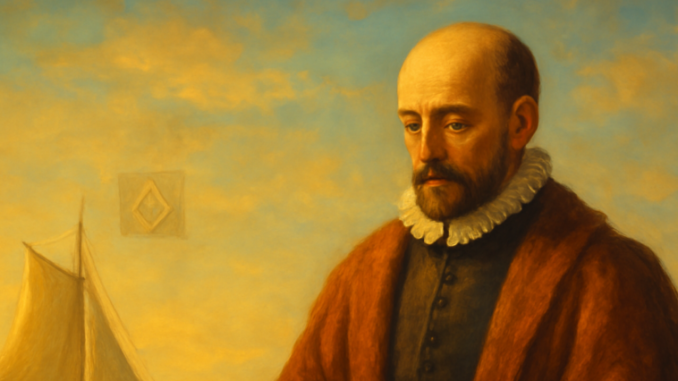
You’ve probably experienced it: a conversation that has all the trappings of depth, yet afterward you realize nothing of substance was actually said. The words sounded beautiful, the sentences were well-crafted, but the core was missing. Michel de Montaigne wrote about exactly this in the sixteenth century, in his essay ‘On the Vanity of Words.’ And that theme touches something surprisingly close to what Freemasons strive for when they speak of genuine connection.
When Eloquence Becomes a Mask
In the fifty-first essay of Book One of the Essais, Montaigne turns his gaze toward rhetoric — the art of persuasion. He observes that eloquence in his time is often not a tool for revealing truth, but rather a veil that conceals reality. Montaigne references the Roman orator Marcus Tullius Cicero and the Greek philosopher Plato, both of whom wrestled in their own way with the tension between form and substance. Cicero mastered the art of language like no other, but Plato warned in his dialogues that sophists use language to deceive rather than to clarify.
Montaigne takes a clear position. He trusts the speaker who searches for the right word not because it sounds beautiful, but because it is true. That attitude is more than a stylistic preference — it is an ethical choice. And it is precisely here that Montaigne touches a foundation that Freemasons recognize: the desire to move beyond the surface, to reach the essence of the matter, to discover what is genuinely meant.
The Freemason and the Weight of Silence
Imagine entering a space where the fastest speaker doesn’t win — where silence holds as much value as the spoken word. In Freemasonry, this is not a thought experiment but a lived practice. During ritual work, careful consideration is given to when words are spoken and when silence is maintained. This discipline is no accident. It reflects the understanding that words only gain power when they are carried by sincerity.
Montaigne would have felt at home in such an environment. His entire essayistic project revolves around self-reflection — around honestly confronting your own motivations. When he writes that hollow rhetoric harms society, he does not mean we should stop speaking. He means we must take responsibility for what we say. That every word is an act, and that an act without authenticity is hollow.
True connection does not arise from saying a great deal, but from speaking out of authenticity — precisely as both Montaigne and Freemasonry teach us.
Brotherhood Beyond Words
In Freemasonry, brotherhood is not about pronouncing beautiful promises. It is about daily conduct — about the way you truly meet another person. The lodge is a workshop where you learn to examine your own prejudices and ingrained patterns. This inner work closely resembles what Montaigne describes when he speaks of the necessity of knowing yourself before attempting to convince others.
Montaigne tells of how the rhetoricians of his day, following the example of the ancient Greek sophists, trained their students to defend any position, regardless of whether they actually believed in it. He sees in this a danger that reaches far beyond the political arena. When you learn to disconnect words from conviction, you ultimately lose the capacity for sincere connection. And that is precisely the point where Montaigne’s concerns converge with a core value of Freemasonry: the search for truth begins with honesty toward yourself.
The Virtue of Listening
There is another dimension at play in Montaigne’s essay that Freemasons will find particularly familiar: the importance of listening. Montaigne frequently quotes Seneca and Plutarch, thinkers who emphasized that wisdom lies at least as much in receiving as in transmitting. In lodge work, newcomers first learn to observe and to listen. Not as a passive act, but as an active exercise in receptivity. You learn the difference between hearing and truly listening, between being present and being truly present.
Montaigne would have appreciated this. His essays are themselves an exercise in listening — he listens to the classical authors, to his own contradictory thoughts, to the silence between the lines. In this lies a form of intellectual humility that you also find in the Masonic tradition. The Freemason who works his rough ashlar knows that the result depends not on how much noise he makes, but on the precision and attention he brings to the task.
What Montaigne Tells Us Today
We live in a time when words are produced faster than ever before. Social media, artificial intelligence, endless news cycles — the vanity of words that Montaigne described has reached a scale he could never have imagined. That is precisely why his message is more relevant than ever. The question he poses is not whether we should speak, but how we speak. Do we speak to impress, or to genuinely convey something meaningful? Do we seek applause, or do we seek understanding?
For Freemasons, this essay holds up a mirror. The lodge is one of the few places in contemporary society where you can still practice the kind of conversation Montaigne envisioned: a conversation that is not about winning or losing, but about collectively approaching a truth that none of the participants could have reached alone. That is connection in the most essential sense of the word.
Three Masonic Values That Resonate with This Essay
Authenticity: Speak only when your words are carried by genuine conviction, not by the desire to impress. Montaigne’s distrust of ornamental rhetoric is a direct call to let substance precede style — a principle that lies at the heart of every Masonic obligation.
Self-reflection: Examine your own motives before attempting to persuade others, as Montaigne did tirelessly throughout his essays. In Freemasonry, working the rough stone is not a metaphor for changing the world — it is a metaphor for changing yourself first.
Brotherhood: Genuine connection arises where people meet one another without pretense, where words serve understanding rather than domination. The Masonic lodge, at its best, is precisely such a meeting place — a space where the vanity of words gives way to the quiet power of truth.
Montaigne’s centuries-old essay on the vanity of words remains a powerful reminder for anyone walking the Masonic path. In a world drowning in noise, the discipline of speaking with intention, listening with humility, and connecting with authenticity is not merely admirable — it is essential. The lodge offers a rare sanctuary for this practice, and Montaigne, though he lived long before modern Freemasonry took shape, would undoubtedly have recognized a kindred spirit in its traditions.
Copyright text & image: devrijmetselaar.nl
Texts are based on the ideas and content of the author of devrijmetselaar.nl, reviewed, corrected, and supplemented with the assistance of OpenAI. Images are created based on the ideas of the author of devrijmetselaar.nl using OpenAI/DALL-E.
Frequently Asked Questions
What is Montaigne's main critique of eloquence in his essay 'On the Vanity of Words'?
Montaigne argues that eloquence in his time often serves as a veil that conceals reality rather than reveals truth. He criticizes rhetoric that prioritizes beautiful-sounding words and well-crafted sentences over substance and authenticity. Instead, he advocates for speakers who search for the right word because it is true, not because it sounds impressive—viewing this as an ethical choice rather than merely a stylistic preference.
How does Freemasonry relate to Montaigne's philosophy about words and authenticity?
Freemasonry shares Montaigne's emphasis on moving beyond the surface to reach genuine essence and meaning. Both value authenticity over eloquence and recognize that true connection arises from sincere, intentional communication rather than an abundance of words. In Masonic ritual practice, silence is given equal weight to spoken words, reflecting the understanding that words only gain power when carried by genuine sincerity—a principle Montaigne championed through his own essayistic self-reflection.
Why does the article suggest that silence is important in Freemasonry?
The article explains that within Freemasonry, silence holds as much value as spoken words during ritual work. This discipline reflects the understanding that words only gain power through sincerity and authenticity. By carefully considering when to speak and when to remain silent, Freemasonry creates a space where genuine connection is prioritized over the speed or volume of speech, embodying the principle that authentic communication requires thoughtful restraint rather than constant talking.

Be the first to comment