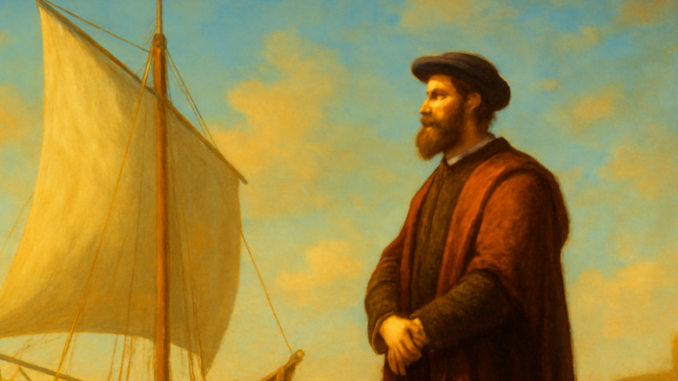
Imagine meeting someone whose customs are entirely alien to your own. Your first impulse might be rejection — perhaps even revulsion. But what if you learned to question that reaction instead of acting on it? In the sixteenth century, Michel de Montaigne wrote an essay that tackles exactly this challenge. His text On Cannibals is not a defense of eating human flesh. It is an invitation to examine your own prejudices. The philosophical sources he drew upon offer practical guidance for anyone who wants to look at the world with a more open mind — and they resonate deeply with the principles that would later become central to Freemasonry.
The Skeptical Method as a Practical Tool
Montaigne was profoundly influenced by the ancient skeptics, particularly the Pyrrhonist tradition of Sextus Empiricus. This philosophical school taught that absolute certainty is unattainable. For Montaigne, however, this was no cause for despair. Quite the opposite — he experienced it as liberation. Once you acknowledge that your own judgments are fallible, you naturally become more cautious about condemning others.
In On Cannibals, Montaigne applies this method in concrete terms. He describes the customs of Brazilian tribes, including their ritual cannibalism, without rushing to judgment. His question is not: are these people wicked? His question is: why do we assume we are any better? This is a technique you can apply immediately in your own life. Whenever you catch yourself judging someone, pause and ask: on what basis am I actually forming this opinion?
Seneca and Plutarch as Moral Compasses
Beyond skepticism, Montaigne drank deeply from the well of Stoic philosophy, especially through Seneca. From this Roman philosopher, he learned that true civilization does not reside in outward display but in inner virtue. Seneca wrote extensively about the fundamental equality of all people, regardless of social status. In his famous Letter 47, he treats enslaved people as fellow human beings — a revolutionary position for his era.
Montaigne carries this principle forward into his own century. If Seneca could regard slaves as equals, why should we not extend the same respect to peoples we dismiss as primitive? Plutarch, another of Montaigne’s favorite authors, added an equally powerful insight: moral examples can be found everywhere, not only within one’s own culture. This thought forms the beating heart of the essay.
Renaissance Humanism and the Noble Savage
Montaigne was writing at a time when Europe was rediscovering itself. Renaissance humanism brought renewed interest in classical texts, but it also fostered a critical perspective on contemporary society. Humanists like Erasmus had already demonstrated that one could critique the Church and the social order without the world collapsing into chaos.
In On Cannibals, Montaigne develops what would later become known as the concept of the noble savage. He portrays the Brazilians as people living close to nature, free from the hypocrisy and cruelty that plagued European civilization. Importantly, Montaigne does not fully idealize them. He acknowledges their cannibalism as horrifying. But he poses a cutting question: is it worse to consume a dead enemy than to torture living people, as Europeans were doing during their wars of religion?
True barbarism does not lie in unfamiliar customs — it lies in refusing to confront your own cruelty.
Practical Lessons for Today
The philosophical background of this essay is not merely of academic interest. It offers concrete steps for anyone grappling with prejudice or cultural differences. Here are three you can put into practice right away:
First, question your initial reaction. When you feel aversion toward an unfamiliar custom, ask yourself: does this reaction come from knowledge or from ignorance? Being honest about the answer changes everything.
Second, look for the mirror. Montaigne used the cannibals to expose European hypocrisy. What uncomfortable truths about your own culture or community are you avoiding? The willingness to face those truths is the beginning of genuine moral growth.
Third, read the classics. Seneca, Plutarch, and the skeptics are not dusty relics. Their insights into human dignity are timeless and immediately applicable. They remind us that the questions we face today are not new — and that wisdom has always required humility.
A Connection to Fraternal Traditions
The central idea of Montaigne’s essay resonates powerfully with principles that would later become foundational in fraternal organizations such as Freemasonry. The conviction that people of all backgrounds, religions, and cultures can meet as equals finds its philosophical grounding in precisely this tradition of tolerance and self-examination. When Montaigne writes that barbarism is not a matter of geography but of behavior, he lays the groundwork for an ethics in which every person is judged on their own merits.
This demands courage. It is easier to judge than to question, easier to reject than to understand. But the philosophers who inspired Montaigne — from the Stoics to the humanists — understood that true wisdom begins with acknowledging your own limitations. That insight is not an abstract principle. It is a daily practice, much like the work that takes place within a Masonic lodge, where Brothers continually strive to refine the rough stone of their character.
Michel de Montaigne did not write On Cannibals to glorify exotic peoples. He wrote it to hold a mirror up to his readers. The philosophical traditions he drew upon — skepticism, the Stoicism of Seneca, the moral wisdom of Plutarch, and the critical humanism of his own age — together form a practical ethics of tolerance. Montaigne’s invitation to us is clear: examine your prejudices, acknowledge your limitations, and treat others as you wish to be treated yourself. That is not weakness. That is wisdom in action — and it remains as urgently needed today as it was in the sixteenth century.
Copyright text & image: devrijmetselaar.nl
Texts are based on the ideas and content of the author of devrijmetselaar.nl, reviewed, corrected, and supplemented with the assistance of OpenAI. Images are created based on the ideas of the author of devrijmetselaar.nl using OpenAI/DALL-E.


Be the first to comment