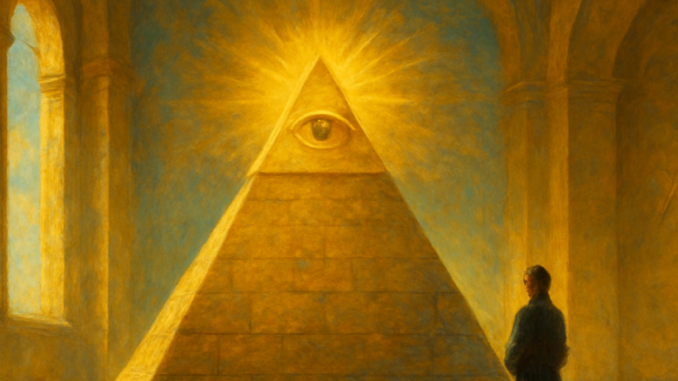
You’ve probably experienced it: the moment you mention Freemasonry, someone immediately brings up the Illuminati as though the two are one and the same. The internet is awash with content that blurs the line between them, fueled by Hollywood thrillers, bestselling novels, and conspiracy theories. But does that picture hold up? What is the real difference between these two organizations — and why does that difference matter so much if you want to understand the spiritual journey that Freemasonry actually offers?
Two Very Different Roots
The first major difference lies right at the beginning — in how each organization came into existence. Freemasonry has a long, organic history stretching back to the medieval stonemason guilds. The oldest known documents, such as the Regius Manuscript from around 1390, reference the craft traditions of the stone workers who built Europe’s great cathedrals. By the early eighteenth century, Freemasonry had evolved into a speculative brotherhood, with the founding of the Grand Lodge of London in 1717 serving as a defining milestone. James Anderson and Jean-Théophile Desaguliers played key roles in drafting its first constitution.
The Order of the Illuminati, by contrast, was founded on May 1, 1776, in Ingolstadt, Bavaria, by Adam Weishaupt, a professor of canon law. Inspired by the Enlightenment, Weishaupt sought to create a secret society that would advance rationalism and secular thinking as a counterweight to what he saw as superstition and the abuse of power by religious and political authorities. As an active organization, the order lasted only about nine years: in 1785, it was banned and dissolved by the Bavarian Elector Karl Theodor.
Political Ambition Versus Inner Growth
Here we reach the heart of the matter — a difference you feel immediately once you look beneath the surface. The Bavarian Illuminati had an explicitly political agenda. Weishaupt pursued a society in which reason would triumph over dogma, and he did not shy away from covert infiltration of existing power structures to achieve that goal. His order was hierarchically organized, with degrees that progressively revealed more of its ultimate political objectives.
Freemasonry works in a fundamentally different way. It has no political program and actually forbids discussions of partisan politics and specific religious doctrines within the lodge. The degrees and rituals of Freemasonry are not aimed at changing the outside world but at changing yourself. The focus is on self-knowledge, moral improvement, and the cultivation of brotherhood. Where Weishaupt sought to reform society through an elite cadre, Freemasonry invites every individual Brother to work on his own rough ashlar.
Put simply: the Illuminati wanted to change the world through political influence; Freemasonry seeks to improve the world by refining the inner life of each individual.
The Historical Entanglement
If the two are genuinely different organizations, why are they so frequently confused? The answer is rooted in history. Shortly after founding his order, Weishaupt realized he needed an existing network to grow. He and his associate Adolph Freiherr von Knigge decided to recruit members from within Freemasonry, which by that time was already widespread across Europe. Some lodges were indeed infiltrated, and certain Illuminati members simultaneously held Masonic membership.
But this entanglement was one-sided and short-lived. Many Freemasons strongly opposed the political agenda of the Illuminati, and the tension between the two groups led to open conflicts. After the ban of 1785, the Order of the Illuminati ceased to exist as an organized society. Freemasonry had already been established for more than half a century before the Illuminati appeared and simply continued after their dissolution — right up to the present day.
Spirituality as the Dividing Line
Perhaps the most essential difference lies in how each organization relates to spirituality. Weishaupt was a rationalist who distrusted the supernatural. His order employed mysterious rituals primarily as tools to bind members and enforce obedience — not as pathways to inner deepening.
Freemasonry, on the other hand, places the spiritual quest of the individual at the very center of its existence. Every Freemason is asked to believe in a higher ordering principle, often referred to as the Grand Architect of the Universe, without any prescription of what that belief should look like. Whether you are Christian, Muslim, Jewish, Hindu, Buddhist, or follow another faith, the lodge offers space for your personal relationship with the transcendent. Thinkers such as Gotthold Ephraim Lessing and Johann Wolfgang von Goethe — both Freemasons — saw in the brotherhood precisely that universal spiritual space that dogmatic institutions could not provide.
Key Differences at a Glance
The Illuminati existed as an active organization from 1776 to 1785; Freemasonry has endured for centuries and remains active worldwide. The Illuminati pursued a political program aimed at societal reform; Freemasonry focuses on personal and moral growth. The Illuminati used rituals as a binding mechanism; Freemasonry regards rituals as mirrors for self-reflection and spiritual deepening. The Illuminati sought secret influence over the state; Freemasonry forbids political discussions within the lodge. The Illuminati were dissolved as a historical organization; Freemasonry is a living, global brotherhood.
Why This Distinction Matters
Imagine someone asks you what Freemasonry is, and you realize they are actually picturing a shadowy cabal pulling strings behind the scenes. That is precisely why clarity about this distinction is so important. Freemasonry is not a shadow government and has never aspired to be one. It is a brotherhood that invites you to look honestly at yourself, to refine your character, and to meet others in a spirit of mutual respect and shared inquiry.
Confusing the Illuminati with Freemasonry does a disservice to both history and to the countless men who have found genuine meaning, purpose, and fellowship within the Craft. Understanding where one ends and the other begins is not just a matter of historical accuracy — it opens the door to appreciating what Freemasonry truly offers: not power over the world, but mastery over oneself.
The Illuminati and Freemasonry may share a brief chapter of intertwined history, but their origins, purposes, and legacies could hardly be more different. One was a short-lived political experiment that aimed to reshape society from above. The other is a centuries-old brotherhood dedicated to the slow, patient work of inner transformation. When we take the time to understand this distinction, we not only correct a persistent myth — we gain a clearer view of the profound spiritual tradition that Freemasonry continues to offer to those willing to seek the light.
Copyright text & image: devrijmetselaar.nl
Texts are based on the ideas and content of the author of devrijmetselaar.nl, reviewed, corrected, and supplemented with the assistance of OpenAI. Images are created based on the ideas of the author of devrijmetselaar.nl using OpenAI/DALL-E.
Frequently Asked Questions
Are Freemasonry and the Illuminati the same organization?
No, they are two very different organizations with distinct origins and purposes. Freemasonry evolved organically from medieval stonemason guilds dating back to around 1390, while the Bavarian Illuminati was founded on May 1, 1776, by Adam Weishaupt in Ingolstadt, Bavaria. Despite popular confusion fueled by conspiracy theories and Hollywood portrayals, they are separate entities with different philosophies and goals.
What was the Bavarian Illuminati's main purpose?
The Bavarian Illuminati was founded by professor Adam Weishaupt as a secret society inspired by Enlightenment ideals. It had an explicitly political agenda aimed at advancing rationalism and secular thinking as a counterweight to religious and political authority. The order pursued covert infiltration of existing power structures to achieve its goals and lasted only about nine years before being banned by the Bavarian Elector Karl Theodor in 1785.
What is the primary focus of Freemasonry?
Unlike the Illuminati's political agenda, Freemasonry has no political program and actually forbids discussions of partisan politics and specific religious doctrines within lodges. The degrees and rituals of Freemasonry are focused on personal development and inner growth rather than changing the outside world or infiltrating power structures. Freemasonry is fundamentally a spiritual brotherhood centered on self-improvement.

Be the first to comment