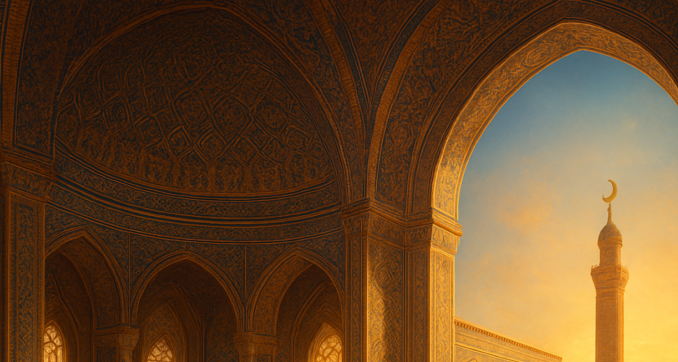
Imagine the sun being rolled up, the stars extinguished, the mountains blown away like dust. Everything you know, everything you consider solid and certain, vanishes in an instant. This is not a science fiction scenario — it is the opening of the eighty-first surah of the Quran, known in Arabic as At-Takwir, meaning roughly “The Folding Up” or “The Unfolding.” This vision of cosmic dismantling may provoke unease at first glance. But those who look deeper discover something surprising: an invitation to self-reflection, to letting go of appearances, and to seeking what is truly lasting. And it is precisely in that seeking that this ancient text touches a tradition that might seem worlds apart — the spiritual practice of Freemasonry.
A Vision of Cosmic Dismantling
The surah opens with a cascade of overwhelming images. The sun loses its light. The oceans boil over. The sky is peeled away like a curtain. Verse after verse describes a world bursting at its seams, where every familiar structure is torn apart. But this is not random chaos — it is a deliberate unveiling. Behind the collapse of the known lies a deeper reality. The surah does not end in darkness; it concludes with the affirmation that this is a message from a noble and trustworthy messenger. The destruction, then, is not an end in itself, but a passage toward truth.
For the believing Muslim, these verses point to the Day of Judgment, the moment when every soul is called to account. The text poses piercing questions: What have you done with your life? What have you neglected? It is a confrontation with one’s own conscience, expressed in cosmic language that compels the reader to contemplate the impermanence of all earthly certainties.
The Chamber of Darkness and the First Light
Now consider a different world entirely. Those familiar with Freemasonry — or simply curious about it — may recognize something in this pattern of breaking down and building anew. The initiation of a Freemason traditionally begins in total darkness. The candidate is blindfolded, stripped of outward signs of status and possessions, and enters the lodge as a seeker in the dark. That darkness is not punishment. It is a symbolic death of the superficial self — a deliberate release of everything you think you are, in order to make room for a deeper truth.
In the Quran’s surah, the cosmos is dismantled; in the Masonic ritual, the ego is dismantled. Both traditions use the imagery of destruction not as an endpoint, but as a starting point. The light that the Freemason eventually receives when the blindfold is removed is comparable to the promise that lies hidden behind the surah’s cosmic upheaval: there is something beyond appearances, something worth seeking.
Only when everything impermanent is stripped away does what is truly valuable become visible — that is the lesson shared by both At-Takwir and the Masonic initiation.
Two Traditions, One Pattern
An important distinction must be made here. The Quran and Freemasonry are fundamentally different traditions. The Quran is a holy book, the cornerstone of a world religion with more than one and a half billion adherents. Freemasonry is not a religion but a fraternity that welcomes people of all faiths and encourages them toward personal moral growth. Yet it is precisely within that diversity that a surprising parallel emerges.
Both traditions employ what might be called a “spiritual pedagogy of shock.” The surah shocks the listener with apocalyptic imagery in order to awaken the conscience. The initiation ritual shocks the candidate with darkness and uncertainty in order to open the inner awareness. In neither case is the goal to instill fear — it is to bring about awakening. The great Islamic thinker Al-Ghazali wrote in the eleventh century that true knowledge only arises when the veils of habit and complacency are torn away. His words would not be out of place in a lecture delivered within a Masonic lodge.
Conscience as a Constant Companion
One of the most harrowing verses in the surah concerns the newborn girl who was buried alive — a reference to a pre-Islamic practice that the Quran unequivocally condemns. On the Day of Judgment, this girl will be asked: for what sin were you killed? It is a heart-wrenching passage that forces the listener to reflect on justice and on the responsibility every human being carries toward the most vulnerable members of society.
Conscience holds an equally central place within Freemasonry. The Mason is continually invited to measure his actions against inner standards of justice and charity. The rough ashlar that must be worked into shape — that famous image from Masonic tradition — is nothing other than the unrefined soul that is polished through honest self-examination. Voltaire, himself a Freemason, emphasized the importance of self-scrutiny as an engine of both personal and social progress. And Michel de Montaigne, though not formally a Mason, described in his essays how candid self-knowledge is the key to an authentic life.
What These Two Worlds Teach Us
What do we gain by placing these two worlds side by side? Not the claim that they are the same. Not that one tradition confirms or refutes the other. Rather, the recognition that the human search for truth, for light, for moral purity takes on universal forms. Whether you read the surah and are struck by the cosmic urgency of the divine word, or whether you enter the lodge in silence and feel the blindfold tighten around your eyes — the pattern is unmistakable: let go, listen, begin again.
Both traditions see darkness as a prerequisite for light. Both emphasize personal responsibility and the examination of conscience. Both invite us to shed outward appearances in order to find inner truth. And both ultimately affirm that the journey inward — however disorienting it may be — is the most meaningful journey a person can undertake.
The eighty-first surah of the Quran and the Masonic initiation ritual may arise from vastly different soil, but they grow toward the same light. They remind us that genuine transformation requires the courage to face what lies beneath the surface — to allow the familiar world to be “unrolled” so that something truer can emerge. In an age of distraction and superficiality, that shared wisdom feels more urgent than ever. Whether one finds inspiration in sacred scripture or in the symbolic work of the lodge, the invitation is the same: strip away the illusion, awaken the conscience, and step boldly into the light.
Copyright text & image: devrijmetselaar.nl
Texts are based on the ideas and content of the author of devrijmetselaar.nl, reviewed, corrected, and supplemented with the assistance of OpenAI. Images are created based on the ideas of the author of devrijmetselaar.nl using OpenAI/DALL-E.
Frequently Asked Questions
What is Surah At-Takwir and what does it describe?
Surah At-Takwir is the eighty-first chapter of the Quran, meaning "The Folding Up" or "The Unfolding." It opens with vivid imagery of cosmic dismantling—the sun losing its light, stars being extinguished, mountains blown away like dust, and the sky peeled away like a curtain. For believers, these verses point to the Day of Judgment and serve as a spiritual call to self-reflection and accountability, prompting contemplation of life's impermanence and the need to seek lasting truth beyond earthly certainties.
How does the Masonic initiation process relate to the themes in Surah At-Takwir?
Both the Masonic initiation and Surah At-Takwir use imagery of destruction and dismantling as a spiritual tool rather than an endpoint. In Freemasonry, the initiate is blindfolded and stripped of outward status and possessions, entering the lodge in darkness—symbolizing the death of the superficial self. Similarly, the Quran's cosmic breakdown represents the removal of illusions. Both traditions use this deliberate destruction to create space for deeper truth and spiritual awakening.
What is the spiritual purpose of the darkness in Masonic initiation?
In Masonic tradition, the darkness experienced during initiation is not punishment but a symbolic death of the ego and superficial identity. By being blindfolded and stripped of external markers of status, the candidate is deliberately released from everything they think they are. This darkness serves as the foundation for discovering a deeper, more authentic truth—mirroring the spiritual journey described in Surah At-Takwir, where cosmic dissolution leads to renewed understanding rather than despair.

Be the first to comment