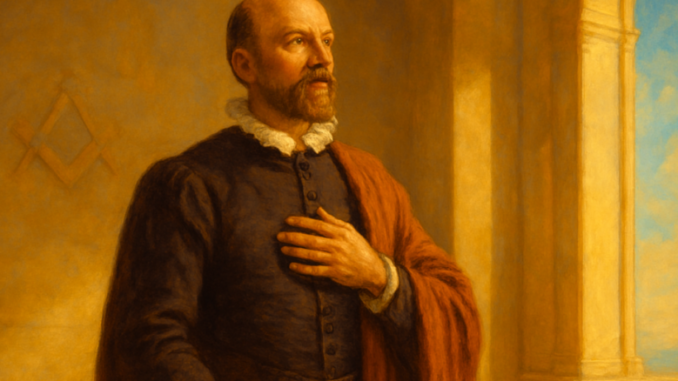
Imagine sitting at a lavishly set table — silverware gleaming, crystal catching the light — and yet sensing that something essential is missing. Not in the food, not in the company, but in the way everything feels so effortlessly excessive. That quiet unease is exactly what Michel de Montaigne captures in his brief but piercing essay “On the Frugality of the Ancients.” Looking back at the simplicity of the Roman Republic, he asks what was lost when abundance became the default. It is a question that strikes remarkably close to the heart of Freemasonry, where inner richness and genuine connection matter far more than outward display.
The Simplicity Montaigne Admired
In Essay 52 of the first book of his famous Essays, Montaigne keeps things unusually short. That alone is telling for a writer who elsewhere devotes dozens of pages to a single subject. He turns his attention to the Roman generals and senators who, after triumphant campaigns, returned to their farms, ate from earthenware, and sought their wealth not in possessions but in character. He invokes figures like Cato the Elder and Gaius Fabricius Luscinus — men who commanded vast armies yet tilled their own soil with their own hands. For Montaigne, the contrast with the opulence of his sixteenth-century France is more than a historical curiosity. It is a mirror.
What fascinates Montaigne is not poverty itself, but the attitude behind it. The ancients chose simplicity deliberately — not from deprivation but from conviction. They believed that excess weakens the mind and that true dignity lies in self-discipline. You may recognize that idea. It echoes through countless wisdom traditions, from the Stoicism of Seneca and Marcus Aurelius to the measured philosophy of Aristotle. Montaigne places himself in that lineage, not as a moralist issuing commandments, but as a restless investigator of his own soul.
Connection as a Counterweight to Decline
When Montaigne describes the decline of the Roman Republic, he is not merely cataloguing material excess. The real loss runs deeper: the bonds between citizens eroded as personal gain eclipsed the common good. That analysis sounds strikingly modern. In an age when individualism sometimes tips into isolation, Montaigne reminds us that frugality is not only about money or possessions — it is about how we relate to the people around us.
In Freemasonry, this insight is deeply embedded. The lodge is, above all, a place where connection takes center stage — not as an abstract ideal but as lived practice. Brothers meet as equals, regardless of social standing or material wealth. The rough ashlar that every Freemason works upon is not the stone of riches or reputation; it is the stone of one’s own character. Montaigne would recognize himself in that symbolism. His entire life’s work revolves around the same principle: know yourself, work on yourself, and seek your worth not in what you have but in who you are.
The Virtue of Temperance in Freemasonry
Temperance — temperantia — is one of the classical cardinal virtues that holds a central place both in the philosophical tradition and in Freemasonry. It is not about denial or self-punishment, but about finding the right measure. The level, one of the most recognizable working tools in the Craft, points to exactly this balance: not too much, not too little, but precisely enough to live justly and with integrity.
True frugality is not poverty of possession but richness of connection: the choice to find your value in who you are for others, not in what you accumulate for yourself.
Montaigne describes how the Roman ancestors shared their meals without pomp, how generals ate the same food as their soldiers. In that shared simplicity, something arose that luxury can never buy: trust. Those who share austerity also share vulnerability. And vulnerability, paradoxically, is the raw material of genuine brotherhood. In the lodge, you experience this when you stand in ritual beside someone you might never encounter in daily life, yet feel connected through shared values and shared silence.
Self-Reflection as a Foundation
Montaigne’s essay is, like all his work, ultimately an exercise in self-reflection. He does not admire the ancients blindly. He holds a mirror up to himself and asks: would I be capable of such simplicity? Am I willing to question my comfortable habits? It is precisely the attitude that Freemasonry asks of its members. The search for truth does not begin with grand cosmic questions, but with an honest look in one’s own mirror. What do I truly need? What am I contributing to the world around me?
In the Masonic tradition, this is called working the rough ashlar. It is not a single act but a lifelong process. Montaigne understood that intuitively. His essays are not finished arguments but perpetual revisions — written, revisited, and refined again and again. Just as Plato used dialogue as his philosophical method and Socrates continually challenged his interlocutors to think more deeply, Montaigne uses the essay as a tool for moral self-inquiry.
From the Ancients to the Present
You might wonder what a sixteenth-century essay about Roman austerity could possibly say to you today. More than you might expect. We live in an era of overflowing information, constant stimulation, and endless choices. The challenge is not to accumulate more, but to choose more consciously. Montaigne calls on us to pause and consider what truly matters. Freemasonry offers a framework for precisely that: a brotherhood where you are judged not by your possessions or status, but by your willingness to grow and to connect.
The frugality of the ancients is not a nostalgic longing for a bygone era. It is an invitation to examine your own life with the same honesty and courage that Montaigne brought to his. In the lodge, surrounded by brothers engaged in the same inner work, that invitation becomes something tangible — a shared commitment to strip away the unnecessary and to build something lasting from within.
Montaigne’s brief meditation on ancestral simplicity carries a message that resonates across the centuries and speaks directly to the Masonic journey. Genuine wealth is not measured in possessions but in the quality of our connections, the depth of our self-knowledge, and our willingness to keep refining the rough stone of our character. In a world that relentlessly urges us toward more, the lodge remains a quiet space where less becomes the foundation for something infinitely greater — true brotherhood, authentic growth, and the enduring pursuit of light.
Copyright text & image: devrijmetselaar.nl
Texts are based on the ideas and content of the author of devrijmetselaar.nl, reviewed, corrected, and supplemented with the assistance of OpenAI. Images are created based on the ideas of the author of devrijmetselaar.nl using OpenAI/DALL-E.
Frequently Asked Questions
How does Montaigne's essay on ancient Roman simplicity relate to Freemasonry?
Montaigne's admiration for Roman generals who chose simplicity and self-discipline over excess mirrors Freemasonry's core values. Both traditions emphasize that inner richness and genuine human connection matter far more than outward display or material possessions. In the lodge, like in Montaigne's philosophy, true dignity comes from character and the bonds between people rather than from accumulating wealth or status symbols.
What did Montaigne mean by 'the attitude behind' simplicity rather than poverty itself?
Montaigne distinguished between forced poverty and chosen frugality. He admired ancient Roman leaders like Cato and Fabricius who deliberately chose simple living from conviction, not deprivation. They believed excess weakened the mind and that true strength came through self-discipline. This intentional simplicity—rooted in philosophy and values rather than circumstance—is what Montaigne found remarkable and relevant to his own sixteenth-century France.
How does the decline of ancient Rome connect to Montaigne's broader concerns about society?
Montaigne argued that Rome's decline was not merely about material excess, but about the erosion of bonds between citizens as personal gain eclipsed the common good. He saw this as a cautionary tale for his own time—and one that remains strikingly relevant today. The essay suggests that when individualism overshadows community and connection, society loses something essential. This theme resonates deeply with Freemasonry's emphasis on brotherhood and the common good over individual advancement.

Be the first to comment